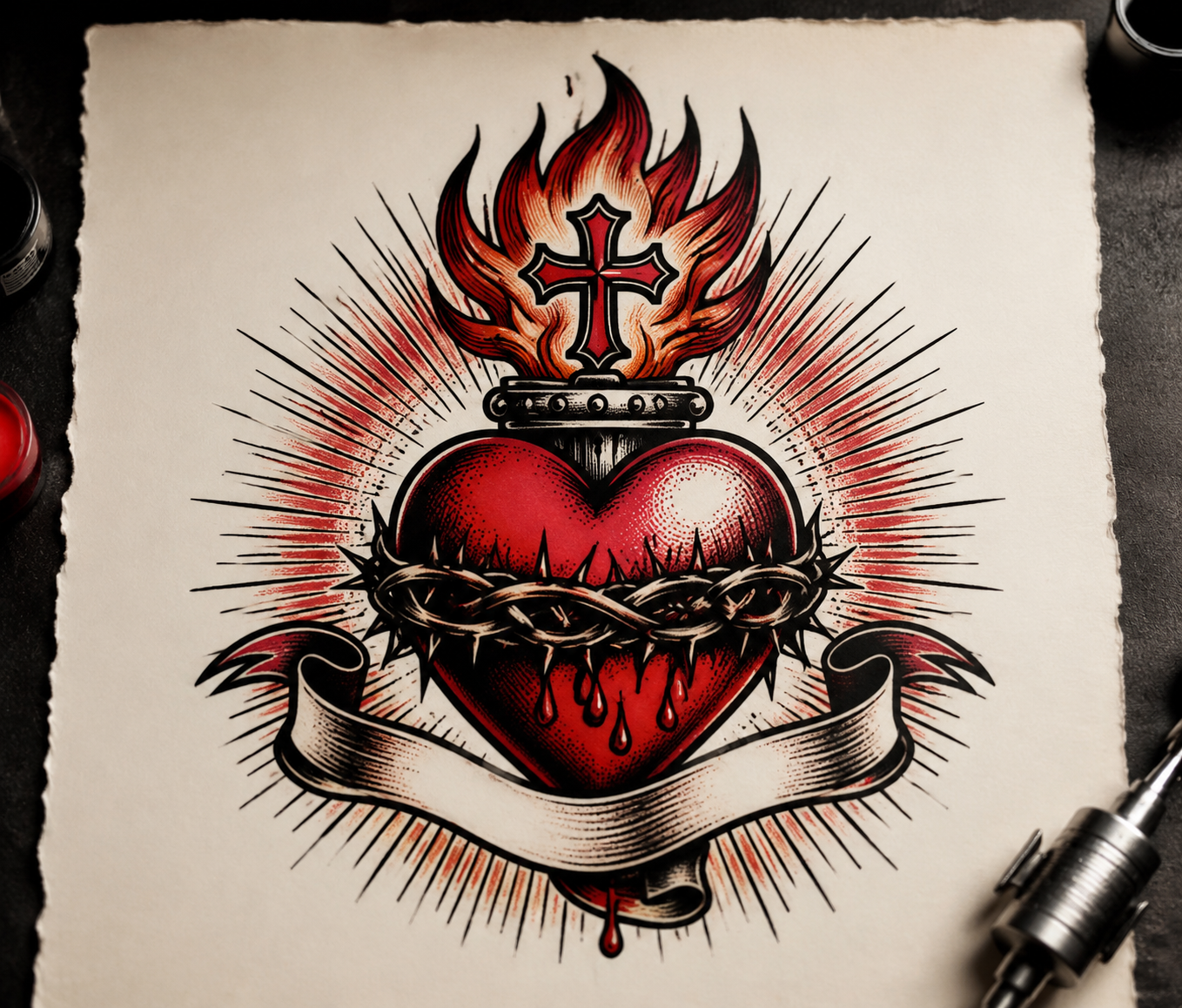
A sacred heart tattoo carries the weight of love that refuses to quit. The image comes from Catholic devotion to the Heart of Jesus, where flames, thorns, and light turn a single organ into a complete picture of mercy pressed through pain. Whether you wear it as faith, memorial, or private endurance, the symbols do the talking.
Quick answer: A sacred heart tattoo means Christ’s burning love and willing sacrifice in its religious reading. The flames stand for passionate love, the crown of thorns for suffering carried without closing down, the cross for the Passion, and the rays for glory. Many wearers keep the Catholic meaning. Others take it as steadfast love, survival, or a heart that has been through fire and keeps beating.
What the Sacred Heart Means
The same design can read as prayer, grief, or old-school flash depending on what you include and what you strip away. The sacred heart holds more emotional range than nearly any other traditional tattoo image because its symbols stack like a language. You build a sentence on your skin.
| Version | Meaning angle | Common placement | Worth knowing |
|---|---|---|---|
| Full sacred heart with flames, thorns and cross | Catholic devotion, Christ’s love and sacrifice | Chest, upper arm, forearm | The cross above the flames makes it explicitly religious |
| Heart with crown of thorns, no cross | Love that endures pain, quieter faith | Forearm, shoulder | Reads as devotion without naming a religion outright |
| Sacred heart with a banner and name | Memorial, loyalty to a person | Chest, upper arm | The banner does the personal talking; keep the text short and legible |
| Sacred heart with rays and light only | Glory, hope, compassion | Chest, back, calf | Softer read, less Passion imagery, more warmth |
| Old-school flash sacred heart | Americana style, faith-and-grit aesthetic | Forearm, upper arm | Bold black lines and a tight red palette carry the look |
Most people choosing this piece are not necessarily Catholic. They are drawn to the raw feeling of it. A heart on fire, wrapped in thorns, still beating. That image lands hard whether you grew up in a church or not. It is one of the few traditional motifs that carries full emotional weight without needing explanation.
The flames mean passion or suffering, sometimes both. The crown of thorns points to sacrifice. A sword cutting through says loss. A banner with a name says someone is held in memory. You are stacking symbols the way old sailors did, building a personal code.
Where the Image Comes From
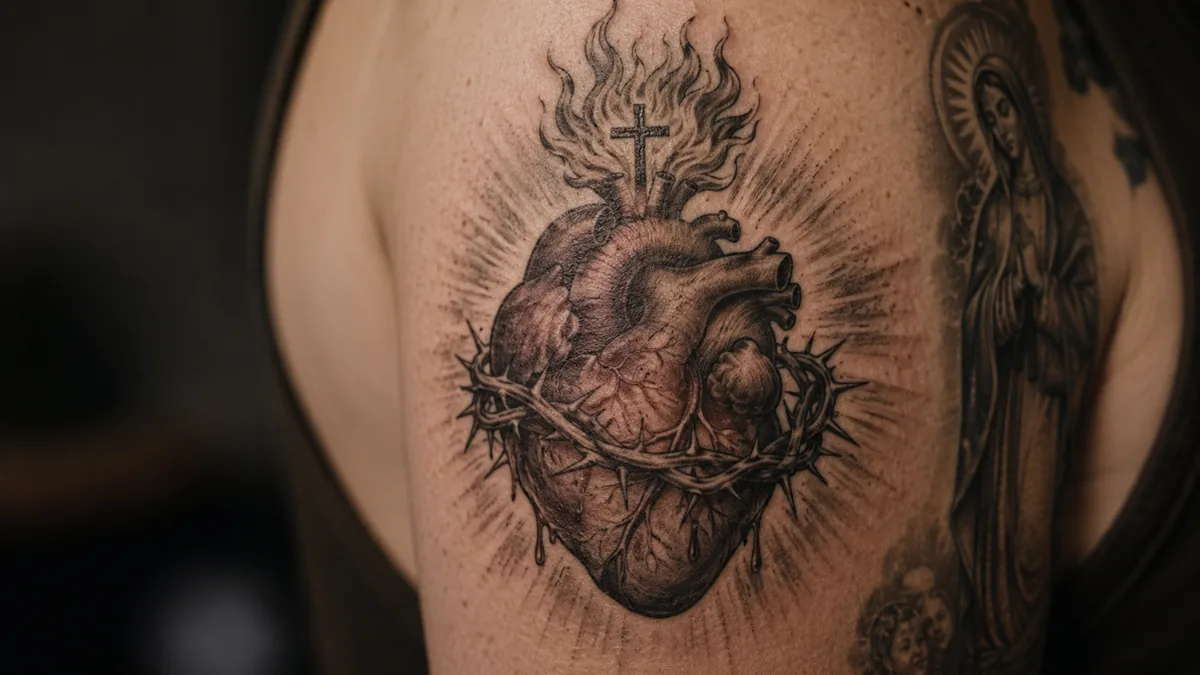
The sacred heart is a Catholic devotion focused on the Heart of Jesus as the visible sign of his love and mercy. The point is that this is not abstract. It is a God who feels, suffers, and stays. The heart stands for love that pours itself out rather than holding back.
Scattered devotion to the Heart of Jesus existed from the eleventh and twelfth centuries, but the version most people picture today took shape in seventeenth-century France. Saint Margaret Mary Alacoque, a Visitation nun at Paray-le-Monial, reported visions between 1673 and 1675 in which Christ showed her his Heart surrounded by flames and ringed with thorns. The Jesuit Claude de la Colombiere backed her account, and the devotion spread from there, picking up papal approval and eventually a place on the universal calendar.
That history matters for the tattoo because it locks in the visual grammar. The flames, the thorns, the wound, and the rays are not decoration someone invented. They are the standard symbols of the devotion, and a good sacred heart tattoo speaks that language whether the wearer is devout or not.
The Catholic Church formalized devotion to the Sacred Heart in 1856. By the early twentieth century, the image had spread into popular prints, home altars, and eventually tattoo flash. It often appeared in Catholic immigrant communities in the United States, and Mexican folk Catholicism developed its own distinct visual language around it. The Sagrado Corazon in that tradition often sits bolder, more saturated, with heavy black outlines and thick flames. That visual style has clear connections to Chicano tattooing, which gave the image much of its street-level power in American tattoo culture. A lot of what people call “traditional sacred heart” today draws on that lineage.
Reading the Symbols
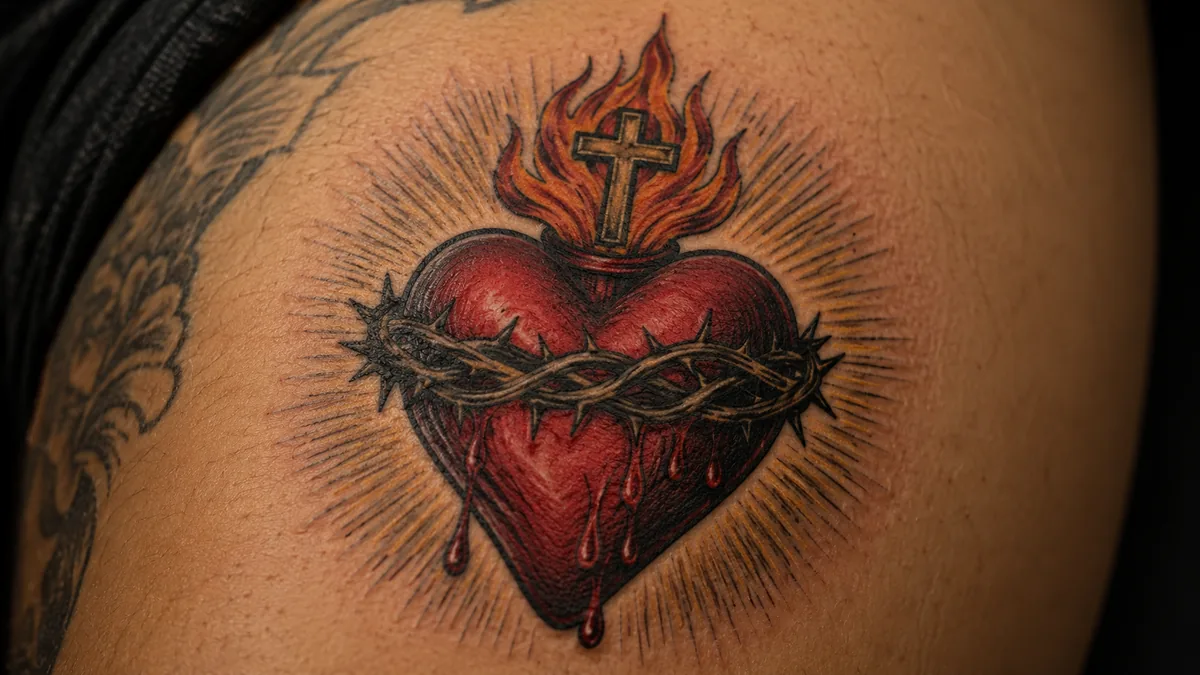
A sacred heart is really a short sentence built from parts. Read them one at a time and the whole design makes sense.
Flames
The fire rising from the top of the heart is the burning love at the center of the whole idea. It says the love here is intense and active, not polite or cool. In flash it is usually drawn as three to five stylized tongues of flame. The color matters: yellow and orange read as warmth and glory, while red and black read as pain and endurance.
Crown of Thorns
The band of thorns wrapped around the heart recalls the crown placed on Christ’s head and the pain caused by human sin. This is the part that turns the image from a valentine into something heavier. Love here is wounded and keeps going anyway. Some wearers add drops of blood at the thorn points. Others keep it clean and let the outline do the work.
Cross
A small cross rising out of the flames marks the heart as explicitly the Heart of Jesus and points to the crucifixion. Leave the cross off and the design reads as devotion in general, or as personal endurance, without the specifically Christian claim. That is a meaningful choice, not an oversight. Many non-religious wearers prefer the cross absent so the piece speaks to love and survival on their own terms.
Rays of Light
The radiating lines around the heart stand for glory, the light of grace, or the heart’s power to reach beyond itself. In some designs they are subtle, thin lines. In others they are bold sunbursts. They soften the image, pulling it toward hope rather than only suffering.
The Wound
Some sacred hearts show a gash or opening, sometimes with blood. This refers to the lance wound from the crucifixion and says that love is not protected. It is exposed. That vulnerability is exactly what makes the image powerful for people who have been through loss and still choose to stay open.
Style and Placement
The sacred heart travels well across tattoo styles, but it has natural homes.
Traditional American flash keeps it bold: thick black outlines, limited color palette, heavy saturation in the red. The image was common in Sailor Jerry-era sheets and has never really left the canon. It works at small sizes on forearms and at larger scale on chests.
Chicano black and grey tends toward the Sagrado Corazon with ornate filigree, banners, and sometimes praying hands or rosaries nearby. These pieces often run larger and read as family devotion, neighborhood identity, or memorial.
Neo-traditional and illustrative styles can push the anatomy, add more realistic flame rendering, or surround the heart with flowers, daggers, or eyes. The core symbols stay recognizable even when the style shifts.
Placement shapes meaning. The chest, over the actual heart, is the most literal reading. The upper arm is classic flash placement, visible and balanced. The forearm makes it conversational, something you see and ask about. The thigh keeps it private, for the wearer more than the viewer. Sternum placement is painful and has become popular in recent years, but the bone makes the tattoo harder to sit for and slightly trickier to heal.
What to Remember
The sacred heart is not a trend piece. It has been in tattoo culture for roughly a century and in religious art for centuries before that. That longevity means two things. First, the symbols are loaded. You cannot really wear this as pure decoration without some of the history sticking. Second, the image has been claimed by enough different communities that no single group owns it. Catholic, Chicano, old-school, secular grieving, romantic devoted: the heart has room for all of them, but you should know which one you are entering.
If you are religious, the traditional elements carry specific weight. The cross, the flames, the thorns, and the rays are not arbitrary. They are a visual creed. A good artist will respect that grammar even when stylizing it.
If you are not religious, you are not stealing anything. The image has been secular for generations. But you should understand what you are borrowing, because people will read it. The crown of thorns in particular is hard to separate from its source. If you want only the feeling of burning love without the Christian frame, consider whether a different heart image might serve you more cleanly. Or go ahead and wear the sacred heart as a symbol of survival, knowing the double meaning is part of what gives it force.
The red is everything. A sacred heart that goes pink or brown with age loses its power. Talk to your artist about how they build their crimson, whether they use multiple red tones, and how they plan for the yellow and orange to age against the darker colors. This is a piece that should look like it is still on fire in ten years.
Finally, the banner. If you add a name, keep it short. Long banners wrap awkwardly and date fast. A single word, a set of initials, or a date sits better than a sentence. The heart itself is doing most of the speaking. Let it.
Frequently Asked Questions
Do I have to be Catholic to get a sacred heart tattoo?
No. The image has been worn by religious and non-religious people for generations. Many choose it for love, endurance, or memorial meaning without the Catholic frame. You should understand the symbols you are using, but you do not need anyone’s permission to wear it.
What does it mean if the cross is left off?
Removing the cross shifts the meaning from explicitly Christian devotion to general endurance, love through pain, or personal spirituality. It is a common choice and not a mistake. The flames and thorns still carry weight on their own.
Why does the red matter so much?
Sacred heart tattoos live or die by their crimson. A saturated, well-layered red keeps the image powerful for decades. A thin or poorly applied red fades to brown or pink and loses the emotional punch. Ask your artist about their red strategy before you commit.
Is the sacred heart only a traditional style tattoo?
Not at all. It works in traditional American, Chicano black and grey, neo-traditional, illustrative, and even fine-line styles. The symbols are recognizable enough to survive translation. The style you choose shapes whether it reads as vintage flash, street culture, or personal art piece.
What is the most painful placement for a sacred heart?
Sternum and chest center tend to hurt most because of bone proximity and thinner skin. The upper arm and outer forearm are generally more manageable. Thigh is often the easiest sit, though healing can be slower due to friction from clothing.