
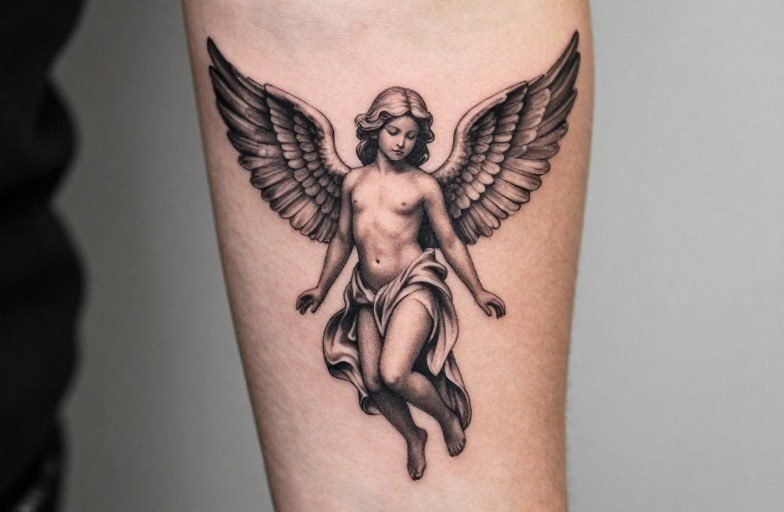
A seraph tattoo typically represents the highest order of angelic beings, creatures of pure fire who exist in constant worship and proximity to the divine. Unlike guardian angels or warrior archangels, seraphim occupy a more abstract, intense symbolic space: they embody total surrender to something greater than oneself, the burning away of ego, and a kind of spiritual devotion so complete it becomes consuming. For many people, this translates to personal transformation, creative passion, or a marker of having survived something that burned away everything non-essential.
What Seraphim Actually Are
The biblical source is slender: Isaiah’s vision, six wings, voices calling to one another. Their name is often linked to the Hebrew root meaning “to burn,” though the etymology remains debated among scholars. The elaborate hierarchy that places seraphim at the absolute peak emerged later, through medieval Christian angelology, particularly the systematic classifications of Pseudo-Dionysius and Thomas Aquinas. The six-winged form, two covering the face, two the feet, two for flight, developed through centuries of commentary rather than direct scriptural description.
This matters for tattoos because the figure you are choosing is already layered interpretation. You are not reproducing a clear image; you are entering a tradition of trying to depict what resists depiction.
The Fire That Purifies
In Isaiah’s account, the seraph touches a burning coal to the prophet’s lips, purifying him for speech. This is not passive worship. It is an active, painful transformation that enables something new. The fire associated with seraphim is often understood as purifying rather than destructive, though the distinction can feel academic when you are the one being burned. For a tattoo, this specificity offers more weight than generic “fire symbolism.” You are marking a process that hurt and changed you, not just a dramatic moment.
Across Traditions
Fire beings and winged intermediaries appear in many cultures, though direct equivalents to seraphim are rare. The Persian fereshta, certain classes of Buddhist deva, and the multi-winged cherubim of Assyrian palace guardians share overlapping functions as messengers or guardians. Jewish mystical traditions, particularly Merkabah mysticism, describe the hayyot of Ezekiel’s vision with multiplied wings and fiery qualities. These interconnections offer richer territory for people drawing on multiple backgrounds, or none, than any single tradition alone.
Why People Choose This Image
The reasons rarely fit neat categories. The six-winged structure itself creates tension: a being that simultaneously sees and hides, moves and stays grounded. That resonates with anyone who has experienced something too overwhelming to face directly, yet felt compelled to move toward it anyway.
Rebirth Through Fire
The seraph’s association with sacred fire makes it a natural symbol for radical personal change. Not the gentle kind. The kind that leaves you different in ways you could not have anticipated. Recovery from addiction, surviving trauma, leaving a fundamental belief system, these experiences share a quality of being burned clean and rebuilt. A seraph tattoo marks that without requiring explanation. The fire does the talking.
Creative Obsession
Artists and musicians sometimes choose seraphim to represent the consuming nature of their work. The original seraphim do not create; they worship. But that total absorption, the inability to do anything else, to be anything else, mirrors how creative drive can feel. It is not always comfortable. Sometimes it is destructive. The tattoo acknowledges that complexity rather than romanticizing it.
Visual History and Tattoo Possibilities
The seraphim’s visual history is shorter than their textual one. Byzantine iconography often linked them to the throne of God, surrounding or supporting it. In Western medieval art, they became increasingly humanoid and beautiful, increasingly distant from the strangeness of earlier tradition. The Renaissance brought more naturalistic wing anatomy and more emotionally expressive faces, developments that made seraphim more accessible but arguably less strange, less true to their original character.
Medieval artists struggled to depict beings scripture described as simultaneously humanoid and incomprehensible. The result was often strange, beautiful distortions: faces that could not quite be seen, wings that multiplied beyond function, bodies that seemed made of light rather than flesh. These visual solutions, abstraction, fragmentation, impossible geometry, offer more interesting tattoo possibilities than the sanitized, pretty angel common in contemporary flash sheets.
Contemporary tattooing has the opportunity to recover some of that strangeness, to draw on the medieval discomfort with these beings as much as on their later beautification.
Color vs Black and Grey
The choice between color and black and grey fundamentally changes what a seraph tattoo communicates. Color, particularly warm oranges, golds, and deep reds, can literalize the fire association. Done well, it creates movement and intensity. Done poorly, it looks like a generic flame element with wings attached.
Black and grey shifts emphasis toward form, shadow, and the more unsettling aspects of seraphim, the hidden face, the covered feet, the sense of something ancient watching. It ages better on most skin tones, maintains readability as lines soften slightly over years, and allows for more subtle gradations in wing texture. For seraphim specifically, the absence of color can feel more theologically appropriate: these are beings of light, not colored light, and black and grey’s high contrast can suggest that luminosity through negative space.
- Color works best for larger pieces where the fire can breathe and gradient properly
- Black and grey suits smaller placements and finer detail in wing structure
- Single-needle black and grey can achieve the ethereal, almost vibrating quality of medieval manuscript illumination
- White ink highlights in either approach can suggest the “burning” quality without literal flames
Design and Placement Challenges
Six wings mean six sets of primary feathers, coverts, and the structural bones that make wings look functional rather than decorative. Most tattoo wings fail at the shoulder joint, where wing meets body, where the anatomy has to convince. A seraph’s covered face and feet add compositional complexity: you are designing around absences, negative shapes that must still feel intentional.
Where to Place It
The back offers the most natural canvas for full seraphim, allowing wing span to read correctly. The upper back, spreading onto shoulders, lets the wings wrap slightly onto the arm, dynamic without requiring the full chest or stomach. Forearms and calves work for single-wing compositions or partial figures, but the six-wing structure gets compressed and can become muddy at smaller scales.
Ribs and sides, while popular for angelic imagery generally, pose problems for seraphim specifically. The covered-face posture reads as fetal or protective, which can flatten the figure’s verticality. If you want the rib placement, consider a seraph in flight rather than the stationary, worshipping posture.
Also be realistic about sessions. Six wings, detailed, covering a back: this is not a single afternoon. The skin fatigue of long sessions affects how fine detail settles. Plan for multiple sittings, or accept that some intricacy will be lost to healing and time.
What to Pair With
Seraphim pair well with imagery that complicates rather than confirms their sacred nature. Eyes (divine witness, or the inability to see?), geometric mandalas (medieval cosmology, or contemporary abstraction?), or broken architectural elements (throne rooms in ruins) all create productive tension. Avoid pairing with other angelic types; too many wings become visual noise, and the hierarchy gets confused.
What to Remember
A seraph tattoo carries specific weight: fire that does not consume, devotion that does not look away, presence that hides its own face. You might be drawn to the theological complexity, the visual challenge of six wings, or the personal resonance of something that burned and rebuilt you. What connects most people who choose this figure is some experience of intensity, religious, emotional, creative, or destructive, that they do not want to simplify or sentimentalize.
The seraph’s particular combination of beauty and terror, of closeness to the divine and inability to look directly at it, attracts people who distrust easy symbolism. A guardian angel protects; a seraph burns. That distinction matters. You are often marking something you still do not fully understand, rather than something you have resolved. The tattoo does not need to explain. It needs to hold the complexity.
Frequently Asked Questions
Are seraphim the same as guardian angels?
No. In traditional angelology, seraphim occupy the highest rank and exist in constant worship and proximity to the divine. Guardian angels serve protective functions for individuals. The seraph’s symbolism leans toward transformation through fire rather than comfort or protection.
Does a seraph tattoo require religious belief?
Not necessarily. Many people drawn to seraphim are working through religious experiences they have left, or are attracted to the figure’s intensity as metaphor for creative or personal transformation. The image carries theological weight regardless of your current beliefs.
Why six wings instead of the usual two?
The six-wing structure comes from Isaiah’s vision: two covering the face, two covering the feet, two for flight. This creates the distinctive visual tension of a being that simultaneously sees and hides, moves and stays grounded. It also makes for a technically demanding tattoo.
How do I avoid a generic angel tattoo?
Work with an artist who understands the visual history of seraphim, particularly medieval depictions that embraced strangeness and distortion rather than prettiness. Consider black and grey for luminosity through negative space, and avoid pairing with other angelic types that dilute the specific hierarchy.









