
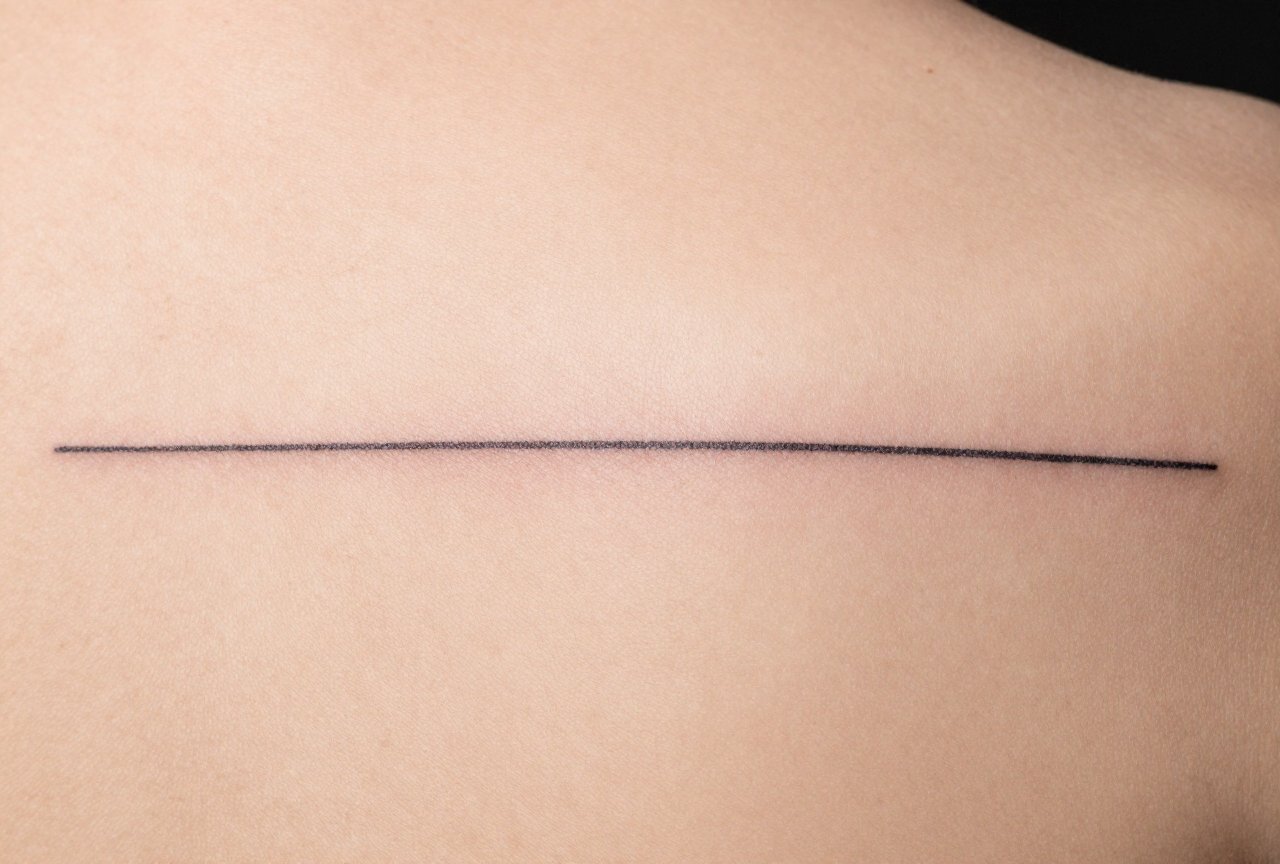
A straight line tattoo is one of the simplest designs you can get, but that simplicity carries weight. It represents continuity, direction, focus, and the unbroken path of a life lived with intention. I’ve had clients sit in my chair for a single clean line that means more to them than any elaborate sleeve ever could.
Symbolism & History
Where the Meaning Comes From
Lines are primal. Before language, before symbols, humans drew lines in dirt and ash to mark paths, boundaries, and time. The straight line tattoo taps into something older than tattoo culture itself. I’ve tattooed lines on people who’ve lost someone, started over, or simply needed a physical reminder to stay the course. The meaning is rarely about the line itself, it’s about what the line does. It goes forward. It doesn’t break.
In my experience, clients who want this design fall into two camps: those who know exactly what it means, and those who feel drawn to it without words. Both are valid. I’ve had a guy get a single vertical line down his spine after getting sober, “one day after another, straight up.” Another woman got three parallel lines on her forearm for her three kids, evenly spaced, unwavering. The symbolism is personal, but the visual language is universal.
Cultural Touchstones
Lines show up across traditions. Aboriginal songlines map sacred paths. Buddhist monks receive Sak Yant lines as spiritual protection. Modernist painters like Barnett Newman made the “zip”, a vertical line dividing color fields, into high art. None of this is required knowledge for getting tattooed, but it explains why the design feels so loaded even when it’s just ink. The straight line carries millennia of human meaning about journey, boundary, and purpose.
Common Variations & Styles
Single Line vs. Multiple Lines
A single line is the purest form. It’s clean, uncluttered, and demands precision from the artist. One wobble ruins the whole thing. I’ve spent twenty minutes on a two-inch line, breathing steady, stretching skin just right. Multiple lines create rhythm, two lines can mean partnership, three can represent past-present-future, five might mark years sober or family members. The spacing matters as much as the lines themselves. Tight spacing feels tense; generous breathing room feels calm.
Line Weight and Technique
- Hairline single needle: Delicate, almost disappears on some skin tones, tends to soften faster with age
- Bold 7-9RL: Stays crisp longer, reads clearly from distance, heals more reliably
- Hand-poked: Slightly organic texture, popular for ritualistic or memorial pieces
- Ornamental with dotwork: Lines framed by dots or geometric accents, common in spiritual pieces
Shading near a straight line is tricky. I’ve seen apprentices try to add a soft gradient beside a clean line and end up muddying the whole thing. If you want contrast, keep it graphic. Black line, bare skin. That’s the move.
Best Placements
Placement changes the meaning. A straight line down the spine reads like a backbone, a center. I’ve done this on dancers, people with scoliosis who wanted to reclaim their alignment, folks who just like the visual. The spine hurts, there’s no fat, skin moves with every breath. Clients grip the table. But the result is striking.
Forearm lines face outward. They’re declarations, visible during handshakes and coffee orders. Behind the ear or along the collarbone feels more private, almost like a secret you’re keeping with yourself. Finger lines are popular but finicky, hands heal rough, ink falls out, touch-ups are standard. I always warn people: “This won’t look this clean in five years.” Some don’t care. The meaning holds.
Ribs, sternum, back of the neck, I’ve done lines in all these spots. The body has natural lines already: the sternum’s center, the clavicle’s edge, the Achilles tendon. Working with those structures makes the tattoo feel inevitable, like it was always supposed to be there.
Who Chooses This Tattoo / Personal Meanings
What Clients Actually Tell Me
After fifteen years, patterns emerge. People getting straight line tattoos are often at inflection points. New job, ended relationship, recovered from something, started something. The line marks a before and after. I’ve tattooed lines on:
- A musician who wanted to “keep the beat straight” after a chaotic tour life
- A widow who got her husband’s EKG flatline transformed into a clean horizontal line, life continuing in another form
- A marathoner with a vertical line down each calf, measuring progress literally
- Someone who simply said, “I need to remember to be direct with people”
We don’t always talk deep in the chair. Sometimes it’s just, “I like how it looks.” That’s enough. The meaning can grow later. The tattoo holds space for that.
Gender and Style Trends
Lines cross all demographics. I’ve seen beefy construction workers with fine lines and petite accountants with thick bold ones. The style choice says more than the placement. Minimalist fine lines skew younger, often first tattoos. Heavy blackwork lines attract people already covered who want something grounding among the chaos. There’s no “type.” The only common thread is intentionality. You don’t accidentally get a straight line tattoo.
Similar Symbols
Clients sometimes compare the straight line to other minimal designs. Here’s how I talk them through it:
- Arrow: Adds direction and movement, more active than a line’s stillness
- Wave: Embraces fluctuation; the straight line resists it
- Circle: Cyclical, complete, no beginning or end; the line is explicitly linear
- Cross or plus sign: Intersection, meeting point; the line refuses intersection
- Semicolon: Specifically about mental health survival; the line is broader, less coded
I’ve had people start wanting an arrow and end with a line. The arrow tells a story of pursuit. The line just is. That presence without narrative can be more powerful for some.
Final Thoughts
Straight line tattoos are deceptively simple. The technique is basic, any apprentice can run a line, but the execution separates good work from great. I’ve watched lines blow out from too much voltage, heal patchy from poor aftercare, age into fuzzy ghosts because the artist went too shallow. The design demands respect. One mark, no hiding.
What I’ve learned in my chair is that people don’t come for simplicity. They come for clarity. The straight line tattoo gives them something they can point to when words fail. A direction. A boundary. A promise to keep going. It’s just ink, just skin, just a mark. But sometimes that’s exactly enough.
Frequently Asked Questions
Do straight line tattoos hurt more than other designs?
It depends on placement, not the design itself. A line on a bony area like the sternum or spine hurts more than the same line on a fleshy thigh. The technique matters too, single needle work takes longer, which can mean more cumulative discomfort.
Will a straight line tattoo blur or spread over time?
All tattoos spread slightly as skin ages, but well-executed lines hold better than you’d think. Bold lines with proper depth last longest. Fine lines on high-movement areas like fingers or wrists will soften faster and may need touch-ups.
How do I find an artist who does clean straight lines?
Look at their healed work, not just fresh photos. Ask to see pieces that are a year or older. A straight line should be consistent in width and saturation throughout. If their portfolio shows wobbly lines or patchy blacks, keep looking.
Can a straight line tattoo be covered up or removed easily?
Covering a solid black line is challenging because it’s dense ink. Laser removal works but takes more sessions than lighter designs because black absorbs the laser energy well. Think of it as permanent, choose placement and meaning with that in mind.
Related Tattoo Meanings
- Ribbon Tattoo Meaning: Symbolism, Styles Personal Stories
- Skull Roses Tattoo Meaning: Life, Death Everything Between
- Tren Aragua Tattoo Meaning: Symbols, Origins Shop Reality
- Explore more









