
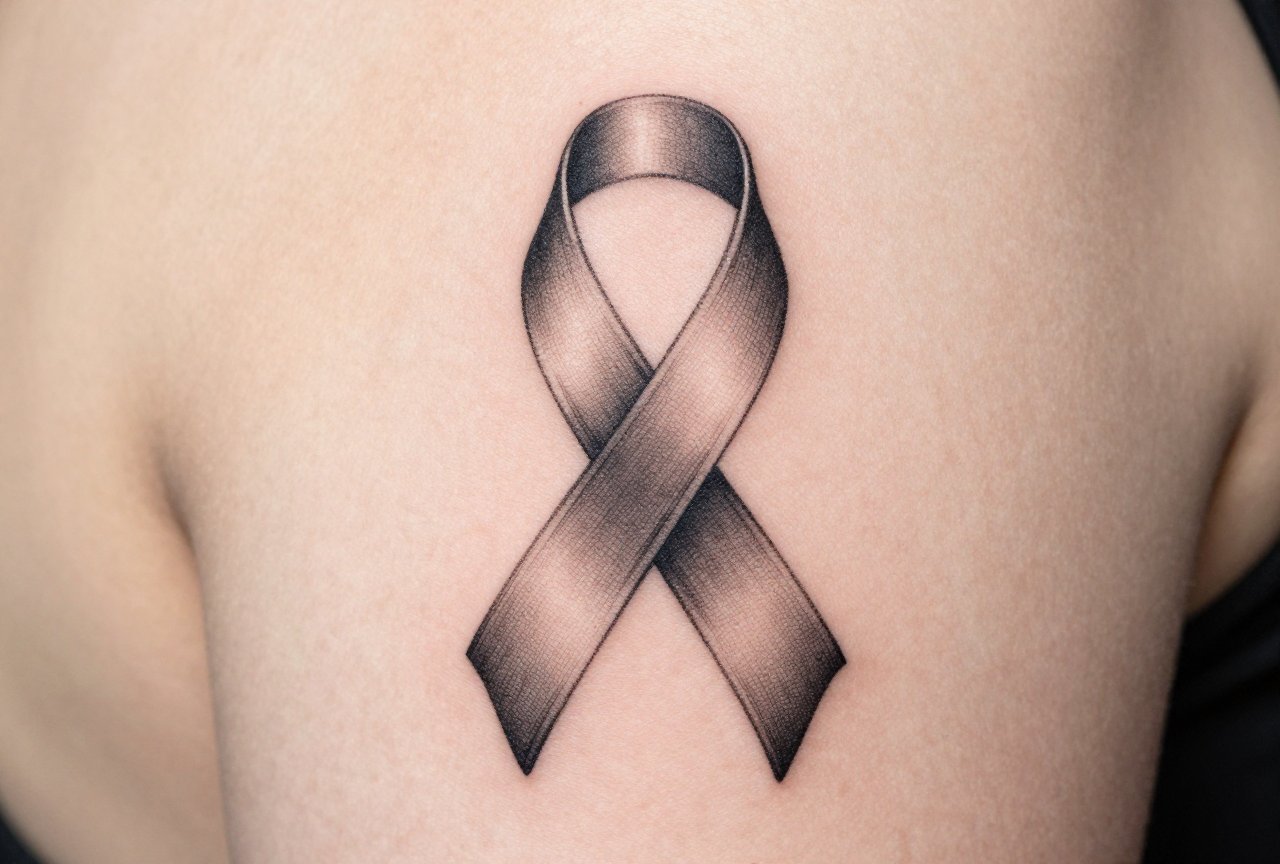
A ribbon tattoo is one of the most emotionally loaded designs you can get. it’s a loop of fabric that represents awareness, remembrance, or personal struggle, but the meaning shifts dramatically based on color, placement, and who’s sitting in the chair. I’ve tattooed ribbons on bikers and grandmothers, and every single one came with a story that mattered.
Symbolism & History
The awareness ribbon as we know it exploded in the 1990s, starting with the red AIDS ribbon and the pink breast cancer ribbon. But tattooed ribbons predate that by decades. Sailors got black ribbons for lost shipmates. Victorian mourning jewelry featured ribbon motifs. The tattoo version strips away the metal and fabric, embedding the symbol permanently into living skin.
What makes ribbon tattoos hit different is their duality. They’re simultaneously public and private. Someone sees the pink ribbon and knows cancer. They don’t know which family member, which hospital room, which year you stopped sleeping through the night. That gap between visible symbol and hidden story is where the tattoo lives.
Color Coding and What Actually Matters
Here’s what colors mean in practice, not just on awareness charts:
- Pink: Breast cancer, but also general women’s health struggles
- Red: HIV/AIDS, heart disease, substance abuse recovery
- Purple: Alzheimer’s, pancreatic cancer, domestic violence, overdose awareness
- Teal: Ovarian cancer, sexual assault, PTSD
- Yellow: Military support, suicide prevention, endometriosis
- Black: Mourning, melanoma, anti-terrorism
- Rainbow/gradient: LGBTQ+ pride, often combined with specific causes
I tell clients: the chart means less than your story. I’ve done purple ribbons for a grandfather’s Lewy body dementia when “officially” that’s not the color. Nobody’s checking your credentials. The tattoo is for you.
Personal vs. Cause-Based Meanings
Some ribbons are purely about solidarity, “my sister survived.” Others mark personal battles. The same pink ribbon can mean “I watched my mom die” or “I had a double mastectomy at 34.” The placement and surrounding design usually telegraph which one. Names, dates, and flowers lean memorial. Clean, standalone ribbons often signal personal survival.
Common Variations & Styles
Ribbon tattoos aren’t one thing. In my shop, we see three approaches that age completely differently.
Realistic Fabric Ribbons
These mimic actual satin or grosgrain with highlights, shadows, and fold lines. They look stunning fresh. The catch? Those soft gradients and white highlights are the first things to blur as skin ages. I’ve watched five-year-old realistic ribbons turn into indistinct grey smears. If you go this route, keep it bold. Strong contrast between light and dark. No whisper-thin white lines, they disappear in 18 months.
Outlines and Minimalist Loops
Single-needle or fine-line ribbons are everywhere on Instagram. Clean. Elegant. And in my chair, I warn people: fine lines spread. Ribbons are curved, which means the needle hits skin at varying angles. That outer loop? It takes more trauma. A 0.35mm line on a forearm might hold. The same line on a ribcage or ankle often blows out by year three. I did a minimalist black ribbon on a dancer’s wrist last year. She knew it might need a touch-up. That’s the trade.
Integrated Designs
Names woven through the ribbon. Birds breaking free from the loop. A ribbon that transforms into a heartbeat line, then a name. These are my favorites to tattoo because they’re collaborative. The ribbon becomes architecture, not just symbol. They also age better, the surrounding elements give context even if the ribbon itself softens.
Best Placements
Where you put a ribbon changes how it’s read.
- Wrist/inner forearm: Visible, vulnerable. Signals openness about the story. These get the most questions from strangers.
- Behind the ear: Private but findable. Often chosen by people who want control over who sees it.
- Ribcage: Painful. Intimate. Frequently paired with names or dates. The pain becomes part of the ritual for some clients.
- Ankle/calf: Easy to cover for work. Can feel like a secret strength.
- Over the heart: Literal and unambiguous. Usually memorial pieces.
- Finger: Trendy, but I talk most people out of it. Finger skin is different, thicker, more movement, faster fading. A ribbon there becomes a blurry suggestion within two years.
Placement also affects how the ribbon curves. A straight ribbon looks wrong. It needs flow. I sketch directly on skin, watching how the body moves, where the loop naturally settles. A ribbon that fights the muscle underneath always looks stiff.
Who Chooses This Tattoo / Personal Meanings
After fifteen years, I can spot the archetypes, but I never assume.
The newly diagnosed. They come in within weeks of a diagnosis, sometimes before treatment starts. The tattoo is preemptive, claiming the narrative before it claims them. These sessions are intense. I work slower. We take breaks.
The survivors. Often years out from treatment. The ribbon marks distance traveled, not current battle. They usually know exactly what they want. Minimal fuss. Sometimes they cry after, relief, not grief.
The grieving. Parents who lost children. Spouses who watched the person they built a life with disappear. These are the hardest to tattoo because there’s no resolution to offer. I just make sure the line is clean. That’s what I can control.
The allies. Siblings, friends, partners who walked alongside. Their ribbons often incorporate the survivor’s or lost person’s elements, a favorite flower, a birthstone color. They’re saying “I was there too.”
And the unexpected ones. I did a black ribbon on a guy who’d been sober ten years. No official “sobriety ribbon” color exists, but he wanted what he wanted. Another client got a teal ribbon after escaping an abusive marriage. The color matched her grandmother’s kitchen, where she’d hidden as a child. Stories don’t follow charts.
Similar Symbols
Clients sometimes hesitate between ribbons and related imagery. Here’s how I break it down:
- Semicolon: Specifically mental health and suicide prevention. More literary, less universally recognized outside those communities.
- Butterflies: Transformation, often post-surgery (mastectomy tattoos frequently use both). More decorative, less immediately readable as “cause.”
- Infinity symbols: General endurance, sometimes combined with ribbons. Can feel generic if not personalized.
- Angel wings: Memorial, often religious. Heavier visually than a ribbon.
- Hearts with banners: Old-school, less contemporary. Reads more “romantic” than “awareness.”
Ribbons occupy a sweet spot: recognizable enough to communicate, simple enough to customize. That’s why they’ve lasted while other awareness symbols faded.
Final Thoughts
Ribbon tattoos are everywhere because grief and resilience are everywhere. What separates a meaningful one from a forgettable one is specificity. The color that matches a hospital wall. The placement that mirrors a scar. The slight asymmetry that makes it yours rather than clip art.
I’ve watched clients trace their fresh ribbon tattoos in the mirror, not checking my work but memorizing the new topography of their own skin. The ink settles. The story doesn’t. That’s the job.
If you’re considering one, bring reference but also bring flexibility. The best ribbon tattoos happen when you trust the artist to adapt the symbol to your particular body, your particular story. The loop closes differently on everyone.
Frequently Asked Questions
Do ribbon tattoos have to follow official awareness colors?
Not at all. I’ve done ribbons in colors that matched a grandmother’s eyes or a childhood bedroom. The official charts are useful starting points, but your personal meaning matters more than any registry. Most artists will respect whatever color you choose and why.
How much does a ribbon tattoo usually cost?
Small, simple ribbons run $80-150 in most shops. Integrated designs with names or surrounding elements can hit $200-400. Highly detailed realistic fabric work takes longer and costs more. Always prioritize the artist’s experience with fine lines over the lowest price.
Will a ribbon tattoo look bad as I get older?
Bold lines and strong contrast age best. I’ve seen twenty-year-old black outline ribbons that still read clearly. Soft, photorealistic shading with lots of grey tones tends to muddy over time. Your artist should discuss this trade-off before you commit to a style.
Is it okay to get a ribbon tattoo if I’m still going through treatment?
Many people do, but timing matters. Fresh tattoos need your immune system working, and chemotherapy specifically complicates healing. I always suggest waiting until you’re in a stable window, and definitely getting clearance from your care team. The tattoo will wait. Your health comes first.
Related Tattoo Meanings
- Teddy Bear Tattoo Meaning: Comfort, Memory, and Childhood Inked
- 1776 Tattoo Meaning: Liberty, Inked
- Semi Colon Tattoo Meaning: Mental Health Awareness Symbol
- Explore more









