I’ve had a lot of clients walk into my shop with their phones out, scrolling through some tattoo design website at 2am the night before. Sometimes they find something genuinely cool. More often, they bring in a tiny JPEG of a hyper-detailed dragon that would need to be billboard-sized to read properly. I’ve tattooed enough of these translations to know what makes the jump from digital file to living skin, and what dies on the table. Let me walk you through what actually works.
Popular Styles That Translate Well
Not every style you see on a tattoo design website is going to hold up once the needle hits skin. I’ve learned this the hard way, and I’ve watched colleagues learn it too. Here’s what consistently works.
American Traditional
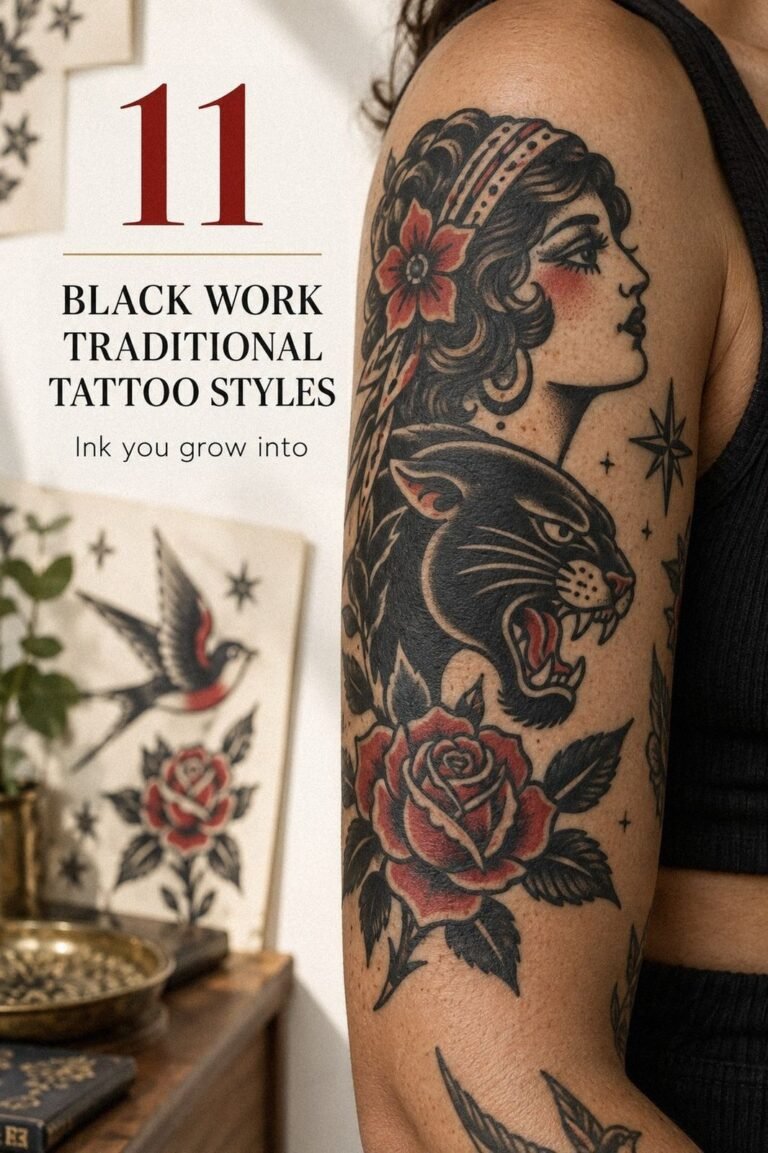
Bold lines. Limited color palette. Simple shapes that read from across the room. This stuff was literally designed for skin before computers existed, and it still photographs beautifully for websites. I tell clients all the time: if you want something that’ll look good in twenty years, start here. The thick black outlines hold. The saturated reds and yellows stay punchy. I’ve got traditional pieces on my own arms that are fifteen years old and still crisp.
Blackwork and Linework
Clean geometric patterns, ornamental mandala-type stuff, single-needle fine lines. These show up constantly on design sites because they look stunning on a white background. The reality? Fine lines blur. I’ve seen gorgeous single-needle designs from websites that looked like hairline fractures after five years. The trick is finding the sweet spot, bold enough to last, delicate enough to feel refined. I usually steer clients toward medium-weight linework, around 3-5RL range, with enough spacing that the ink won’t bleed together.
- American Traditional: bold outlines, limited colors, high contrast
- Blackwork: heavy saturation, graphic shapes, ages like iron
- Neo-Traditional: more detail than traditional but keeps the bold structure
- Japanese: large-scale storytelling, specific imagery rules, built for the body
- Minimalist: deceptively hard to execute; spacing is everything
Design Ideas That Make Sense
Here’s where I get picky. A tattoo design website can show you a million pretty pictures. What matters is whether the idea works for a human body that moves, stretches, and ages.
Flow With Anatomy
I had a client bring in a perfect circle from a website once. Wanted it on her inner bicep. I had to explain: arms are cylinders, not flat planes. That circle becomes an oval the second she flexes. We ended up adapting it into a flowing organic shape that followed her muscle structure. Good design websites are starting to show tattoos on actual body contours, not just flat mockups. Look for those. The ones that still use floating white-background images? Take them with a grain of salt.
Animals work great when they wrap and move. A snake coiling around a forearm. A bird with wings spread across shoulder blades. I’ve tattooed a lot of wolves howling at moons, and the ones that work best have the neck curving with the collarbone, the body following the chest or rib flow.
Text and Lettering
Script is everywhere on design sites. Cursive that looks elegant at thumbnail size. I warn every client: small text spreads. It blurs. It becomes unreadable. If you’re pulling a lettering design from a website, size it up. Way up. I won’t do text smaller than about 10-12 point equivalent, and even that depends on the font. Simple sans-serif holds better than elaborate cursive. I learned this tattooing names that needed cover-ups five years later.
Best Placements for Website Designs
Where you put it changes everything. I’ve watched the same design from the same tattoo design website look incredible on one person and awkward on another because of placement alone.
- Forearm: Flat canvas, easy to show off, heals relatively simply. Most designs read well here. I’ve done tons of website-sourced pieces on forearms.
- Upper arm/shoulder: Classic. Muscle structure gives natural framing. Traditional and Japanese styles thrive here.
- Ribs: Painful. Skin stretches weird. Detailed designs from websites often lose definition here. I usually simplify web designs for ribs.
- Thigh: Big, flat, forgiving. Great for larger pieces that need detail. I’ve translated elaborate website illustrations to thighs successfully.
- Back: Maximum real estate. Spine hurts. Scapulas move. Center back pieces from websites need to account for the spine’s shadow and curve.
- Ankles/wrists: High visibility, small space. Website designs almost always need major downsizing, which kills detail. Be prepared to lose elements.
We see this a lot in the shop: someone falls in love with a back-piece-sized design and wants it palm-sized. I have to be the bearer of bad news. Negative space is your friend. The best website designs for small placements are the ones that already have it.
Color Choices: Screen vs. Skin
Monitors lie. That electric blue you see on a tattoo design website? It’s RGB light, not pigment under skin. I’ve had clients get genuinely upset when I explain that neon colors don’t really exist in tattoo ink.
What Actually Exists
Blacks, true reds, deep blues, forest greens, yellows (that fade fastest), purples (variable, some go muddy). White ink is tricky, on light skin it barely shows, on dark skin it can look ashy or disappear entirely. I’ve stopped using white as a standalone color; it’s only for highlights over other colors now.
That watercolor splash effect every website shows? Achievable, but temperamental. It requires a skilled artist and specific techniques. The colors bleed and blend in ways that don’t match the digital preview. I do them, but I always have a long conversation about expectations first.
Black and Grey Realism
This is where website designs often shine. Good black and grey photography translates well. The values are honest, what you see is roughly what you get. I’ve done portraits from client-submitted website images that turned out stunning. The key is starting with high-resolution source material. A 400-pixel-wide image becomes a blurry mess at any size.
Tips for Choosing From a Tattoo Design Website
After years in the chair, here’s what I tell people who come in with digital inspiration.
- Check the artist’s portfolio, not just the design. A gorgeous image from a website means nothing if your local artist can’t execute that style. I turn down requests outside my wheelhouse regularly. Better to find someone whose healed work matches what you want.
- Look for healed photos, not fresh. Fresh tattoos are swollen, saturated, shiny. They look completely different at six weeks. Some design sites are starting to show healed results; prioritize those. In my shop, I try to get clients back for healed photos specifically for this reason.
- Consider the source’s cultural context. That Polynesian-inspired tribal from a random website? Probably bastardized and meaningless. I’ve had uncomfortable conversations with clients about cultural appropriation they didn’t realize they were engaging in. Do some research.
- Be ready to adapt. The best tattoo sessions I’ve had started with a website design that became a collaboration. Your artist knows how skin works. The design that respects that knowledge will always be better than a stubborn copy-paste.
- Resolution matters more than you think. If you can’t zoom in and see clean edges, your artist can’t either. Blurry source material makes for blurry tattoos. I refuse to work from pixelated references; it’s not worth the frustration for either of us.
One more thing: the flash sheets on old-school tattoo design websites? Those exist because they’ve been tested. Thousands of times. There’s something to be said for choosing a design that’s already proven it works on human bodies. I still flash classic designs regularly, and they never disappoint.
Final Thoughts
A tattoo design website is a starting point, not a destination. I’ve seen incredible art come from digital inspiration and I’ve seen disasters from people who treated a JPEG like a finished blueprint. The skin is not a screen. It breathes, it sweats, it scars, it changes. The best designs account for that reality.
When you find something you love online, bring it to an artist whose healed work you trust. Have a real conversation about what needs to change. Be open to the translation process. The tattoo you walk out with should be a collaboration between the image that sparked your imagination and the person who knows how to make it live on your body. That’s where the good stuff happens. I’ve been doing this long enough to know: the clients who get the best tattoos are the ones who listen as much as they dream.
Frequently Asked Questions
How do I know if a design from a website will work on my specific body type?
Your artist should do a stencil placement before any needles come out. In my shop, we always do a dry run with the stencil, have the client move around, check it in the mirror from multiple angles. What looks centered standing still might drift when you reach overhead.
Can I bring a design from a website and ask my artist to change the style completely?
Absolutely, but find an artist who actually works in that target style. I’ve had people bring me delicate watercolor designs and ask for American Traditional reinterpretation. I can do that, but not every artist can switch gears like that. Check their portfolio for the style you want, not just technical skill.
Why do some colors from website designs look completely different on skin?
Skin isn’t white paper. It’s translucent, with undertones, melanin, blood vessels showing through. That bright teal on your monitor becomes a darker, more muted blue-green under skin. I always do color tests for uncertain clients, especially with unconventional shades.
Is it okay to use the exact same design someone else has from a website?
Technically yes, but most artists I know prefer to modify it. In shop culture, straight copying another person’s custom tattoo is frowned upon, but flash designs are made to be repeated. If it’s a common stock image, you’re probably fine. If it’s clearly someone’s original piece, expect your artist to suggest changes.
More Tattoo Ideas
- Venom Tattoo Ideas That Actually Work
- Authentic Japanese Tattoos: A Working Artist s Guide
- Black and Grey Realistic Tattoos: Complete Style Guide
- Explore more