
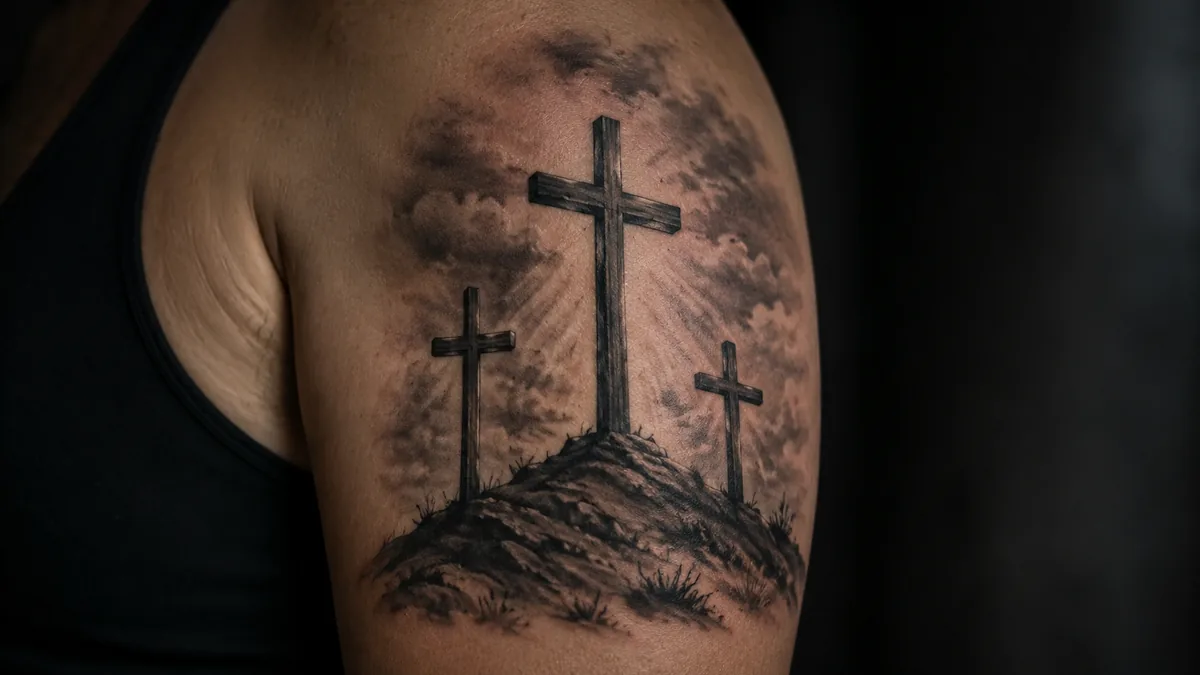
The three crosses tattoo is one of the most recognized religious symbols you’ll see in a shop. It pulls straight from the Christian account of the Crucifixion, where Jesus was executed between two other men on Golgotha, the hill also called Calvary. That imagery is thousands of years old, and it still carries serious weight today.
But it’s not just a faith piece. The three crosses read as a conversation about life, death, choice, and redemption all packed into a clean, bold composition. If you’re deeply religious or you’re drawn to the symbolism on a more personal level, this design has layers worth understanding before you sit in the chair.
The Core Meaning: Calvary and the Crucifixion
The foundational meaning comes directly from the New Testament. Jesus of Nazareth was crucified alongside two other men, traditionally identified as thieves or criminals. The center cross represents Christ. The two flanking crosses represent the two men beside him. That’s the scene on Golgotha, and almost everyone getting this tattoo is referencing it, whether they spell that out or not.
The theological weight is heavy. The center cross signals salvation, sacrifice, and grace. The side crosses add the human element: two people facing death, one mocking, one asking for mercy. That contrast is the whole point. Good and evil, redemption offered and rejected, all in one image. That’s why this composition hits harder than a single cross ever could.
Beyond the Bible: Broader Symbolism People Attach to It
Two men died beside Christ, only one left forgiven.
Not everyone who gets three crosses is making a strict doctrinal statement. A lot of people connect with the symbolism of past, present, and future. Or faith, hope, and love, which mirrors 1 Corinthians 13:13. Some wear it as a memorial piece, with each cross representing someone they’ve lost. The number three carries spiritual significance across multiple traditions, so the design has room to breathe outside strict Christianity.
Others read the outer crosses as representing their own struggles or the people in their life who shaped them. The meaning you bring to it is real. Just be clear with your artist about your intent so the design choices reinforce what you’re actually saying. Line weight, scale, and whether you add elements like a crown of thorns or a banner all shift the reading fast.
Historical and Cultural Context
The three-cross image became a staple in Western Christian art starting in the early medieval period. Churches, stained glass, and illuminated manuscripts used it to depict the Passion narrative. It traveled through Catholic, Protestant, and Orthodox traditions and landed in American culture through revival movements, prison tattoo culture, and military service. It’s been worn by the deeply devout and by people who just grew up around the image.
In traditional American tattooing, crosses were among the earliest religious motifs, often paired with roses, banners, or sacred hearts. The three-cross layout gave artists a natural triangular or horizontal composition that fills well on skin. That design logic kept it in heavy rotation. It’s not a trend piece. It has deep roots in both religious practice and tattoo history.
Design Variations and Style Options
The most classic version is three Latin crosses in a row, center cross taller than the two flanking ones, rendered in bold black lines. That’s the Calvary setup. But shops see a lot of variation. Fine line single-needle versions done in a delicate stipple or thin outline read more contemplative and personal. Neo-traditional versions might add roses, clouds, or rays of light with saturated color. Blackwork pieces can go heavy with bold fills and thick outlines that hold up for decades.
Some clients want the three crosses integrated into a full sleeve or chest piece as an anchor image. Others want a standalone piece, small and tight. Script banners with names or dates wrapped around the base is extremely common as a memorial variation. Geometric interpretations using clean linework are popular right now. Whatever the style, make sure the composition is balanced. Three elements side by side can feel flat if the sizing and spacing aren’t dialed in.
Black and Grey vs. Color
Black and grey is the dominant choice for this piece, and it makes sense. The subject matter is serious and spiritual. A tight black and grey rendering with soft whip shading gives it gravitas. It reads well from across the room, ages predictably, and heals nice on most skin tones. If you add realistic elements like weathered wood grain on the crosses or a dramatic sky behind them, black and grey lets that detail breathe without competing colors pulling focus.
Color works when it’s deliberate. Saturated warm tones in the sky, gold rays, or a vivid red drape over the center cross can be striking, but they require a skilled colorist and diligent aftercare. Color fades faster, especially in high-wear zones. If you’re going color, choose an artist whose healed color work you’ve seen in person, not just fresh photos on Instagram. Bold will hold if it’s applied right, but color needs a committed client too.
Best Placements and How It Ages
The chest is the most natural home for three crosses. The horizontal layout mirrors the collarbone and fills the sternum area cleanly. The upper back and shoulder blade area work for the same reason. These are low-wear zones with stable skin, so the tattoo holds its shape long-term. The forearm is another strong option if you want it visible, and the flat surface makes crispy lines easy to execute. Calf and upper arm are solid mid-tier placements.
Avoid the inner wrist, finger, and hand if you want this to stay clean long-term. Those are high-wear zones prone to blowout and fast fading. The ribs will hold the detail well but that placement is spicy, no question. The neck carries the image well if you’re ready for that level of commitment and visibility. Whatever placement you choose, factor in how the three-element composition sits on the body’s natural contours. A flat cross layout on a curved surface needs to be drawn on you, not off a printout.
Who Gets This Tattoo and How to Make It Yours
The people sitting down for three crosses run the full range. Devout Christians wanting a permanent expression of faith. People memorializing family members, especially parents or grandparents who were religious. Former military or corrections clients where the symbol has deep cultural history. People in recovery who connect the imagery with a turning point in their life. It crosses demographics hard, which is a sign of a symbol with real staying power.
To make it personal, think about what each cross means to you specifically. Talk to your artist before you pick a flash sheet design. Add initials, dates, a specific scriptural reference, or design elements that connect to your story. If it’s a memorial piece, bring photos of the people you’re honoring. A good artist will work that into the piece in a way that feels earned. This design has centuries of meaning behind it. What you add on top of that is what makes it yours.









