Three Swords Tattoo Meaning: Symbolism, Styles & What to Ask Your Artist
Three swords arranged in deliberate configuration carry weight that transcends simple weapon imagery. Whether crossed in classic heraldic fashion, plunged into a heart, or suspended in abstract composition, this motif demands understanding before commitment. The following breaks down what matters for your decision.
Symbolism & Core Meaning
At its foundation, the three-sword image operates on multiple interpretive layers. The number three itself holds cross-cultural resonance: past-present-future, birth-life-death, mind-body-spirit. Combined with the sword’s established associations with truth, protection, and decisive action, the composition becomes inherently complex.
Traditional Heraldic Roots
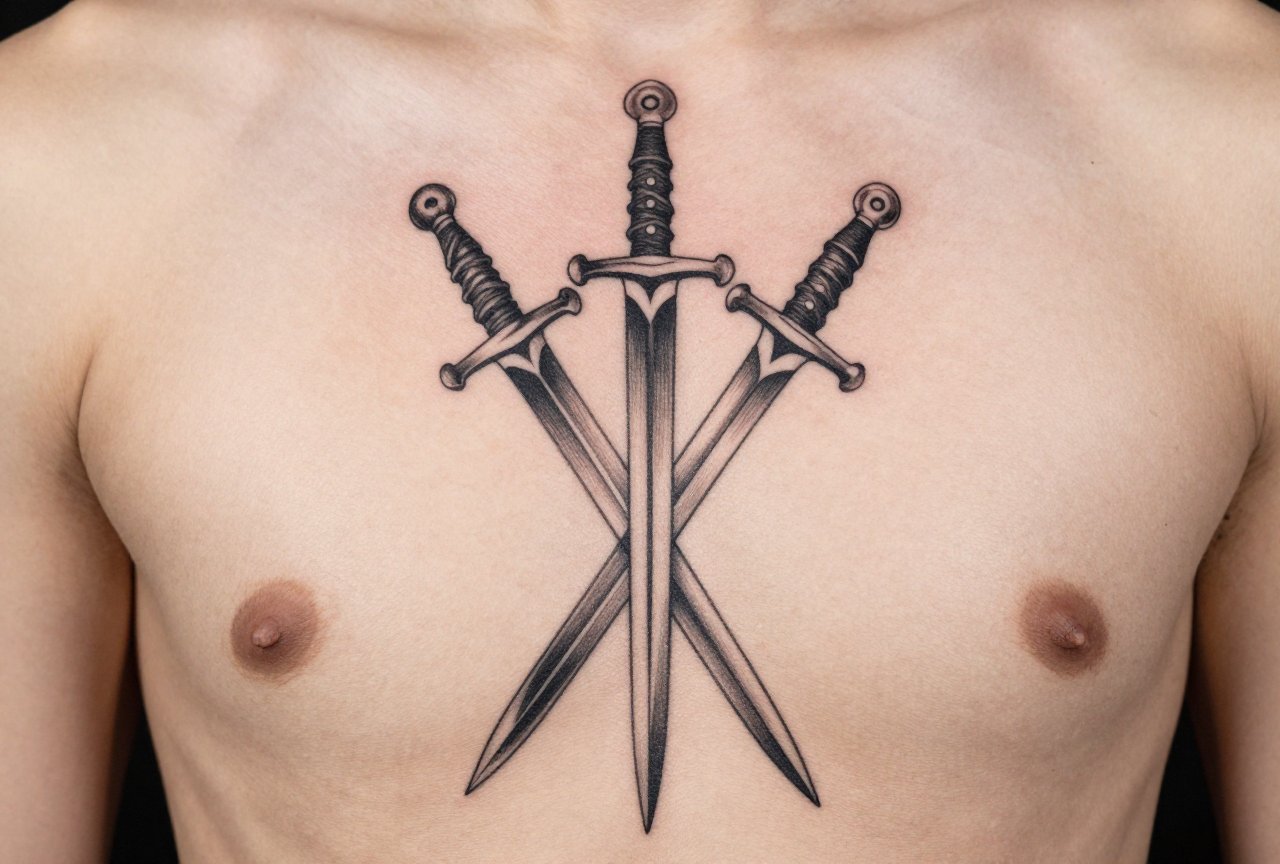
Coats of arms frequently employed multiple swords to denote military honor, judicial authority, or familial sacrifice. The specific arrangement mattered enormously. Crossed blades pointing upward suggested active defense or readiness. Swords pointing downward indicated peace, rest, or sometimes mourning. Parallel placement created different visual tension entirely, often reading as collective strength rather than individual conflict.
The Tarot Connection
The Three of Swords card deserves particular attention. Its imagery (a heart pierced by three blades) represents sorrow, heartbreak, and necessary pain leading to transformation. Many seekers gravitate toward this specific reference, though not all artists execute the tarot aesthetic with equal fluency. The emotional rawness attracts those processing grief, ended relationships, or difficult personal growth. Some choose it as memorial; others as acknowledgment that pain shaped rather than destroyed them.
Religious & Spiritual Angles
Christian iconography offers substantial precedent. The three nails of the crucifixion, while technically distinct objects, sometimes blur visually with sword imagery in certain artistic traditions. Three swords can echo the Holy Trinity through triune symbolism without explicit cruciform structure.
Japanese spiritual contexts provide different resonance. The three imperial regalia include Kusanagi, the grass-cutting sword, representing valor and divine authority. Buddhist tradition sometimes depicts Manjushri wielding a flaming sword of wisdom that cuts through ignorance. Three such blades might suggest multiple obstacles overcome or multiple wisdoms cultivated.
Norse and Celtic pagan associations also surface regularly. Odin’s sword, the blades of the Morrigan, or the threefold death motif in various Indo-European traditions all inform how some wearers conceptualize their design. These connections are often linked to rather than definitively established in historical record, so honest artists acknowledge interpretive flexibility.
Personal & Modern Meanings
Contemporary wearers increasingly detach the motif from specific cultural anchors, creating personal symbolic systems. Three swords might represent three survived hardships, three protective relationships, or three principles guiding conduct. The geometric clarity appeals to those favoring structured self-expression over fluid imagery.
Common Contemporary Interpretations
- Triumph over three specific challenges (addiction, illness, loss)
- Protection of self, family, and community
- Commitment to honesty, courage, and discernment
- Partnership bonds (three siblings, friends, or allies)
- Rejection of passivity in favor of decisive engagement
The design’s severity attracts those who find floral or animal imagery insufficiently stark for their temperament. There is no requirement that tattoos feel gentle. Some wearers specifically seek the visual aggression that swords provide, then temper it through arrangement, ornamentation, or placement choice.
Best Placements
Anatomical consideration dramatically affects how three swords read. The composition’s linear elements reward certain locations while fighting others.
Natural Compositions
Crossed configurations suit the upper chest, between shoulder blades, or outer thigh where intersecting angles find adequate flat surface. The sternum specifically accommodates heart-piercing tarot variations with almost too-perfect anatomical irony. Forearms work well for parallel arrangements, allowing the blades to follow natural limb lines. Ribs demand particular courage; the canvas is excellent for vertical plunging compositions but notoriously challenging for both artist and recipient.
Smaller scales than four inches risk muddled detail. Sword hilts, guards, and pommels contain information that collapses at insufficient size. Conversely, expansive back pieces allow environmental context (storm clouds, blood, flames, roses) that transforms isolated symbolism into narrative scene.
Flow and Movement
Consider how the body moves. A three-sword design on a frequently flexing bicep will distort differently than one on relatively stable calf muscle. Discuss this with your artist during consultation, not after stencil application. Some prefer the slight warp as organic integration; others find it undermines geometric precision.
Choosing the Right Artist
Not every skilled tattooist handles this motif equally. Swords require specific technical competencies: straight lines that actually read straight, symmetrical elements that hold symmetry, metallic texture suggestion without over-rendering.
Portfolio Red Flags and Green Lights
Examine prospective artists’ healed work specifically. Fresh tattoos hide imperfections that emerge weeks later. Look for consistent line weight, confident hilt geometry, and blades that suggest dimension rather than flat cartooning. Japanese-trained artists often excel at sword imagery given the weapon’s centrality in that tradition. Black-and-grey specialists frequently outperform color generalists for metallic realism.
Ask directly about their experience with your specific variant. An artist strong in single-sword samurai designs may struggle with European crossed-hilt arrangements. Someone accomplished at tarot card reproduction might lack fluency in heraldic minimalism. Honest practitioners will redirect you if your vision falls outside their strength.
Consultation Questions Worth Asking
- How would you handle the negative space between blades?
- What reference material do you prefer for historical accuracy?
- How has this design aged in your healed portfolio?
- Would you recommend color or strictly black and grey for my skin tone?
- What modifications would improve longevity?
What to Expect
Session duration varies enormously by size and complexity. A palm-sized three-sword outline might complete in under two hours. Detailed chest pieces with environmental elements require multiple sessions spanning months. The motif’s linear nature means substantial needle time on bone-adjacent areas; ribs, sternum, and spine locations test pain tolerance.
Healing demands standard diligence: moisture control, sun avoidance, no submersion during initial weeks. The straight lines particularly benefit from careful after-since uneven healing distorts geometric designs more noticeably than organic ones. Plan touch-up scheduling during initial consultation; most artists include one within their pricing structure.
Long-term, sword tattoos age reasonably well if executed with adequate line weight. Excessively fine detail in hilts and guards may soften over years. Discuss this trade-off with your artist: historical accuracy versus longevity, intricate rendering versus bold readability.
Key Takeaways
Three swords tattoo meaning ultimately coheres around triune symbolism filtered through personal significance. The design’s strength lies in structural clarity and historical depth rather than decorative softness. Successful execution requires artist selection as deliberate as the symbolic choice itself. Prioritize portfolios demonstrating specific relevant competence, insist on consultation thoroughness, and respect the motif’s demand for technical precision. Your patience in finding appropriate partnership between vision and execution determines whether this becomes enduring emblem or regretted impulse.
Frequently Asked Questions
Does the direction the swords point change the meaning?
Yes, significantly in traditional contexts. Upward-pointing blades suggest readiness, protection, and active vigilance. Downward orientations historically indicated peace, mourning, or rest from conflict. Contemporary wearers sometimes disregard this convention, but understanding the precedent helps informed choice.
Is the Three of Swords tarot design too negative for a tattoo?
Interpretation varies by individual. The card represents heartbreak and sorrow, but also necessary pain leading to growth. Many wearers choose it precisely to acknowledge difficulty survived rather than ongoing suffering. Discuss your specific relationship to the imagery with your artist to ensure execution matches intention.
How much should I expect to pay for quality three-sword work?
Pricing varies by region, artist reputation, and session length. Small, simple designs might start around $200-400. Extensive custom work from established specialists often runs $150-300 hourly across multiple sessions. Exceptional portfolios command premium rates. Avoid bargain hunting for this technically demanding motif.
Can three swords work with other elements, or should they stand alone?
Both approaches succeed. Isolated compositions emphasize geometric purity and symbolic directness. Integrated elements (roses, snakes, banners, flames) create narrative context and personal specificity. The choice depends on your communicative intent and the artist’s compositional strengths.