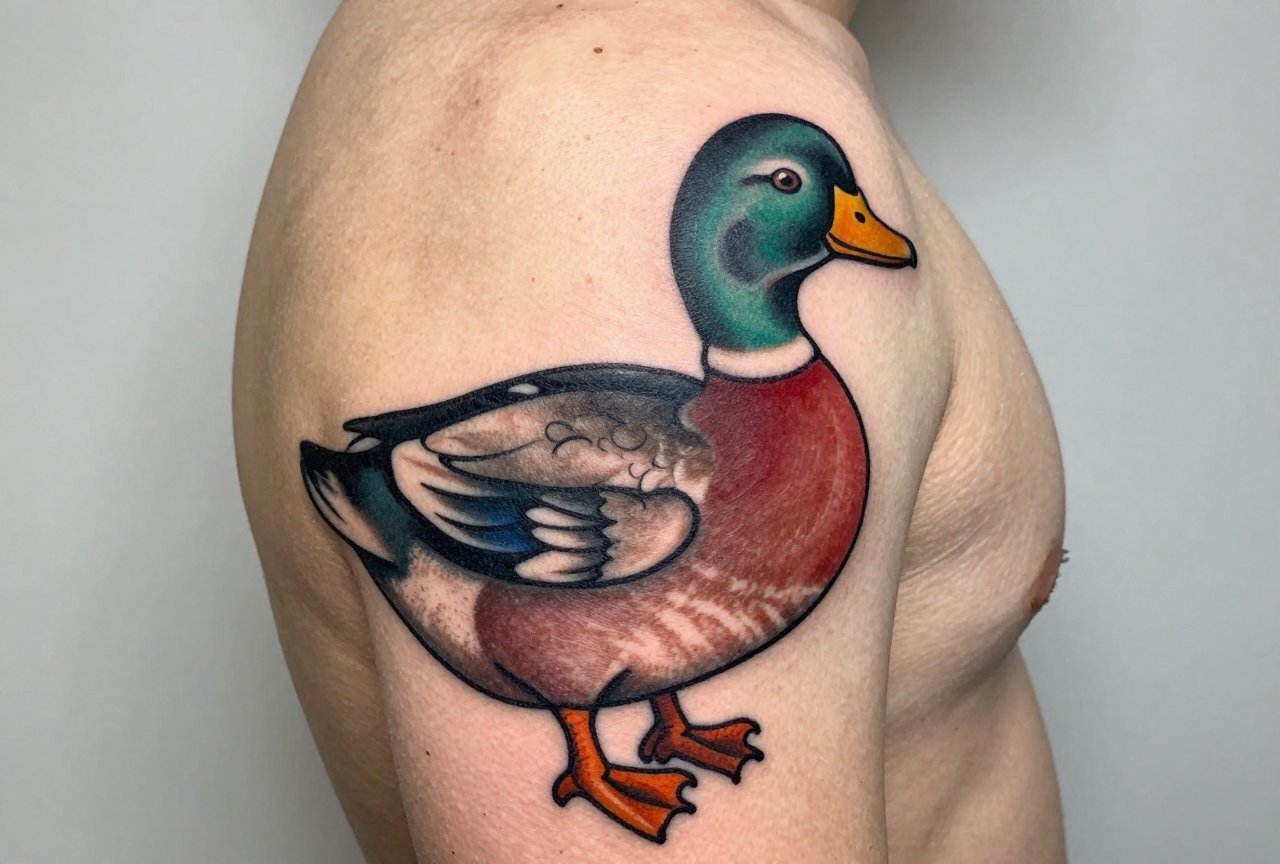
A traditional duck tattoo hits that sweet spot between playful and tough. In my chair, I’ve tattooed mallards taking flight, angry wood ducks, and plenty of those classic “duck in a hunting dog’s mouth” flash pieces. The style demands bold black outlines, limited but saturated color, and a certain attitude that comes straight from the sailor-and-soldier roots of American traditional tattooing. Ducks work surprisingly well in this vocabulary: the shape of the body, the spread of wings, the curve of the neck, all of it translates to skin with that heavy, readable confidence that makes traditional tattoos last.
Origins & History
American traditional tattooing crystallized in the early 1900s through artists like Sailor Jerry, Bert Grimm, and the Bowery shops in New York. The imagery came from what soldiers and sailors saw and valued: women, ships, eagles, and animals that meant something. Ducks entered the lexicon because hunters and outdoorsmen wanted their passions on their skin, and because the form, rounded body, distinctive bill, recognizable silhouette, reads instantly even at small sizes.
I’ve flipped through enough vintage flash sheets to tell you ducks show up more than you’d expect. They’re not as common as swallows or panthers, but they’re there: sometimes realistic for the era, sometimes cartoonish, often paired with hunting imagery. The tradition carried forward because it works. A duck in traditional style doesn’t need explanation. You see it, you know it, you get the reference.
From Flash to Custom
Back in the day, you’d pick a duck design off the wall. Now most of my clients bring reference, but the good ones still want that classic feel. The difference is customization: your hunting dog, your favorite marsh, your grandfather’s call. The bones stay traditional. The details get personal.
Key Characteristics & Motifs
Traditional duck tattoos share DNA with every other animal in the style. Heavy black outlines. Minimal shading, and when it’s there, it’s whip-shaded or peppered for texture rather than smooth gradients. Color sits in distinct blocks: teal and green for mallard heads, brown bodies, orange legs, maybe a flash of white neck ring.
- Bold outlines: The black line carries the design. Without it, you don’t have traditional. Period.
- Limited palette: Red, yellow, green, blue, black. Maybe brown. That’s your menu.
- Legible from distance: If you can’t read it across the room, the design’s too busy.
- Attitude over accuracy: Anatomical precision matters less than character. A traditional duck looks alive, sometimes angry, always present.
Common Pairings
Hunters want their duck with a retriever, a shotgun shell, or a marsh scene framed in a circle. Others go pure bird: wings spread, taking off, that classic waterfowl silhouette. I’ve done ducks with banners reading family names, dates, or coordinates. The banner itself is traditional vocabulary. The words make it yours.
Color vs Black and Grey
This is where I have real conversations with clients. Color traditional pops. That mallard green, that chestnut brown, the orange legs, it’s unmistakable. But black and grey traditional has its own power. It reads older, more utilitarian, closer to the tattooing that happened in shops before reliable color ink.
Color holds up fine if your artist knows their pigments. I’ve seen twenty-year-old traditional color that still sings. But black and grey forgives sun exposure better, and some skin tones carry grey wash with a depth that color can’t match. I always ask: what’s your lifestyle? Outdoor work? Swimming? Sunscreen discipline? These answers steer the choice more than aesthetics alone.
Best Placements
Ducks suit certain spots because of their shape. That elongated body, the neck curve, the wing spread, each suggests different real estate.
- Outer forearm: Classic. The duck’s body follows the muscle, wings can wrap slightly. Easy to show, easy to hide with a sleeve.
- Thigh: Room for detail. Hunting scene with marsh grass, dog, the whole narrative. Heals well, hurts less than you’d think.
- Chest, over heart: For the dedicated hunter. The bird faces outward, wings sometimes spread across pecs.
- Calves: Another traditional stronghold. The curve of the duck’s back echoes the calf muscle.
- Hands and fingers: I talk people out of this unless they’re already heavily tattooed. Small duck silhouettes work, but the detail that makes traditional sing gets lost at that scale.
We see a lot of duck tattoos in hunting communities where they travel in groups, brothers, cousins, fishing buddies getting matching or complementary pieces. Thighs and forearms dominate those sessions.
Who It Suits
There’s no type. I’ve tattooed ducks on grandfathers passing tradition to grandsons, on women who grew up in duck blinds with their dads, on city kids who just love the graphic punch of the image. The common thread is meaning, or at least genuine attraction. Don’t get a duck because your friend has one. Get it because you feel something when you see that shape.
The style itself suits people who want their tattoo to read clearly for decades. Traditional ages like granite. The bold lines spread slower than fine detail, the color stays in its lanes, the image remains legible even as skin changes. If you’re worried about longevity, traditional is your friend.
Modern Variations
Contemporary artists push the boundaries while keeping the bones. Neo-traditional ducks might have softer shading, more colors, ornamental backgrounds. Japanese-influenced versions add waves, maple leaves, or wind bars behind the bird. I’ve seen ducks done with Chicano black and grey realism techniques, incredible technical work, though purists argue it’s a different language entirely.
What Stays, What Goes
The outline stays. That’s non-negotiable for anything I’d call traditional. What loosens is the color restriction, the background simplicity, sometimes the proportions. A modern traditional duck might have a sunset gradient behind it, or water rendered with more than three lines. It still reads as traditional because the structure, outline, limited shading, bold presence, remains intact.
Choosing an Artist
This matters more than design. Traditional tattooing looks simple. It’s not. The line weight has to be consistent. The color has to be packed evenly. The design has to be built for skin, not paper. I’ve fixed too many “traditional” tattoos done by artists who learned the look from Instagram without apprenticing in the discipline.
- Look at healed work: Fresh photos lie. Ask for one-year-healed shots. That’s the truth.
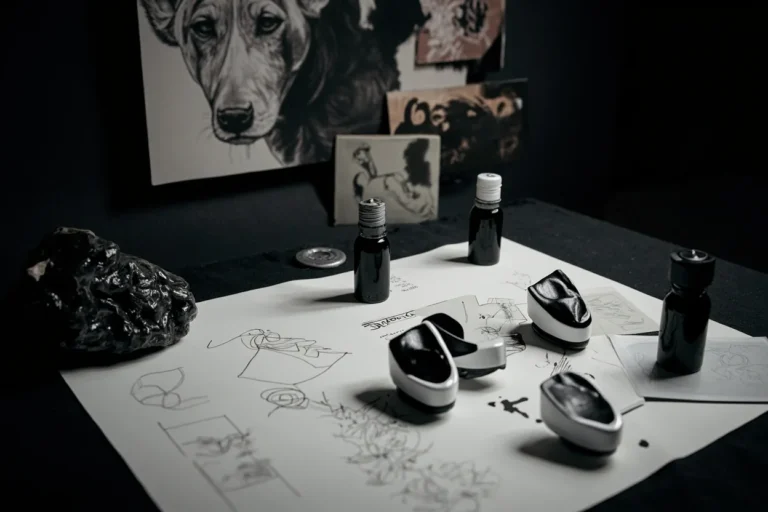
- Check their flash: Artists who live in this style draw constantly. Their sketchbooks and flash sheets show fluency, not just competence.
- Ask about their training: Apprenticeship under a traditional artist means something. Self-taught can work, but it’s riskier.
- Shop vibe: Traditional shops feel a certain way. Flash on walls, respect for history, artists who can talk Sailor Jerry without googling.
I tell clients: the best traditional artist for your duck might not be the one with the most followers. They might be the quiet one in the corner shop who’s been doing this for fifteen years and knows exactly how thick that wing outline needs to be.
Final Thoughts
A traditional duck tattoo connects you to a lineage of working-class art, of images that traveled on skin across oceans and wars, that meant enough to mark permanently. The duck itself, whether it’s your hunting passion, your family story, or just a shape that grabs you, gets translated into a visual language proven across decades. Done right, it heals dark and strong, settles into your skin like it was always there, and keeps reading true when you’re old and the details of other tattoos have blurred beyond recognition. That’s the promise of traditional. That’s why I still love doing it.
Frequently Asked Questions
How long does a traditional duck tattoo take to heal?
Most traditional pieces heal in two to three weeks for the surface, though the deeper skin takes longer. I tell clients to keep it clean, don’t pick at scabs, and keep it out of the sun during that window. The bold lines actually heal pretty forgivingly compared to fine detail work.
Can a traditional duck tattoo be covered up later if I change my mind?
Traditional’s heavy black lines make cover-ups challenging but not impossible. A skilled artist can work with it, especially if the original has open skin around it. I always suggest thinking of tattoos as permanent, though, cover-ups are a last resort, not a plan.
Why do traditional duck tattoos cost more than some other styles?
You’re paying for the artist’s fluency in a specific vocabulary, not just time in the chair. A solid traditional piece requires confident line work that comes from years of practice. Cheap traditional usually means someone faking the style without the foundation.
Do traditional duck tattoos work on darker skin tones?
Absolutely. The bold black outlines read on every skin tone, and we adjust color choices for maximum vibrancy. I’ve tattooed traditional ducks on clients across the spectrum, the key is an artist who understands how pigment interacts with melanin, not avoiding the style entirely.
Related Style Guides
- Traditional Head Tattoos: A Working Artist s Guide
- Traditional Japanese Tattoo Artists: A Real Shop Guide
- Traditional Marine Tattoos: A Working Artist s Guide
- Explore more