Traditional Military Tattoos: Complete Style Guide
Service members and veterans have worn inked symbols for centuries. These markings carry weight beyond decoration, encoding rank, unit, loss, and survival into permanent skin. The traditional military tattoo follows strict visual rules: bold black outlines, limited color palettes, and imagery stripped to its essential communicative form. Understanding this language helps you choose work that honors its roots while remaining genuinely yours.
Who Chooses This Tattoo
Active duty personnel, veterans, and direct family members form the core audience for military tattooing. Yet the style has expanded beyond these circles. Civilian collectors drawn to the graphic strength and historical lineage increasingly seek traditional military pieces. This crossover demands respect for the original context. Wearing a Marine Corps bulldog without service connection, for instance, carries different implications than collecting a generic anchor or eagle motif.
Service-Connected Wearers
For those who served, these tattoos function as external records of internal experience. A sailor’s swallow marked nautical miles traveled. A paratrooper’s wings verified qualification. The skin became a portable service record, visible in civilian clothes when uniforms were packed away. Many veterans describe the process as reclamation: choosing what to commemorate, in what order, with what emphasis. The military controlled the narrative during service; the tattoo returns some of that control.
Civilian Collectors
Interest from non-military clients has grown alongside the broader traditional tattoo revival. Some seek family connections, honoring a grandfather’s service through adapted imagery. Others respond purely to the aesthetic: the disciplined linework, the symbolic clarity, the historical weight. If you fall into this category, research matters deeply. Avoid direct unit insignia you did not earn. Consider broader motifs: anchors, roses, daggers, banners, and eagles that belong to the visual vocabulary without claiming specific affiliation.
Mythology & Folklore
Military tattooing intertwines with maritime folklore, superstition, and protective ritual. Sailors particularly developed elaborate symbolic systems where image placement and combination carried specific powers and warnings.
Protective Symbols at Sea
Hold and pig imagery, often linked to maritime safety traditions, were believed to prevent drowning. Pigs and roosters were kept in wooden crates, theoretically floating if a ship sank, so their images promised similar survival. A pig on the left foot, rooster on the right, created a specific protective pairing. The north star offered navigational guidance and spiritual orientation. Crossed anchors on the webbing between thumb and index finger identified a boatswain’s mate, but also invoked stability.
Marks of Experience and Mortality
Swallows accumulated with distance traveled: one for 5,000 nautical miles, traditionally a second for 10,000. A fully rigged ship indicated rounding Cape Horn, one of sailing’s most dangerous passages. Shellback turtles celebrated crossing the Equator. Less celebratory, a dagger through a rose or heart warned of loss and readiness. Skulls appeared not as generic rebellion but as memento mori, the sailor’s daily confrontation with mortality made visible.
Personal & Modern Meanings
Contemporary military tattooing balances institutional symbolism with individual interpretation. The same image carries different weight depending on era, branch, and personal history.
Unit insignia remain common: division patches, battalion numbers, specific equipment silhouettes. These identify belonging and shared ordeal. Memorial pieces have grown more prevalent, particularly since sustained combat operations in Iraq and Afghanistan. Names, dates, and unit designations commemorate specific losses. Some veterans integrate medical imagery, such as the caduceus or star of life, marking medical service or injury survived.
Modern deployments have generated new imagery: specific aircraft silhouettes, route numbers, geographic coordinates. These function as coded language, immediately readable to those who shared the experience, opaque or meaningless to outsiders. This selective visibility matters. The tattoo communicates when desired, protects privacy when needed.
Reintegration themes appear increasingly: civilian and military imagery merged, transition dates, or symbolic bridges between states. These mark not just service but the difficult passage back, often as significant as the deployment itself.
Common Variations & Styles
Traditional military tattooing encompasses several distinct visual traditions, each with regional and temporal characteristics.
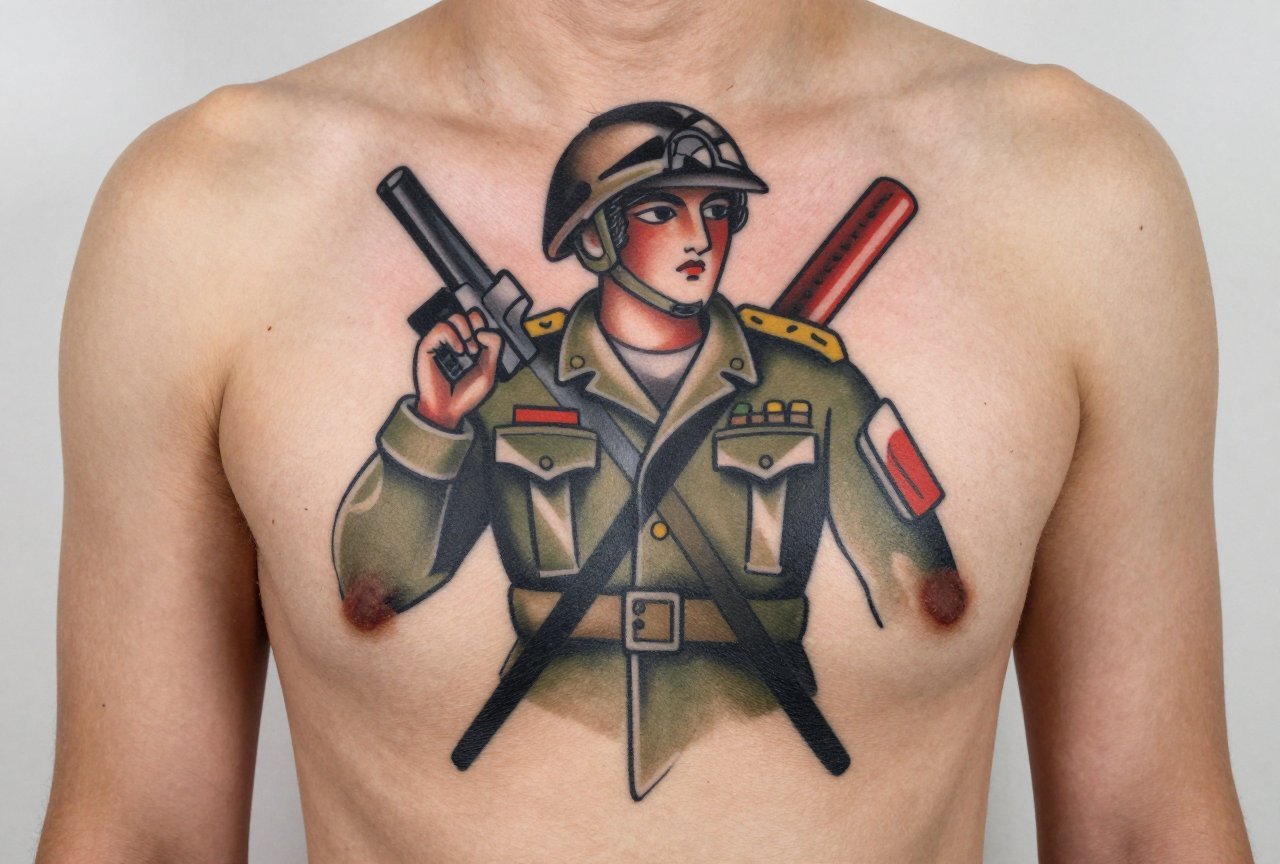
- American traditional: Heavy black outlines, limited saturated colors (red, yellow, green, blue), minimal shading. Imagery tends toward bold, immediately readable silhouettes. Norman Collins (Sailor Jerry) refined this vocabulary in Honolulu, blending naval imagery with Polynesian influences and his own graphic innovations.
- British and Commonwealth traditional: Often linked to similar maritime roots but with regional variations. Royal Navy imagery dominates, with specific ship classes, crown motifs, and regimental badges. The style frequently employs more text integration and finer line weights than its American counterpart.
- European continental traditions: German and French military tattooing developed distinct characteristics, sometimes incorporating more illustrative detail and regional folk art elements. Post-war German tattooing carried additional complex layers of historical avoidance and reclamation.
- Contemporary neo-traditional: Retains the bold structure and symbolic clarity while introducing expanded color palettes, more sophisticated shading, and sometimes blended stylistic references. These pieces honor the tradition without being constrained by mid-century technical limitations.
Placement follows functional and symbolic logic. Forearms and hands maintain visibility, asserting identity. Chest and back accommodate larger compositions. Thighs and calves offer concealment under uniform or civilian dress. The throat and face remain generally avoided in traditional military contexts, associated with disciplinary marking or extreme disgrace in some historical periods.
Similar & Related Symbols
Military tattooing shares visual territory with several adjacent traditions. Understanding these relationships clarifies your choices and their reception.
Prison tattooing developed overlapping imagery through shared working-class roots and institutional confinement, but carries different, often coded, meanings. Similar visual elements may signal entirely different affiliations. The teardrop, for instance, has military memorial usage in some contexts but prison homicide marking in others.
Biker and outlaw club tattooing borrowed heavily from military traditions, particularly among Vietnam-era veterans who transitioned into motorcycle culture. Shared imagery includes eagles, flags, and patriotic themes, but placement rules and combination meanings diverge significantly.
Police and fire service tattooing emerged from similar occupational solidarity but developed distinct iconographies: maltese crosses, helmet numbers, mourning bands. The structural parallels are strong; the specific content differs.
Folk tattooing from various cultures contributed protective and status imagery that merged into military traditions through colonial contact and port city mixing. The nautical star, for instance, appears across multiple maritime cultures with related but not identical meanings.
History & Cultural Roots
Military tattooing extends far deeper than American twentieth-century practice. Ancient and early modern soldiers marked themselves for identification, protection, and group cohesion.
Early Military Marking
Roman soldiers were sometimes tattooed with permanent service marks, though the practice was often linked to penal and slave status as well, creating complex associations. Byzantine military units reportedly used tattoos for identification. In early modern Europe, mercenary companies and standing armies developed various marking systems, sometimes voluntary, sometimes coerced.
The systematic connection between tattooing and naval service emerged with European expansion and the growth of standing navies. Sailors encountered tattooed peoples in the Pacific and elsewhere, adopted and adapted the practice, and developed their own symbolic systems aboard ship. Captain Cook’s voyages are often linked to the reintroduction and popularization of tattooing in European contexts, though the practice never fully disappeared.
American Institutionalization
American military tattooing intensified during the Civil War, with both Union and Confederate soldiers marking allegiance and unit. The Spanish-American War and subsequent Philippine occupation expanded exposure to Pacific tattooing traditions. The World Wars created mass mobilization and the conditions for widespread, shared tattoo culture. Honolulu, San Diego, and Norfolk became centers of naval tattooing. The post-Vietnam era saw temporary decline, followed by resurgence and stylistic evolution.
Before You Decide
Consider placement in relation to your current and anticipated professional life. Military tattooing has historically been more visible and accepted in working-class and service contexts; corporate and professional environments may still carry bias despite broader tattoo acceptance.
Research your specific imagery thoroughly. Symbols shift meaning across branches, eras, and nations. An image appropriate for one context may be misread in another. Consult multiple sources, including veteran communities and historical references, not just tattoo studio flash sheets.
Choose an artist with demonstrated experience in traditional military work. The style requires specific technical discipline: consistent line weight, solid color saturation, understanding of historical conventions. Portfolio review should show healed work, not just fresh photographs, since traditional tattooing’s longevity depends on technical execution.
Finally, sit with your design. Military tattooing carries permanence in both technical and emotional dimensions. The best pieces result from sustained consideration of what you genuinely need to carry, what you can stand to remember, and what you are willing to explain or defend across decades of changing context.
Frequently Asked Questions
What makes a tattoo ‘traditional military’ versus just traditional American style?
Traditional military tattooing uses the same technical foundation, bold outlines, limited color, strong silhouettes, but draws specifically from service-related imagery and historical conventions. The difference lies in content and context: anchors, unit insignia, nautical miles markers, and protective maritime symbols rather than purely decorative or civilian themes. A traditional rose differs from a dagger-through-rose memorial piece with specific unit numbers.
Can I get a unit insignia tattoo if I didn’t serve in that unit?
This generates significant disagreement within military and veteran communities. Some view direct unit insignia as earned only through service; others are more permissive, particularly for family memorial pieces. The safest approach is avoiding exact reproductions of specific unit patches or qualification badges you did not earn. Adapted imagery, broader branch symbols, or family-adjacent designs (names, dates, service eras without specific unit claims) navigate this respectfully.
Why are swallows and pigs common in naval tattooing?
These images are often linked to maritime folklore about survival at sea. Pigs and roosters were kept in wooden crates that would float if a ship sank, so their images were believed to offer similar protection from drowning. Swallows marked accumulated nautical miles, traditionally one for 5,000 miles, a second for 10,000, and were also associated with the hope of return, since swallows migrate home. The symbolism predates modern navigation but persists as traditional vocabulary.
How do I find an artist who genuinely understands military tattoo history?
Look beyond general traditional tattoo portfolios. Ask specifically about military flash history, Sailor Jerry’s innovations, or regional naval tattooing traditions. Review healed work for technical execution that will last. Consult veteran tattoo communities for recommendations. A knowledgeable artist will discuss historical context unprompted, warn you about problematic imagery combinations, and ask about your service connection or family history rather than treating the piece as generic product.