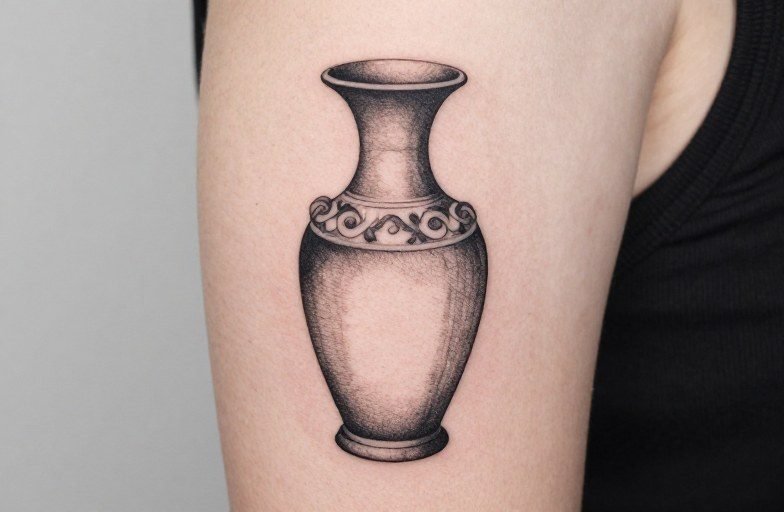
A vase tattoo primarily symbolizes containment, potential, and the balance between emptiness and fullness. Depending on design choices, it can represent feminine creative energy, cultural heritage, personal loss, or the idea that value lies in what we choose to hold. The meaning shifts dramatically based on whether the vase is depicted empty, overflowing with flowers, cracked, or drawn in a specific historical style.
Symbolism & History
Core Meanings Across Cultures
The vase carries weight in nearly every major artistic tradition. In Chinese culture, vases are often linked to peace and stability, the word for vase (瓶, píng) sounds similar to “peace” (平, píng). Greek pottery connects to storytelling, with black-figure and red-figure techniques depicting myths and daily life. Japanese ikebana vases emphasize restraint and the beauty of empty space. A tattoo drawing from these traditions taps into centuries of accumulated meaning without needing to spell it out.
Empty vases speak to possibility, waiting, or grief. Filled vases suggest abundance, creativity, or the temporary nature of beauty, cut flowers die, after all. Cracked or broken vases, particularly those referencing kintsugi, carry explicit meaning around repair, resilience, and finding value in damage rather than hiding it.
Feminine and Domestic Symbolism
Vases have historically been coded feminine in Western art, associated with domestic space, receptivity, and decoration. Some people reclaim this as strength; others reject the association entirely through aggressive or unconventional vase designs. A vase rendered in heavy blackwork with sharp geometry reads differently than a delicate porcelain-style piece with soft shading. The vessel itself is neutral, your choices load it with meaning.
Common Variations & Styles
Classical and Historical Approaches
Greek amphora or kylix designs work well as standalone pieces or as part of larger mythology-themed work. These typically rely on strong outline work with limited color, mimicking the actual pottery technique. The challenge is making the flat, graphic quality feel alive rather than static. Good artists solve this through careful line weight variation and strategic negative space.
Chinese blue-and-white porcelain patterns translate beautifully to tattoo, though the fine detail demands an artist experienced in tight linework. These pieces often age better when scaled slightly larger than initially tempting, the blue can blur, and the intricate patterns need room to breathe.
Contemporary and Abstract Interpretations
- Minimalist outline: Single continuous line or near-line drawings, often placed on forearms or collarbones. Age reasonably well if kept bold enough.
- Surreal or melting vases: Dali-esque distortions that suggest instability or transformation of traditional form.
- Vase as negative space: The vase shape formed by surrounding imagery, flowers, smoke, or abstract fill, rather than direct outline.
- Kintsugi repair: Gold or metallic ink (or yellow/gold-toned regular ink) highlighting cracks. Be aware that metallic tattoo inks are largely unreliable; most artists simulate the effect with solid yellow-gold.
Floral Pairings
The flowers you choose matter as much as the vessel. Peonies, common in Japanese and Chinese vase imagery, carry their own prosperity and honor associations. Dried or dead flowers in a vase shift meaning toward memento mori. Wildflowers suggest informality and natural cycles; highly arranged, formal blooms imply human intervention and control. The combination creates a complete symbolic statement.
Best Placements
Vase tattoos suit vertical or slightly elongated spaces given the natural proportions of actual vessels. The outer forearm remains popular for medium-sized pieces, visible, relatively flat, and easy to show or cover. Ribs work for taller, narrower designs but require commitment to the pain and the limited visibility.
Upper arms and thighs offer more canvas for detailed porcelain patterns or scenes wrapping around the vessel. Ankle and wrist placements demand simplified designs; the small circumference forces either a very small vase or one viewed from above (looking into the opening). Neither is inherently better, but the perspective change alters the tattoo’s impact.
Back pieces incorporating vase imagery usually place the vessel centrally, often as part of a larger still life or narrative scene. The back’s flat plane suits symmetrical, formal compositions.
Who Chooses This Tattoo / Personal Meanings
People drawn to vase tattoos often have specific, sometimes private, connections. Some have lost someone and want a container for memory, empty or filled depending on where they are in grief. Others work in ceramics or art history and want a professional emblem that isn’t literal or obvious. The vase offers that layered recognition.
There’s also a subset who respond to the concept of “holding space”, therapists, caregivers, people in recovery, who find the vessel metaphor personally resonant. The tattoo becomes a private anchor for a way of being in the world, not a statement for others to decode.
The design’s flexibility means two people with identical vase tattoos might attach entirely different significance. One person’s blue-and-white porcelain piece celebrates immigrant heritage; another’s identical piece simply liked the aesthetic. Neither meaning is more valid, but the tattoo functions differently for each.
Similar Symbols
If the vase appeals but doesn’t quite fit, consider related imagery. Urns carry more explicit funerary weight and less domestic ambiguity. Chalices or grails bring in spiritual or quest symbolism. Jars and boxes suggest containment with different cultural echoes, Pandora’s box, for instance, or Mason jar Americana.
Baskets overlap in function but read more rustic, less refined. Bowls and cups share the vessel quality but lack the verticality and neck that make vases distinctive. For those specifically drawn to the emptiness/potential aspect, an open door or window might communicate similar ideas with different visual language.
Final Thoughts
A vase tattoo rewards thoughtful design choices. The symbol itself is broad enough to accommodate many personal meanings, but that same breadth means lazy execution produces generic results. Work with an artist who understands the specific tradition you’re drawing from, whether that’s Greek pottery techniques, Chinese porcelain patterns, or contemporary minimalism. Ask to see healed photos of their fine linework if you’re considering detailed patterns.
Consider the emptiness or fullness carefully. An empty vase in 2024 might read as minimalist chic; in ten years, it might feel like unfinished business. Or the opposite, an overflowing design could feel cluttered as tastes shift. The best vase tattoos, like the objects themselves, achieve balance between what they contain and what they leave open.
Frequently Asked Questions
Does a vase tattoo always represent something feminine?
Not necessarily. While Western art history has coded vases as feminine and domestic, many people reclaim or reject that association through bold, geometric, or unconventional designs. The vessel itself is a neutral form, your styling choices determine its gendered reading.
How well do detailed porcelain-style vase tattoos age?
Fine blue-and-white patterns can blur over time, especially if placed on areas with frequent movement or sun exposure. These designs generally age better when scaled slightly larger than you might initially want, and when placed on relatively flat, stable skin like the upper arm or thigh.
What’s the difference between a vase tattoo and an urn tattoo symbolically?
Urn tattoos carry stronger, more explicit funerary associations, ashes, memorial, death. Vase tattoos have broader symbolic range: emptiness, potential, creativity, cultural heritage, or domesticity. The overlap exists, but urns narrow the meaning toward grief and remembrance more directly.
Is kintsugi-style gold repair in vase tattoos achievable with actual metallic ink?
Most metallic tattoo inks are unreliable and can cause reactions or fade unpredictably. Experienced artists simulate kintsugi using solid yellow-gold or warm orange-gold standard inks. Ask your artist specifically about their approach to metallic effects before committing to the design.
Related Tattoo Meanings
- Scarring Look Like Tattoo Meaning: Symbolism Design Guide
- Wheat Tattoo Meaning: Harvest, Hardship, and Quiet Strength
- 508 Tattoo Meaning for Guys: Symbolism, Styles Placement
- Explore more