
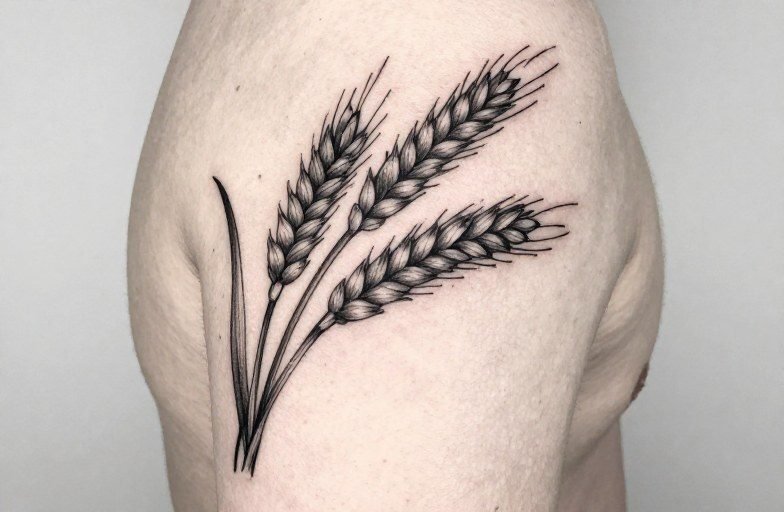
Wheat tattoos symbolize abundance and the harvest cycle, but the meaning runs deeper than prosperity. The grain also represents endurance through difficult seasons, nourishment given and received, and respect for agricultural roots. For many, it serves as a quiet nod to family farming history or a personal reminder that growth requires patience and hardship.
Symbolism & History
Agricultural and Seasonal Meanings
Wheat follows a predictable cycle: planting, dormancy, growth, harvest, and replanting. This mirrors human experience in ways that feel grounded rather than abstract. The dormant winter phase matters as much as the golden field; the tattoo can acknowledge that struggle and waiting are part of any productive life.
Common symbolic associations include:
- Abundance and prosperity, the literal harvest, food security, reward for labor
- Resurrection and renewal, the grain that dies to produce more grain, often linked to ancient Mediterranean and European folklore
- Humility and sustenance, wheat is staple, not luxury; the tattoo rejects flashier status symbols
- Time and mortality, the sickle or scythe paired with wheat references the “grim reaper” harvest motif, but also natural life cycles
Religious and Cultural Threads
Wheat appears across traditions. In ancient Greek and Roman contexts, it was commonly associated with grain goddesses like Demeter and Ceres. Some trace it to early mystery cults where the agricultural cycle mirrored spiritual initiation. In Christian iconography, wheat connects to the Eucharist and the “bread of life” metaphor. Slavic and Baltic folk art often incorporated wheat sheaves in harvest rituals and protective embroidery. The tattoo draws on any or none of these; the visual language is flexible enough to carry personal weight without requiring orthodox belief.
Common Variations & Styles
Single Stalk vs. Sheaf
A single wheat stalk reads as delicate, personal, almost whispered. The sheaf, multiple stalks bound together, carries collective weight: family, community, accumulated effort. The sheaf also provides more visual density for larger placements and allows for natural bundling that frames other elements.
Accompanying Elements
Artists frequently pair wheat with:
- Sickles or scythes, adding edge, mortality, or labor acknowledgment
- Wildflowers or poppies, field context, color contrast, seasonal specificity
- Script or dates, memorial pieces, farm establishment years, birth dates
- Birds or insects, barn swallows, bees, grasshoppers that share the habitat
- Geometric containers, circles, triangles, or vases that formalize the organic lines
Linework vs. Shading Approaches
Clean single-needle linework captures wheat’s architectural quality, the parallel veins, the segmented stem, the herringbone pattern of the grain head. This style ages well on flat skin areas where lines won’t blur into each other. Heavier blackwork or dotwork shading can create volume and shadow, suggesting sun angle or the weight of a mature head bending the stalk. Watercolor backgrounds behind structured wheat stalks remain popular but require maintenance; the soft edges fade faster than the linework defining the grain itself.
Best Placements
Wheat’s vertical form suits narrow spaces naturally. The forearm outer or inner side runs with the grain’s growth direction. Ribs follow the body’s own organic lines, though the curvature there challenges artists to adjust the stalk angle so it doesn’t read as bent or broken. Behind the ear, a single simplified stalk works as a micro-piece; the area’s limited real estate forces reduction to essential lines.
For sheaves or compositions with additional elements, the upper arm (front or outer), thigh front or side, and calf provide adequate canvas. The shoulder blade accommodates spreading arrangements, stalks fanning outward from a central bind. Foot and hand placements are possible but problematic; both areas shed ink rapidly due to friction and skin turnover, and wheat’s fine lines blur within a few years.
Consider skin tone with wheat’s typical palette: golden yellows and warm browns show clearly on lighter skin, while on deeper skin tones, artists often rely more on black and grey contrast, or use bolder, more saturated earth tones that hold visibility. A skilled artist adjusts value ranges rather than simply transferring a light-skin reference design.
Who Chooses This Tattoo / Personal Meanings
The wheat tattoo attracts people with direct agricultural connections, farm-raised individuals, agricultural students, viticulture workers who understand the seasonal rhythm intimately. But the design also resonates with those who’ve never touched soil: urban people reclaiming family farming roots several generations back, or anyone who identifies with the metaphor of planting, waiting, and eventual reward.
Some choose wheat after significant hardship, illness recovery, career collapse and rebuilding, relationship endings that forced self-sufficiency. The grain’s requirement of winter dormancy before spring growth validates that unproductive periods aren’t wasted. Others select it for dietary or environmental values: visible commitment to plant-based eating, sustainable agriculture, or local food systems.
Memorial wheat tattoos bind the deceased to cycles of return and nourishment. A birthdate or initials tucked among the stalks keeps the person present without the explicit sentimentality of angel wings or hearts. The grain’s practicality suits those who find overt grief imagery uncomfortable.
Similar Symbols
People considering wheat often also look at:
- Barley or rye, similar visual language, more specific regional associations (Scotch whisky heritage, Nordic brewing traditions)
- Corn/maize, stronger American indigenous and agricultural history, broader leaves, more tropical visual weight
- Lavender, another vertical, aromatic crop, but carrying Provence and calm associations rather than sustenance
- Poppy, shares field context, adds remembrance and sleep symbolism, offers red color contrast
- Oak leaves or acorns, similar endurance and patience themes, but woodland rather than field ecology, slower growth cycle
Each alternative shifts the ecological and cultural setting. Wheat occupies the cultivated middle ground, not wild like oak, not ornamental like lavender, not politically charged like corn can be. Its domestication thousands of years ago makes it feel ancient and foundational rather than trendy.
Final Thoughts
A wheat tattoo succeeds when the specific execution matches the specific intention. A single-needle stalk behind the ear carries different weight than a bold sheaf across the shoulder. The design’s strength is its interpretive range, prosperity or hardship, individual or collective, religious or secular, grounded by the biological reality of a plant that feeds billions. Choose an artist who understands botanical structure; the slight curve of a mature head, the precise angle of awns, the way stems segment at nodes. Generic “plant” tattoos look like generic plants. Wheat, rendered accurately, looks like wheat, and that specificity is what makes the symbolism feel earned rather than borrowed.
Frequently Asked Questions
Does a wheat tattoo always mean farming heritage?
No. While agricultural connections are common, many people choose wheat for its broader symbolism of patience, renewal, or surviving difficult periods. The meaning depends on what the individual connects to, not just literal farming experience.
How well do wheat tattoos age over time?
Fine linework of single stalks can blur after 5-10 years, especially on high-movement areas like wrists or ankles. Slightly bolder lines and occasional touch-ups help maintain the grain head’s distinctive shape. Shading tends to soften faster than clean outlines.
Can wheat tattoos work in color, or is black and grey better?
Both work, but color choices should account for skin tone. Golden yellows and warm browns show well on lighter skin; on deeper skin, artists often use richer, more saturated earth tones or rely on black and grey for longevity. Color in wheat tattoos typically fades faster than in designs with heavier black saturation.
What’s the difference between wheat and barley in tattoo symbolism?
Visually, barley has a longer, more slender awn and often grows in wilder formations. Symbolically, wheat dominates as the global bread grain, while barley carries stronger associations with brewing, animal feed, and cooler northern climates. The choice often comes down to family tradition or personal preference rather than dramatic symbolic divergence.
Related Tattoo Meanings
- Barn Owl Tattoo Meaning: Mystery, Wisdom Silent Flight
- Yellow Rose Tattoo Meaning: Friendship, Joy New Beginnings
- Yhwh Tattoo Meaning: Sacred Name Ink Symbolism
- Explore more









