
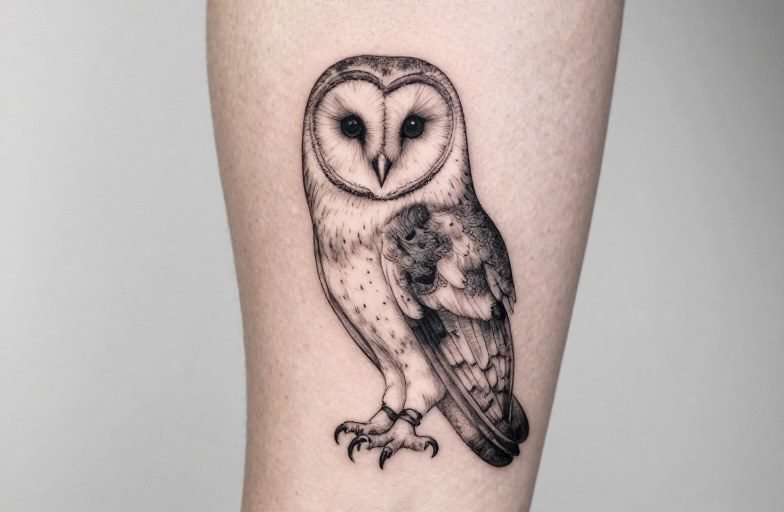
Barn owl tattoos most commonly symbolize intuition, mystery, and the ability to navigate darkness, both literal and metaphorical. Unlike the generic “wise owl” trope, the barn owl specifically carries associations with silence, stealth, and the liminal space between life and death due to its ghostly appearance and nocturnal habits. For many, the design functions as a personal emblem of seeing clearly when others cannot, or of moving through difficult periods without fanfare.
Symbolism & History
The Ghost Owl: Death, Transition, and the Unseen
Barn owls have long been linked to death and the spirit world across multiple cultures, though these connections vary significantly. In British folklore, the bird was often called the “ghost owl” or “demon owl”, its heart-shaped face, pale plumage, and habit of nesting in church belfries and abandoned barns made it an uncanny presence. Hearing a barn owl’s screech (not a hoot) was commonly interpreted as an omen. Some trace this association to the owl’s role as a rodent hunter near human habitation; where grain stores attracted mice, barn owls followed, and human death often followed famine or plague.
In contrast, ancient Egyptian symbolism often linked owls generally to guardianship of the afterlife, while some Indigenous traditions of the Americas viewed the barn owl as a protector against evil spirits rather than a harbinger of doom. The key for tattoo wearers is recognizing which thread resonates: the owl as psychopomp guiding souls, or as silent guardian watching from the shadows.
Intelligence Without Noise
The barn owl’s hunting method distinguishes it symbolically from other owl species. Where great horned owls rely on power and intimidation, barn owls are specialized for complete silence, fringed flight feathers muffle sound entirely. This biological fact translates into tattoo symbolism about quiet competence, strategic patience, and effectiveness without self-promotion. Someone who has survived professional or personal challenges through persistence rather than aggression often gravitates toward this specific species over more aggressive raptor imagery.
Common Variations & Styles
Realistic vs. Stylized Approaches
Realistic barn owl portraits emphasize the bird’s most distinctive feature: the heart-shaped facial disc of feathers that functions as a sound-collecting antenna. Fine-line single-needle work captures this structure well, though it requires an artist experienced in animal portraiture to avoid a generic “bird of prey” look. The pale coloration, white to buff with subtle speckling, presents a challenge: without sufficient contrast, healed tattoos can appear muddy or washed out within 2-3 years.
Neo-traditional and illustrative styles solve this by exaggerating the dark eyes (which appear black but are actually dark brown) and using deep navy or violet shadows in the facial disc. Blackwork versions often focus on the silhouette in flight, wings spread in that characteristic shallow V-shape, which reads immediately as barn owl rather than generic owl.
Common Companion Imagery
- Moon phases: Directly references nocturnal habits; crescent moons pair well with the owl’s hunting posture.
- Keys or locks: Plays on the “keeper of secrets” interpretation, though this has become somewhat common.
- Barbed wire or fence posts: Grounds the image in agricultural settings, referencing actual barn owl habitat; works well in American traditional style.
- Skulls or hourglasses: Leans into the death-symbolism thread; requires careful composition to avoid appearing like a metal album cover.
- Botanical elements: Wheat, corn stalks, or wild grasses connect to the barn owl’s hunting grounds and soften the potentially ominous tone.
Best Placements
Forearms and outer upper arms remain the most common placements for barn owl tattoos, allowing sufficient space for the facial disc to read correctly, minimum 3-4 inches in diameter for recognizable detail. The bird’s natural posture in flight (wingspan roughly 3.5 times body length) makes it well-suited to chest pieces spanning pectoral muscles, though this requires the head to be positioned carefully to avoid awkward distortion across the sternum.
Thighs and calves offer excellent canvas for the perched variant, talons gripping a branch or post, which many find symbolically appropriate, grounded watchfulness rather than active hunting. Ribs and sternum placements work for smaller, more graphic interpretations but sacrifice the detail that makes a barn owl identifiable as this species.
One practical consideration: the pale colors that define this owl (white, cream, light tan) are among the fastest-fading pigments, particularly on areas with high sun exposure like forearms. Expect significant softening within 5-7 years without touch-ups and diligent sun protection. Black-and-grey versions with heavy contrast age more predictably.
Who Chooses This Tattoo / Personal Meanings
The Silent Survivor
People drawn to barn owl tattoos often describe themselves as observers rather than performers, individuals who process information before acting, who have learned that loud responses rarely serve their interests. This isn’t necessarily introversion; many report high-stakes professional roles where discretion matters. The tattoo functions as a private acknowledgment of a skill set that doesn’t advertise itself.
Connection to Specific Loss
For some, the barn owl’s association with death translates into memorial function without the explicit sentimentality of names, dates, or angel imagery. The bird’s role as a nocturnal sentinel, watching, waiting, present but unseen, maps onto the experience of grief that doesn’t resolve cleanly but integrates into ongoing life. This interpretation has grown more common as explicit religious memorial imagery has declined in popularity.
Rural or Agricultural Roots
Actual exposure to barn owls remains geographically concentrated, open farmland, grasslands, marsh edges in temperate zones. People with childhood connections to these landscapes sometimes choose the tattoo as specific habitat memory rather than abstract symbolism. The distinction matters: a barn owl chosen for lived experience carries different weight than one selected from image search results.
Similar Symbols
Great horned owl tattoos share the wisdom association but carry more aggressive, dominant energy, tufted “ears,” heavier body, more confrontational posture. Snowy owl tattoos overlap in pale coloration but symbolize endurance and stark beauty rather than stealth; they’re also significantly less common in tattoo culture due to the Harry Potter association feeling dated.
Raven and crow tattoos occupy adjacent symbolic territory (death, mystery, intelligence) but with more explicit trickster or messenger-of-the-gods framing. The barn owl’s silence distinguishes it, corvids are vocal, social, visible. For someone wanting to emphasize solitude or unseen observation, the barn owl offers cleaner symbolic separation.
Moth tattoos, particularly death’s-head hawkmoths, share the nocturnal death-association but with more overt gothic styling. The barn owl maintains a foot in the agricultural and natural-history world that keeps it from reading as purely occult.
Final Thoughts
Barn owl tattoos reward specificity. The generic “owl wisdom” reading misses what makes this species distinctive: the silent flight, the ghostly pallor, the scream instead of the hoot, the church-belfry nesting habit that seeded centuries of unease. If you’re drawn to the biological fact of its hunting silence or the folkloric weight of its death-associations, the design works best when it carries personal substance beyond the image itself.
Work with an artist who understands animal anatomy well enough to capture the facial disc structure, this single feature separates barn owl from generic owl in portraiture. Consider how pale pigments will age on your chosen placement. And recognize that this tattoo, perhaps more than others, will prompt questions about meaning; the image itself invites interpretation, for better and for worse.
Frequently Asked Questions
Does a barn owl tattoo always mean death or something ominous?
Not necessarily. While the barn owl carries death associations in some European folklore, many people choose it for silence, intuition, or agricultural roots. The meaning depends entirely on which symbolic thread you emphasize and your personal connection to the image.
How well do the pale colors in barn owl tattoos hold up over time?
White and cream pigments fade faster than darker colors, especially on sun-exposed areas. Expect noticeable softening within 5-7 years without touch-ups. Black-and-grey versions with strong contrast typically age more reliably while maintaining the species’ recognizable structure.
What’s the difference between a barn owl tattoo and a regular owl tattoo?
The barn owl has a distinctive heart-shaped facial disc, pale plumage, and dark eyes, features that require specific technical skill to render correctly. Symbolically, barn owls emphasize silence, stealth, and liminal spaces, whereas generic owl tattoos lean harder into broad “wisdom” associations without the same death or nocturnal hunter connotations.
Is there a best style for a barn owl tattoo to look recognizable?
Neo-traditional and illustrative styles handle the barn owl’s distinctive features well by exaggerating contrast. Fine-line realism works but demands larger size minimums and expert execution. Blackwork silhouettes in flight are immediately readable due to the species’ characteristic wing shape and shallow flight profile.
Related Tattoo Meanings
- Straight Line Tattoo Meaning: Symbolism, Styles Why People Get It
- 17+ Bee Tattoos That Carry More Meaning Than They Look
- Billie Eilish Back Tattoo Meaning: Dragon Symbolism Explained
- Explore more









