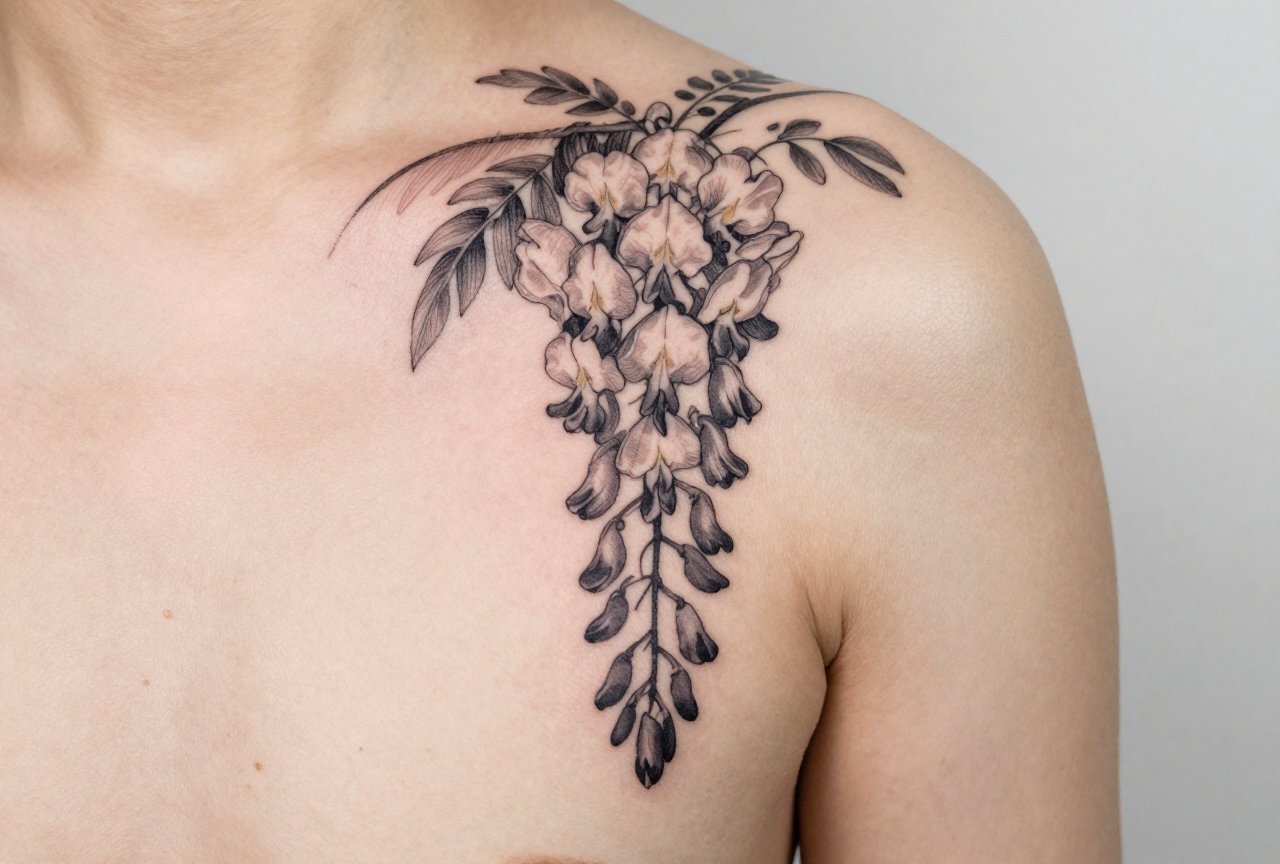
A wisteria tattoo carries layered meaning rooted in devotion, longevity, and the bittersweet beauty of things that don’t last forever. The vine itself clings and grows for decades, sometimes over a century, yet its flowers drop within weeks. That tension between endurance and transience is what draws people to it. I’ve tattooed wisteria on clients who just lost someone, who just survived something, or who simply fell in love with the color purple spilling down a trellis in their grandmother’s garden.
Symbolism & History
What the Vine Itself Represents
Wisteria doesn’t mess around. It twists, it grips, it outlives the structure it grows on. In Japanese culture, the fuji flower has signified longevity and resilience for centuries. I’ve had clients point to their forearm wisteria and say, “This is for my marriage. Twenty years and we’re still climbing.” The vine’s physical behavior, needing support but ultimately dominating it, mirrors how we lean on people and eventually grow strong enough to hold our own weight.
The drooping clusters carry their own language. They hang heavy, almost weeping, which reads as romantic longing or quiet mourning depending on the person wearing it. Purple wisteria specifically ties to nobility and spiritual growth in East Asian traditions. I did a piece last year where we worked deep violet into near-black shadow, and the client told me it was for her sobriety, eight years, and she finally felt like she was blooming downward, releasing instead of striving upward.
Cultural Layers You Should Know
There’s a darker thread too. In some Japanese folklore, wisteria can signify caution or even warning, its beauty is overwhelming, almost suffocating when untended. The Wisteria crest appears on samurai armor, not for delicacy but for tenacity. When someone asks for wisteria in my chair, I ask what drew them to it. The answer almost always reveals which symbolism they’re actually carrying: the romantic, the mournful, or the stubborn.
- Chinese tradition: wisteria represents youth and vitality, often given to young women
- Japanese hanakotoba (flower language): passionate love, devotion, and sometimes “welcome”
- Victorian floriography: “my love is over you,” suggesting affection that overshadows
- Modern Western adoption: resilience, survival, and personal transformation
Common Variations & Styles
Color vs. Black and Grey
Color wisteria hits different. The purple shifts from lavender to deep violet to almost blue depending on the light, and that gradient work separates a decent tattoo from one that makes people stop mid-conversation. I use a lot of magenta and white ink mixed into the purple for that fresh, just-opened look. Black and grey wisteria, though, ages cleaner. The fine lines of individual petals hold up better without color bleeding, and the contrast between deep black vine and grey-wash flowers can look stunning on darker skin tones where purple might muddy.
Watercolor style is popular for wisteria, but I warn clients: that soft, bleeding-edge look requires maintenance. After five years, those “splash” effects often look like blowout or fading rather than intentional art. I’ve seen too many watercolor pieces turn into expensive cover-ups. If you want the soft look, consider a hybrid, defined linework for the vine and petals, with controlled color washes behind.
Compositional Approaches
- Cascading down the arm or leg: follows the body’s natural lines, emphasizes the “falling” symbolism
- Wrapping a wrist or ankle: the vine’s circular growth pattern mirrors the placement
- Single cluster as focal point: often paired with a name, date, or small creature like a bee or butterfly
- Full back piece with architecture: trellis, gate, or Japanese torii framing the blooms
One of my favorite pieces was a wisteria vine starting at a woman’s hip, climbing her ribcage, with the densest cluster sitting right below her collarbone where she could see it in the mirror. She’d survived breast cancer. The vine covered her scar tissue. That’s the kind of placement that means something beyond aesthetics.
Best Placements
Wisteria’s natural shape determines where it works. The hanging clusters need vertical space. Horizontal placements across shoulders or lower back fight the imagery and tend to look like purple blobs within a few years. I’ve tattooed wisteria on:
- Outer forearm: visible, good length for cascading clusters, easy to show or hide
- Side of the thigh: enough real estate for detail, the curve complements the droop
- Behind the ear trailing to neck: delicate, but requires touch-ups as the area blurs
- Foot and ankle: classic vine placement, though feet heal rough and fade fast
- Full sleeve component: wisteria transitions beautifully into other floral work
Ribcage placement hurts. I won’t sugarcoat that. The skin stretches, breathes, and sits thin over bone. But the wisteria symbolism, endurance through discomfort, makes the ribcage almost too perfect for some clients. One guy I tattooed sat for six hours on his ribs, didn’t flinch, told me his wisteria was for his daughter born premature, clinging to life like the vine clings to brick. You don’t forget sessions like that.
Who Chooses This Tattoo / Personal Meanings
There’s no single wisteria person. I’ve tattooed it on a nineteen-year-old who’d never seen real wisteria but loved the anime Demon Slayer (the Wisteria family features prominently). I’ve tattooed it on a seventy-three-year-old whose Georgia porch was shaded by a vine planted by her great-grandmother. The meaning shifts with the wearer.
Common threads I hear in consultation:
- Memorial work, wisteria blooming over a date or name
- Recovery markers, the vine’s persistence through harsh seasons
- Romantic commitment, couples getting matching pieces, though I always side-eye matching tattoos
- Adoption or found family narratives, “this grew where I planted myself”
- Simple aesthetic pull, sometimes the meaning is “I think it’s beautiful,” and that’s enough
A client last month told me her wisteria was for “the year I stopped apologizing for taking up space.” The vine’s aggressive growth, its refusal to stay small, resonated with her. That’s not traditional symbolism, but it’s real. Personal meaning always overrides dictionary definitions in tattoo work.
Similar Symbols
If wisteria speaks to you but doesn’t quite fit, consider these alternatives I’ve suggested in consultations:
- Cherry blossom: similar Japanese floral tradition, more explicitly about mortality and the fleeting nature of beauty
- Grape vine: Western equivalent of clinging, fruit-bearing vine, more associated with abundance and celebration
- Ivy: loyalty and attachment, but without the blooming payoff, more understated
- Wisteria’s cousin, the laburnum: golden hanging clusters, similar growth habit, less common in tattoo work so more distinctive
- Trumpet vine or honeysuckle: native alternatives with similar cascading forms, good for clients wanting American flora
I once talked a client out of wisteria and into native Virginia creeper because she wanted something that grew wild where she was from. The meaning wasn’t in the flower language anymore, it was in the specific creek bank she walked as a kid. Good tattoo work should be that specific.
Final Thoughts
Wisteria tattoos work because they’re beautiful and because that beauty is complicated. The vine doesn’t symbolize one clean thing. It means devotion and suffocation, longevity and brief blooming, romance and the weight of memory. When someone sits in my chair asking for wisteria, I don’t just pull up reference photos. I ask where they’ve seen it grow, who they were with, what season of life they’re in. The best wisteria tattoos carry all that specificity in the petals.
If you’re considering one, spend time with the actual plant if you can. Watch how it behaves in wind, how heavy the clusters feel, how aggressively it reclaims abandoned structures. Your tattoo should feel like that lived observation, not like a Pinterest board. Bring your artist stories, not just pictures. The difference between a pretty wisteria tattoo and one that matters is whether the person wearing it can tell you why this vine, why this placement, why now.
Frequently Asked Questions
Does wisteria tattoo meaning change if I get it in pink instead of purple?
Pink wisteria exists in cultivation but carries less traditional symbolism. Purple dominates the cultural associations, though personal meaning always overrides color conventions. If pink resonates with you specifically, that’s your meaning.
Will a wisteria vine tattoo look good as I age?
The fine petal details will soften over time, which actually suits wisteria’s natural, slightly blurred appearance. Bold vine lines anchor the design. I generally recommend thicker main stems with finer cluster details for longevity.
Can wisteria work in a small tattoo, or does it need to be large?
Small wisteria is tricky, individual flowers are tiny, and at miniature scale they blur into purple blobs. I suggest at least palm-sized for a single cluster, or consider just the vine with minimal bloom if you want something smaller.
Is it culturally appropriative to get wisteria if I’m not Japanese or Chinese?
Wisteria grows worldwide and has been adopted into Western horticulture for centuries. The plant itself isn’t sacred or restricted. Be respectful if you’re pairing it with specifically Japanese iconography like torii gates or family crests, but the flower alone is broadly accessible.
Related Tattoo Meanings
- Vine Tattoo Meaning
- Womens Turtle Tattoo Meaning: Symbolism, Styles Personal Stories
- Yggdrasil Tattoo Meaning: Roots, Branches What It Actually Means
- Explore more