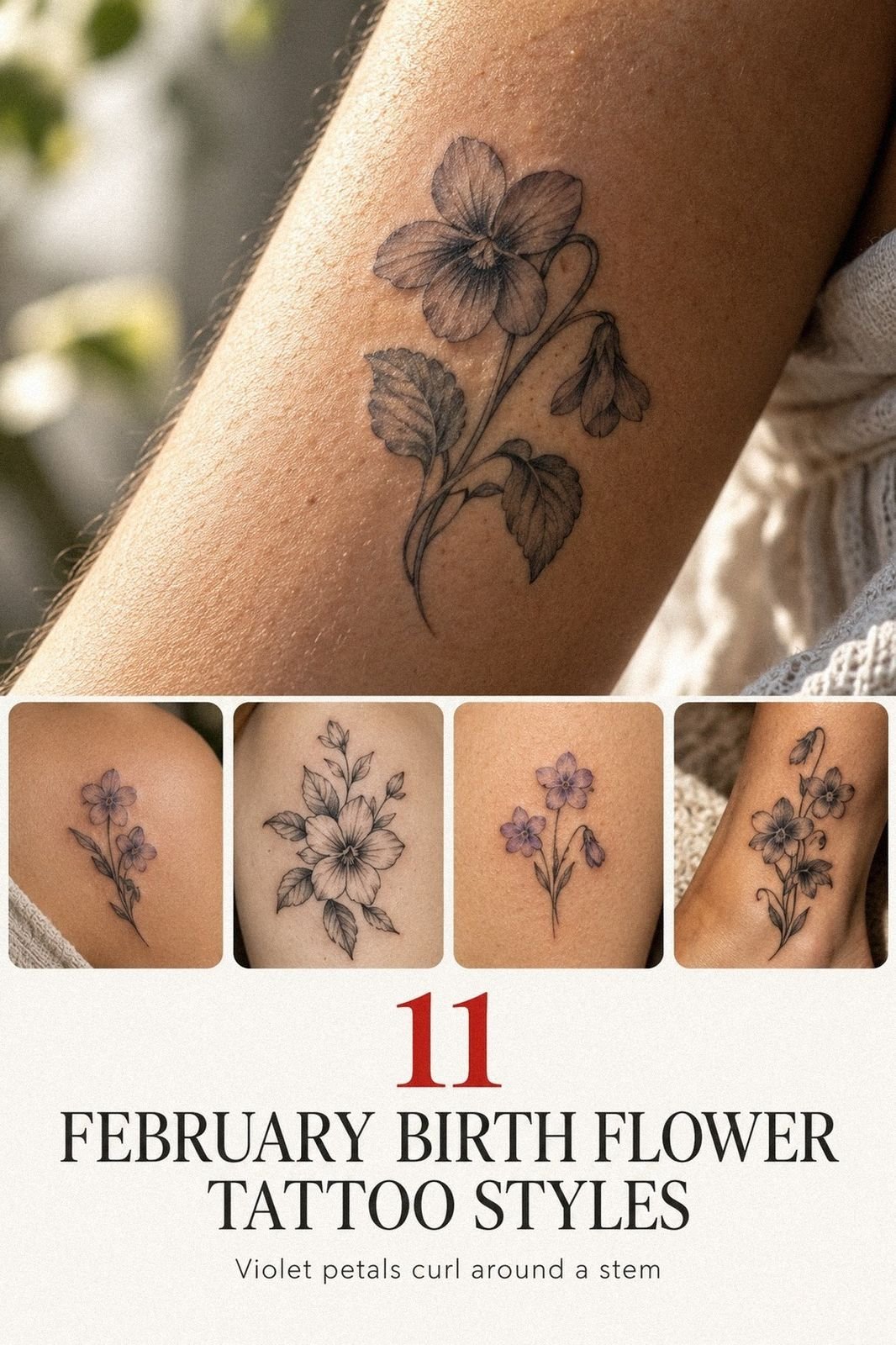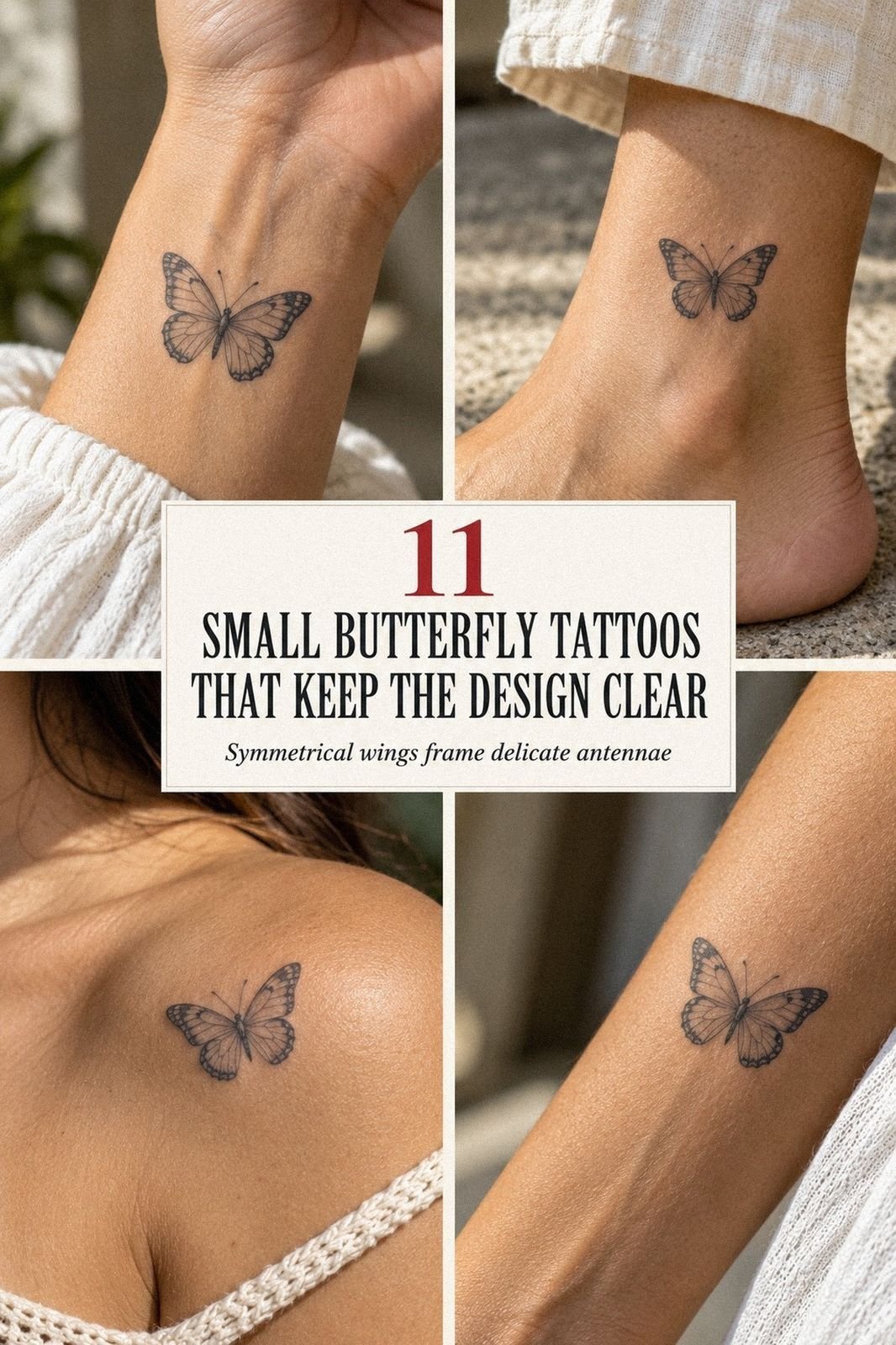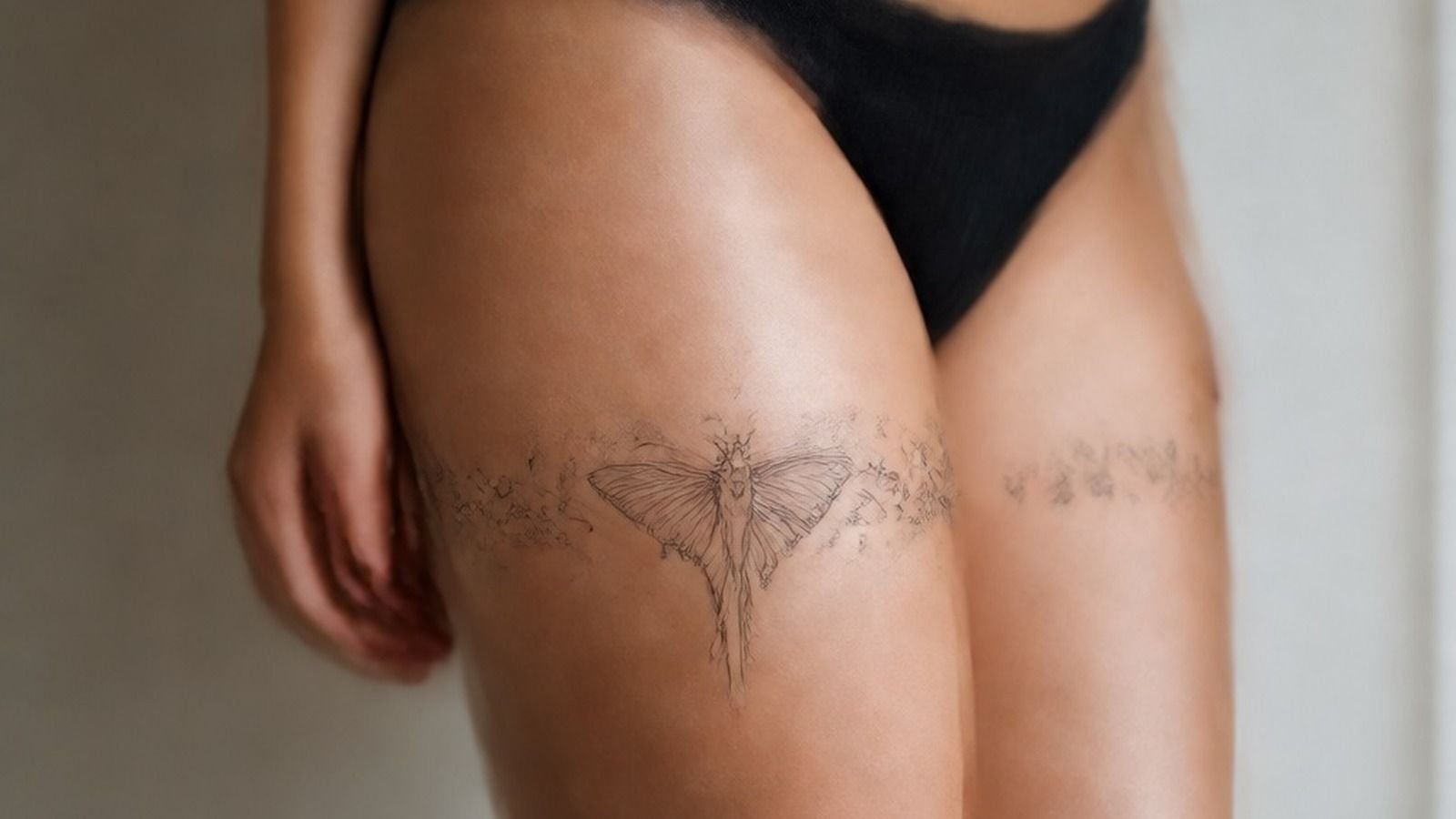
Luna moth tattoos age well when you give them clean structure, enough skin, and a placement that won’t get chewed up fast. I almost talked myself out of my first moth piece because I thought fine line meant fragile. I was wrong. If you keep the silhouette clear, size it for the body, and don’t force tiny detail into a high-wear zone, a luna moth can heal soft and still read years later. If you’re still sorting placement and scale, start with tattoo planning before you book.
- Fine Line Luna Moth Wrist Tattoo
- Blackwork Luna Moth Sternum Tattoo
- Luna Moth Forearm Tattoo With Moon Phases
- Minimal Luna Moth Behind The Ear Tattoo
- Luna Moth Spine Tattoo With Soft Shading
- Botanical Luna Moth Tattoo With Wildflowers
- Watercolor Luna Moth Shoulder Blade Tattoo
- Geometric Luna Moth Upper Arm Tattoo
- Luna Moth Thigh Tattoo With Stars
- Tiny Luna Moth Ankle Tattoo
- Neo Traditional Luna Moth Tattoo
- Luna Moth Chest Tattoo With Symmetry
- Dotwork Luna Moth Calf Tattoo
- Luna Moth Hand Tattoo With Clean Lines
- Luna Moth Rib Tattoo With Delicate Antennae
- Realistic Luna Moth Tattoo With Green Ink
- Luna Moth Collarbone Tattoo With Fine Details
- Matching Luna Moth Tattoos For Friends
- Luna Moth Tattoo With Death And Rebirth Symbolism
1Fine Line Luna Moth Wrist Tattoo
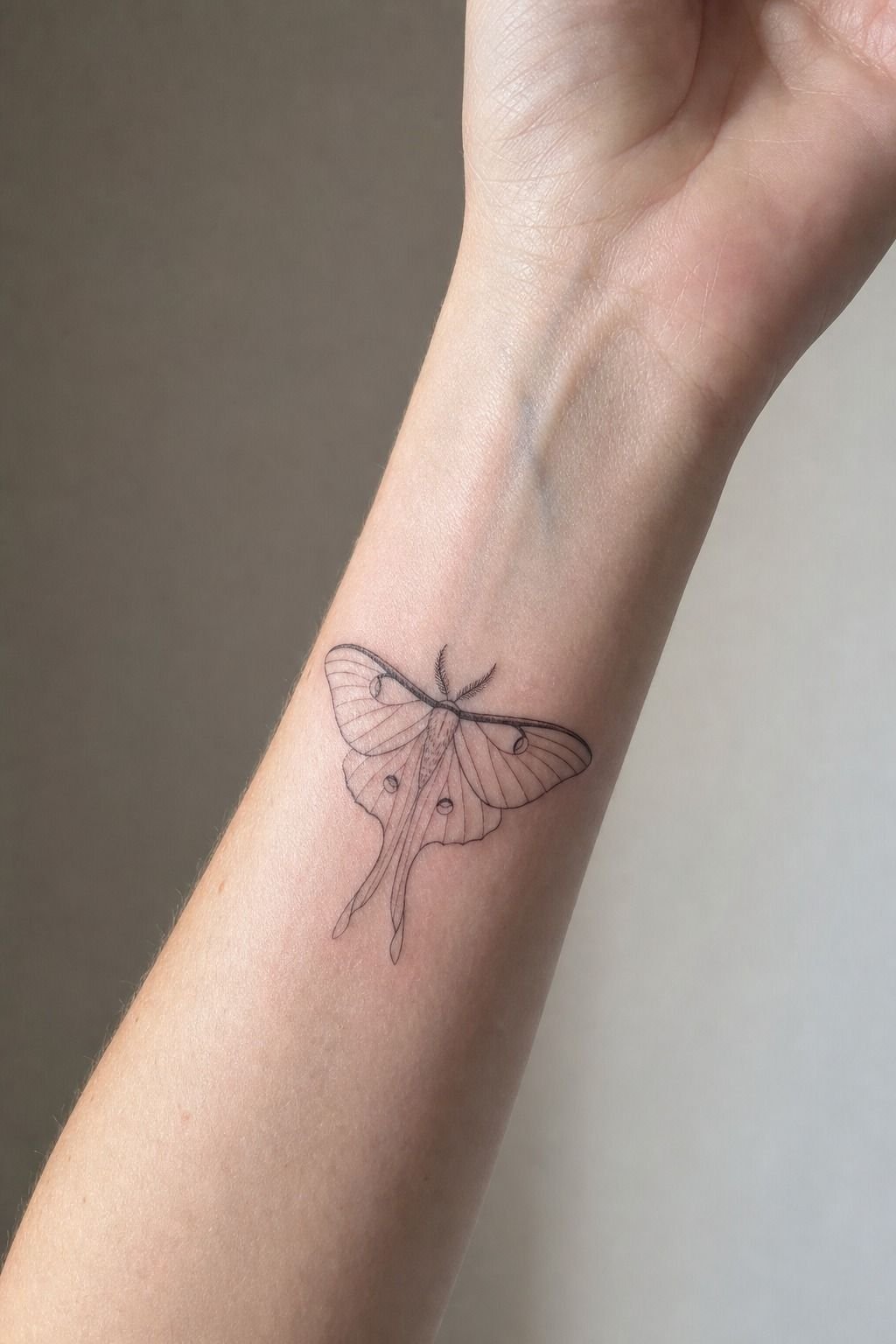
Start with the wrist only if you’re willing to size the wings a touch bigger than Pinterest wants. On fair cool-pink skin, a fine line luna moth looks clean when the outer wing edge gets one crisp pass and the body stays simple, not furry, not overloaded. I like this placement when you want a piece that peeks out under sleeves and still feels light on you.
Your best move is to keep it around 2.5 to 3.5 inches tall so the lower wings don’t collapse into soup later. Thin black linework.
Tiny crescent hints. One soft body segment. If you want more symbolism, tuck the meaning into shape instead of clutter.
A slightly longer tail reads more lunar than a bunch of extra marks. If you want the spiritual side first, read my take on small minimalist tattoos.
2Blackwork Luna Moth Sternum Tattoo
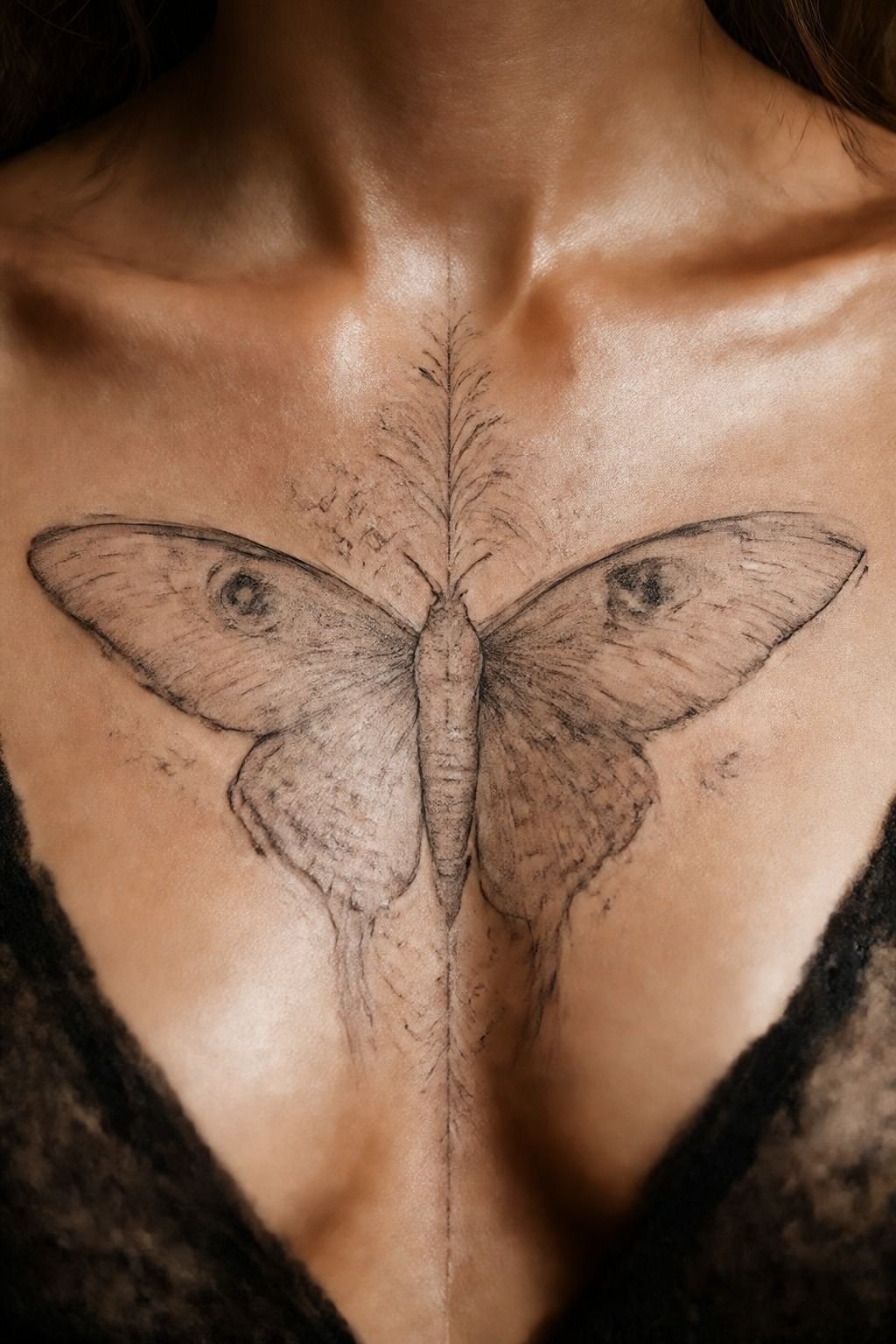
Go blackwork on the sternum when you want the moth to hit hard from the first glance.
This placement gives you drama, but it also raises the pain factor and the session time because the sternum is spicy and symmetry takes real time. If you want a tattoo that feels bold from a few feet away, this is worth it. If your money is tight and you still want strong contrast, I would move the same blackwork idea to the upper arm and compare it with cool arm tattoos.
Keep the body central, the top wings a touch heavier, and the fill blocks simple enough that the skin doesn’t get overworked. A sternum moth usually earns its keep at 5 to 7 inches, not at micro scale.
Tiny sternum blackwork can look tough fresh, then heal cramped. Bigger reads cleaner.
Much cleaner!
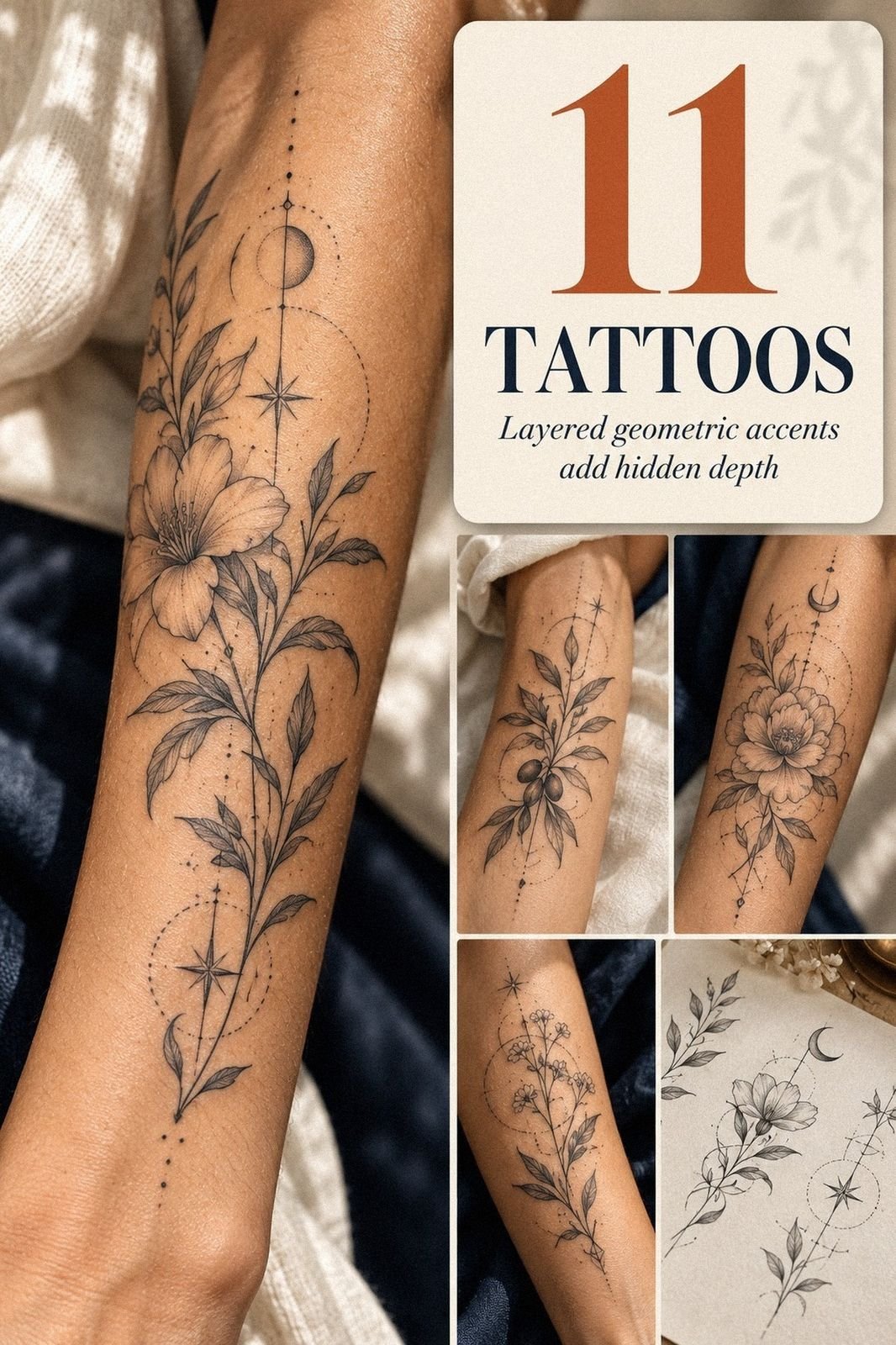
3Luna Moth Forearm Tattoo With Moon Phases
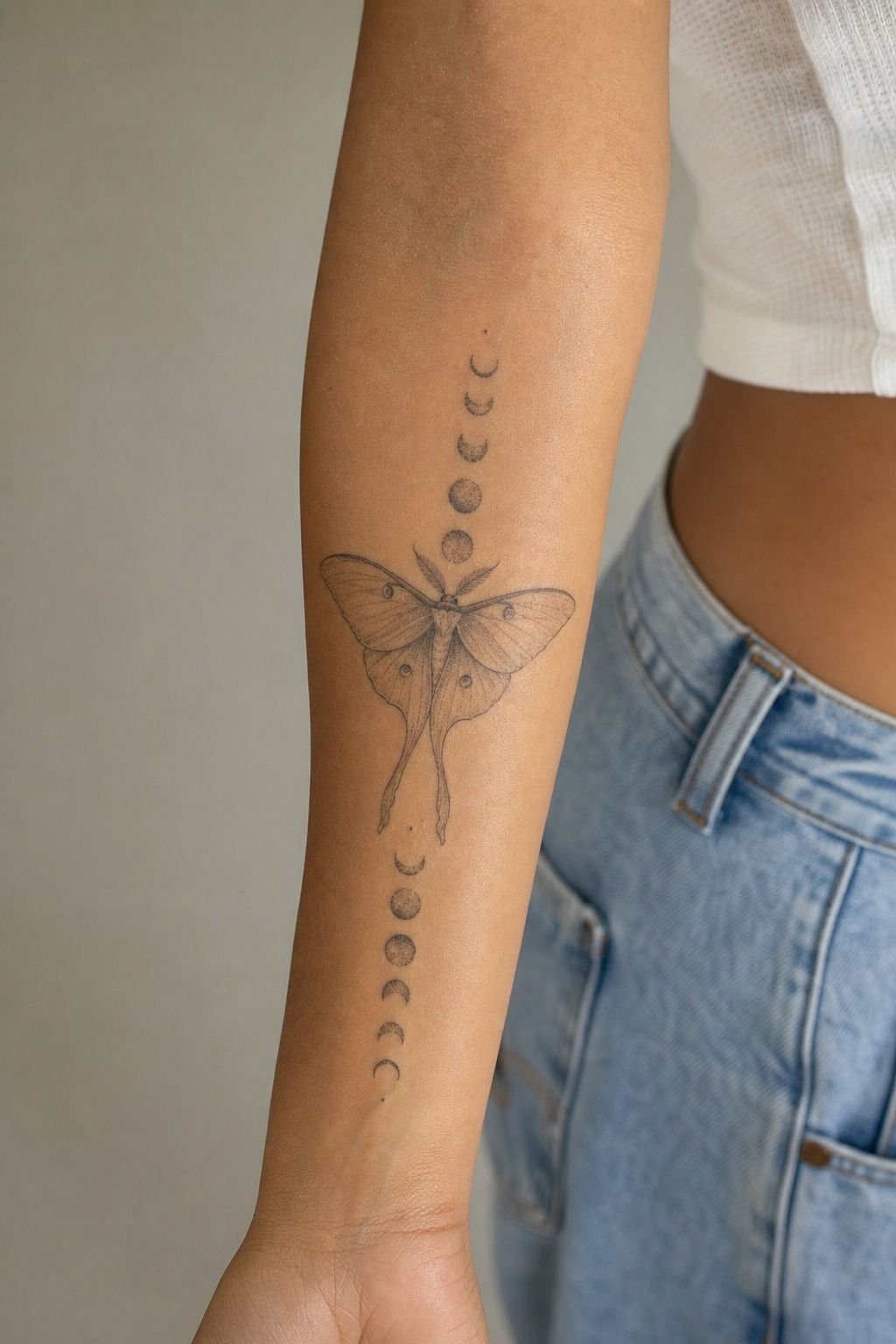
Use the forearm if you want the moth and moon phases to read like one story instead of two separate stickers. The healed look on medium olive skin works because the moth stays central and the phases track vertically without crowding the antennae.
That is the kind of layout that heals nice. You see the whole thought fast.
I would keep the full run around 4 to 6 inches so each moon phase gets breathing clearance and the moth still leads. Grey wash works best when it stays whisper-soft. The forearm is one of my favorite first-tattoo placements because it’s lower on the pain scale than ribs, feet, or sternum.
It’s also smarter payoff because the wear is calmer and touch-ups is usually lower than high-friction placements. If you’re building the symbolism side first, compare this setup with tattoo ideas by placement.
4Minimal Luna Moth Behind The Ear Tattoo
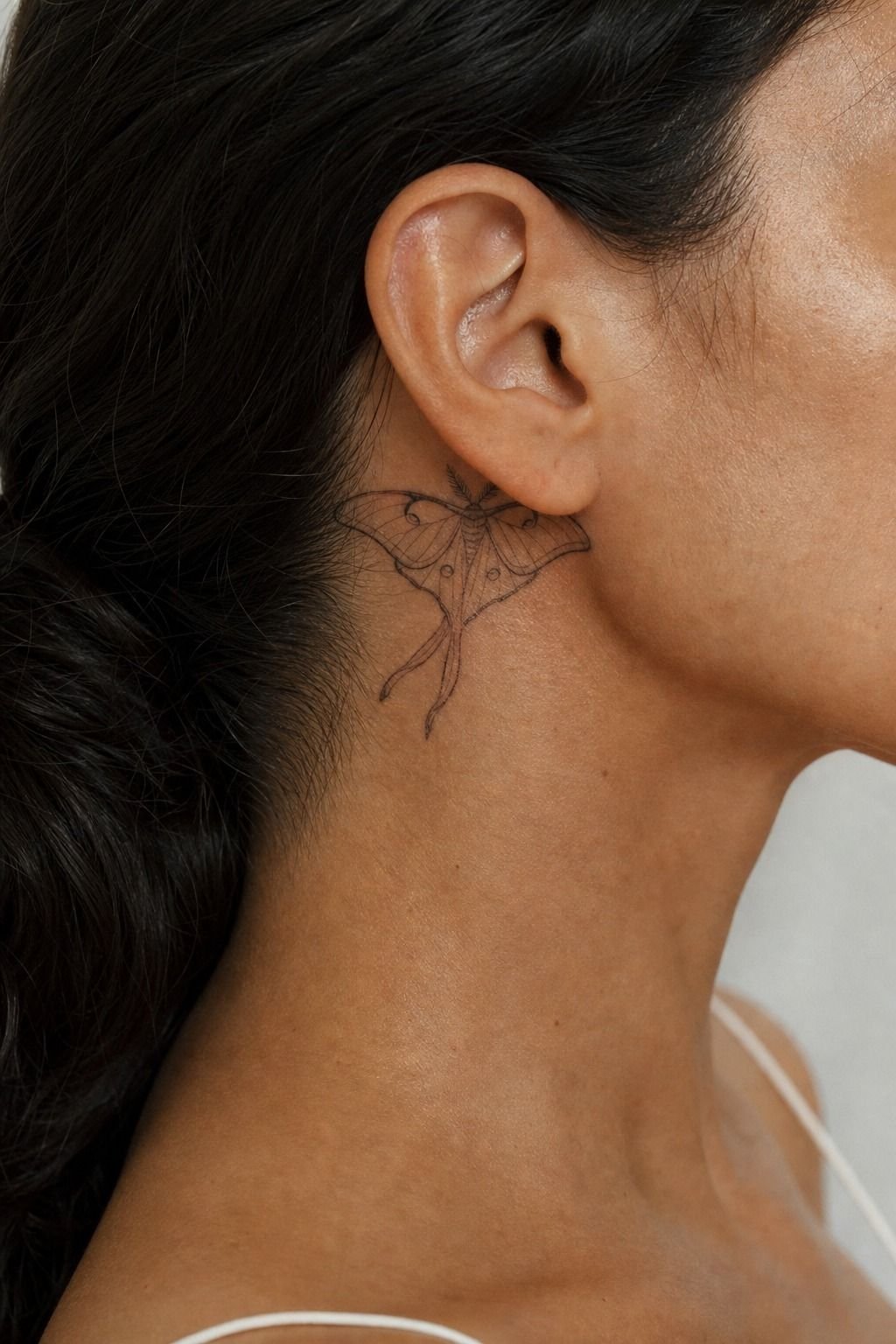
Choose behind the ear only if you love subtle placement more than long-term crispness. It looks slick on golden tan skin because the curve of the body follows the anatomy and the wings can angle with the hairline. But tiny behind-the-ear tattoos don’t forgive indecision.
If you go too small, the antennae and lower tails blur first.
But you want a stripped-down moth here. Think 1.5 to 2 inches, no extra stars, no script, no fake watercolor cloud.
One clean pull on the outer wing, then let open skin do the rest. This is also a friction zone from hair products, sun, and daily touch, so you need to baby it the first 2 to 3 weeks. Wash gentle, keep ointment thin, and don’t suffocate it.
Simple wins here. Really wins! If you like neck-adjacent placements, side neck tattoo ideas help you judge how much detail survives in that area.
5Luna Moth Spine Tattoo With Soft Shading
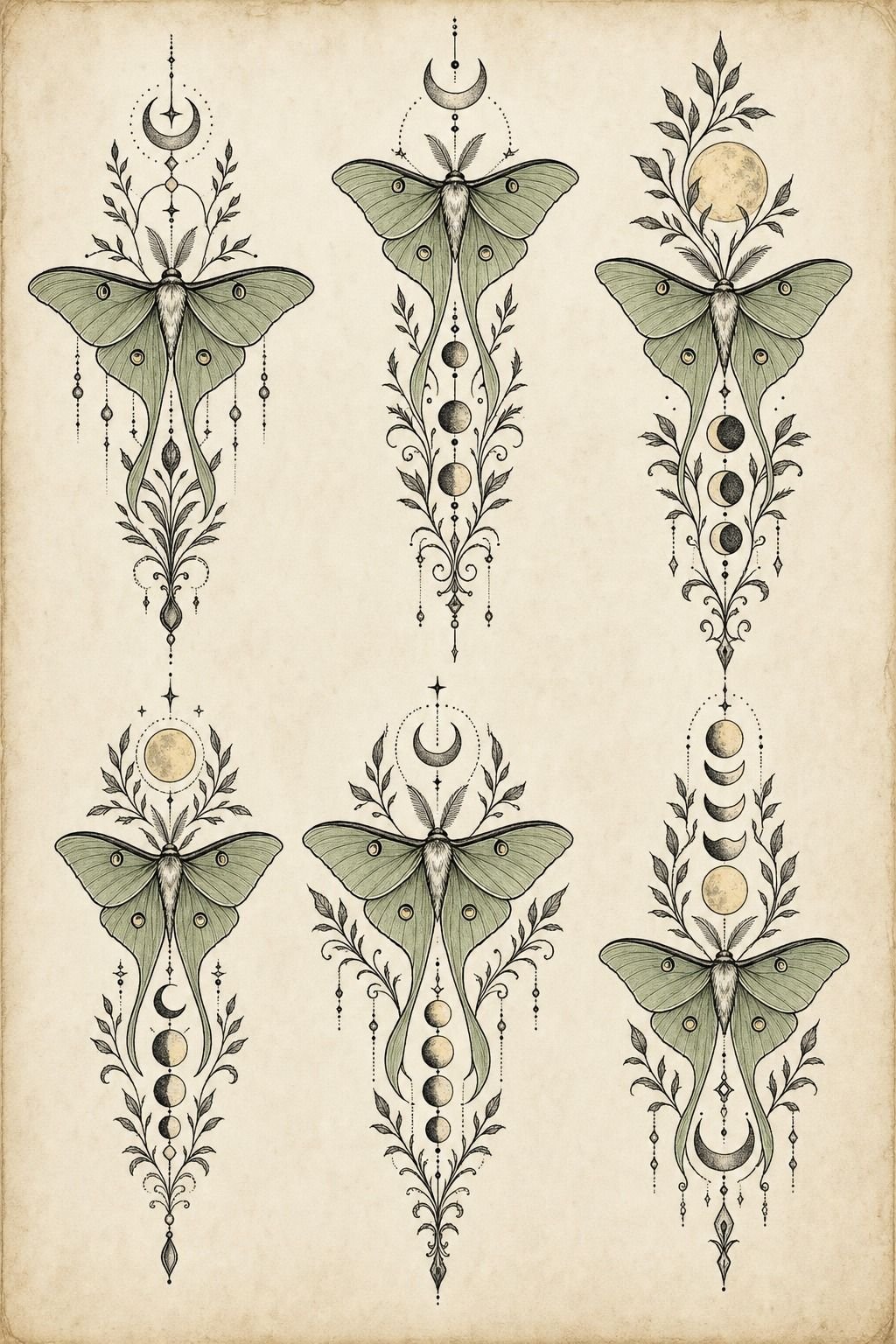
Build a spine moth from a flash-sheet mindset even if you’re commissioning it custom.
6Botanical Luna Moth Tattoo With Wildflowers
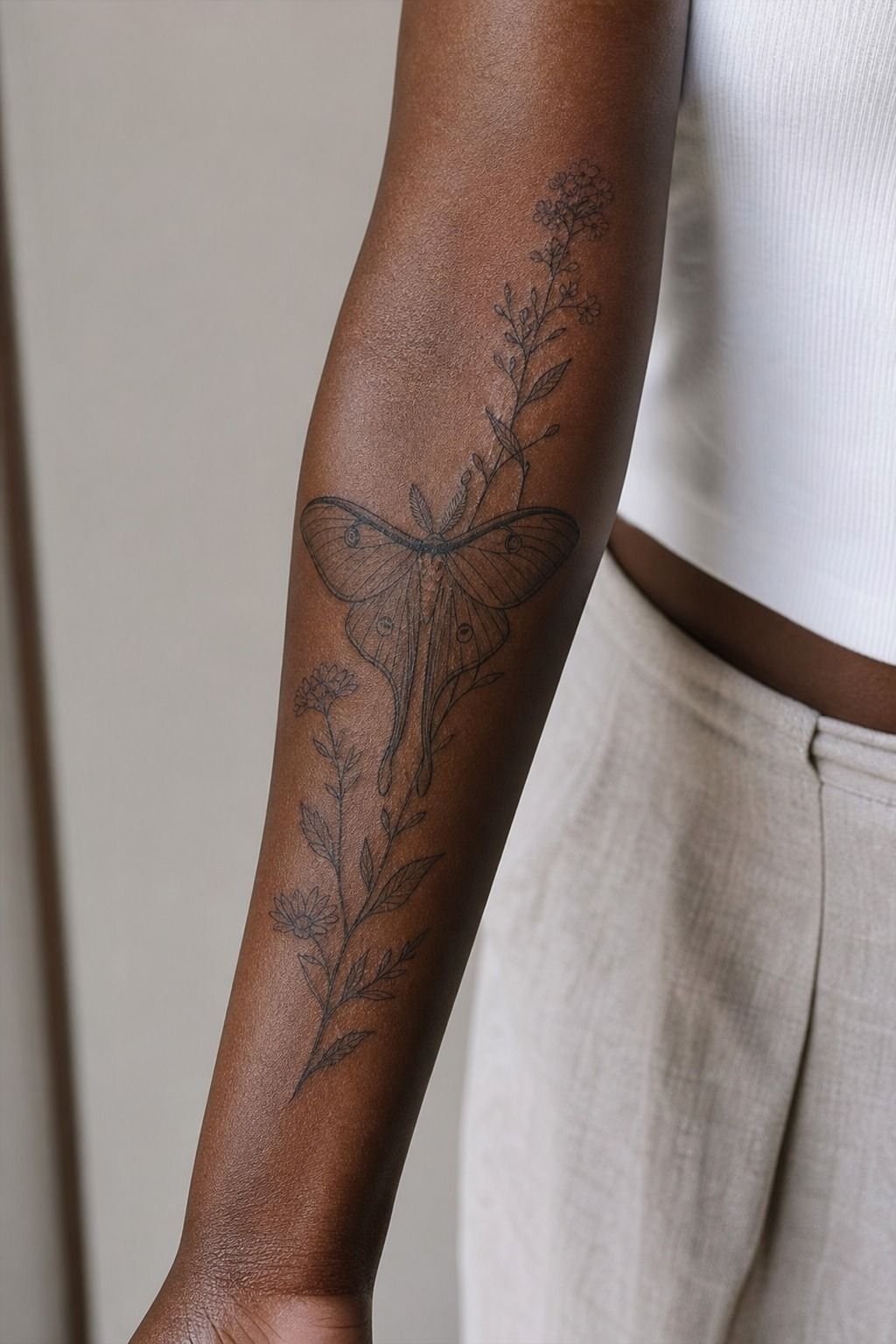
Layer wildflowers only if the flowers support the moth instead of swallowing it. On deep ebony skin, this kind of forearm tattoo looks best when the moth stays the hero and the stems give you movement around it. Think Eternal Ink Lining Black for the structure, then fine botanical lines that stay open, airy, and easy to read.
But I like using two or three wildflowers at most. A daisy shape, a small sprig, maybe one bell flower.
That is it. If you let every petal compete, your luna moth loses its read and the whole piece gets noisy on you. Ask for the floral parts to sit slightly lighter than the moth body.
That contrast is what keeps the tattoo elegant instead of busy. For a broader soft-organic direction, nature tattoos are useful for comparing how much background is too much.
7Watercolor Luna Moth Shoulder Blade Tattoo
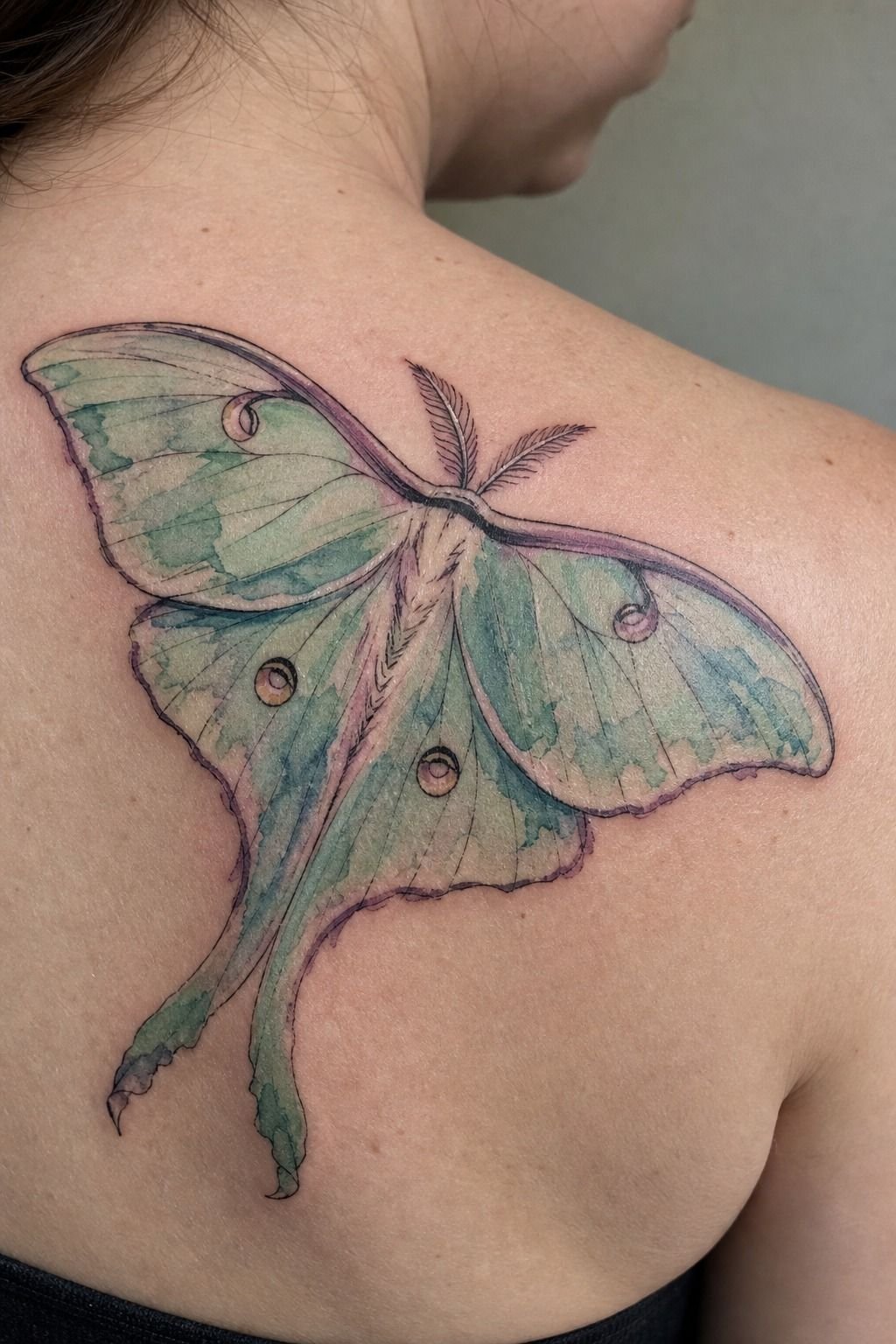
Anchor watercolor with line or don’t do watercolor at all.
8Geometric Luna Moth Upper Arm Tattoo
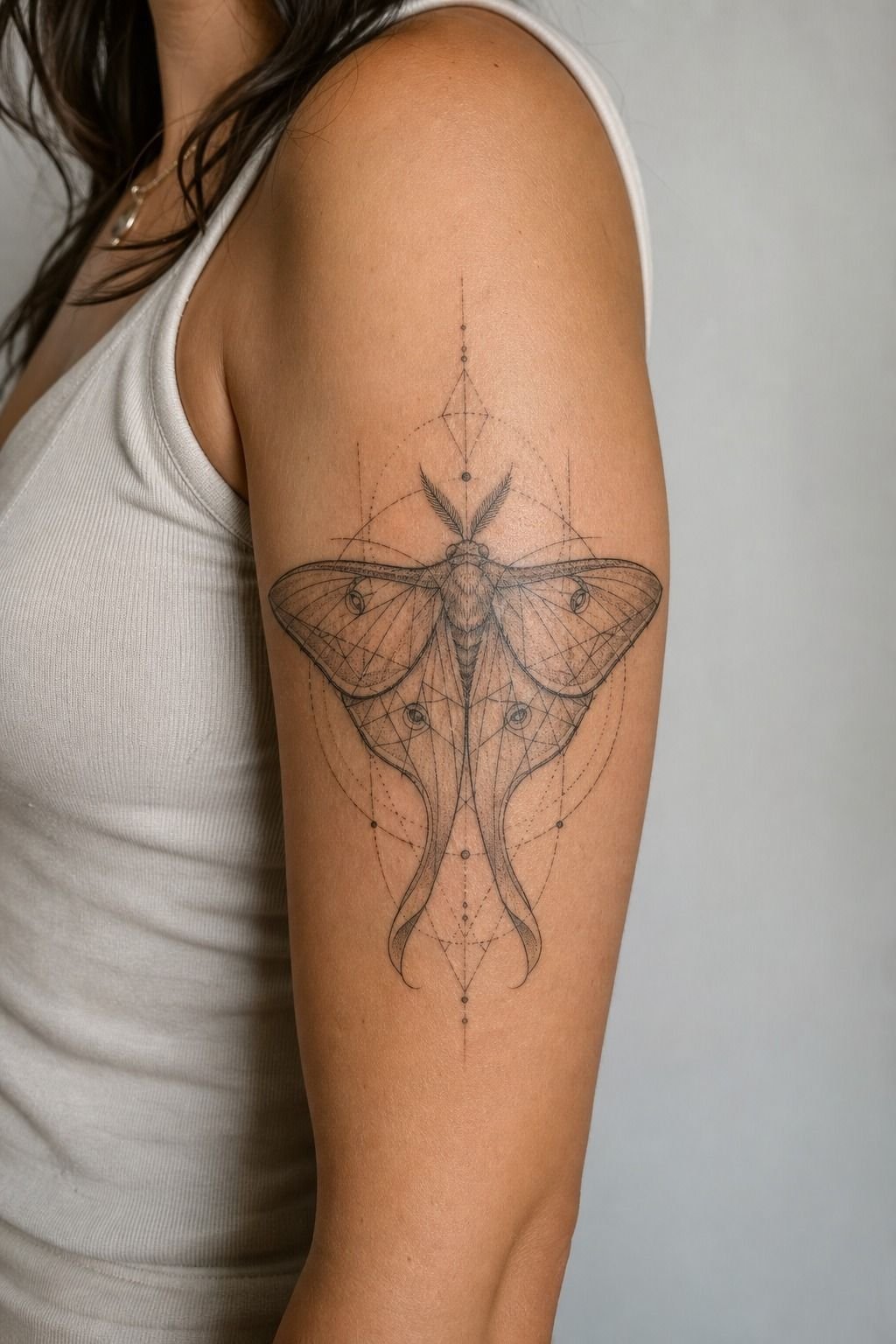
Frame geometry around the moth only when the shapes sharpen the body flow. Healed geometric work on the upper arm can age great because this is a forgiving placement and you get enough surface to keep lines distinct. Medium warm ivory skin shows healed black geometry nicely, especially when the moth wings stay soft and the shapes behind them stay crisp.
I usually tell people to pick one system. Sacred-circle geometry or angular diamond geometry.
Not both. Mixing every symbol you saw online is how a clean upper-arm tattoo turns into visual static. Use a 4 to 6 inch format, solid black anchors, and measured dot spacing so the geometry stays intentional.
If you love a more mysterious read, compare the mood against dream tattoos before you commit.
9Luna Moth Thigh Tattoo With Stars
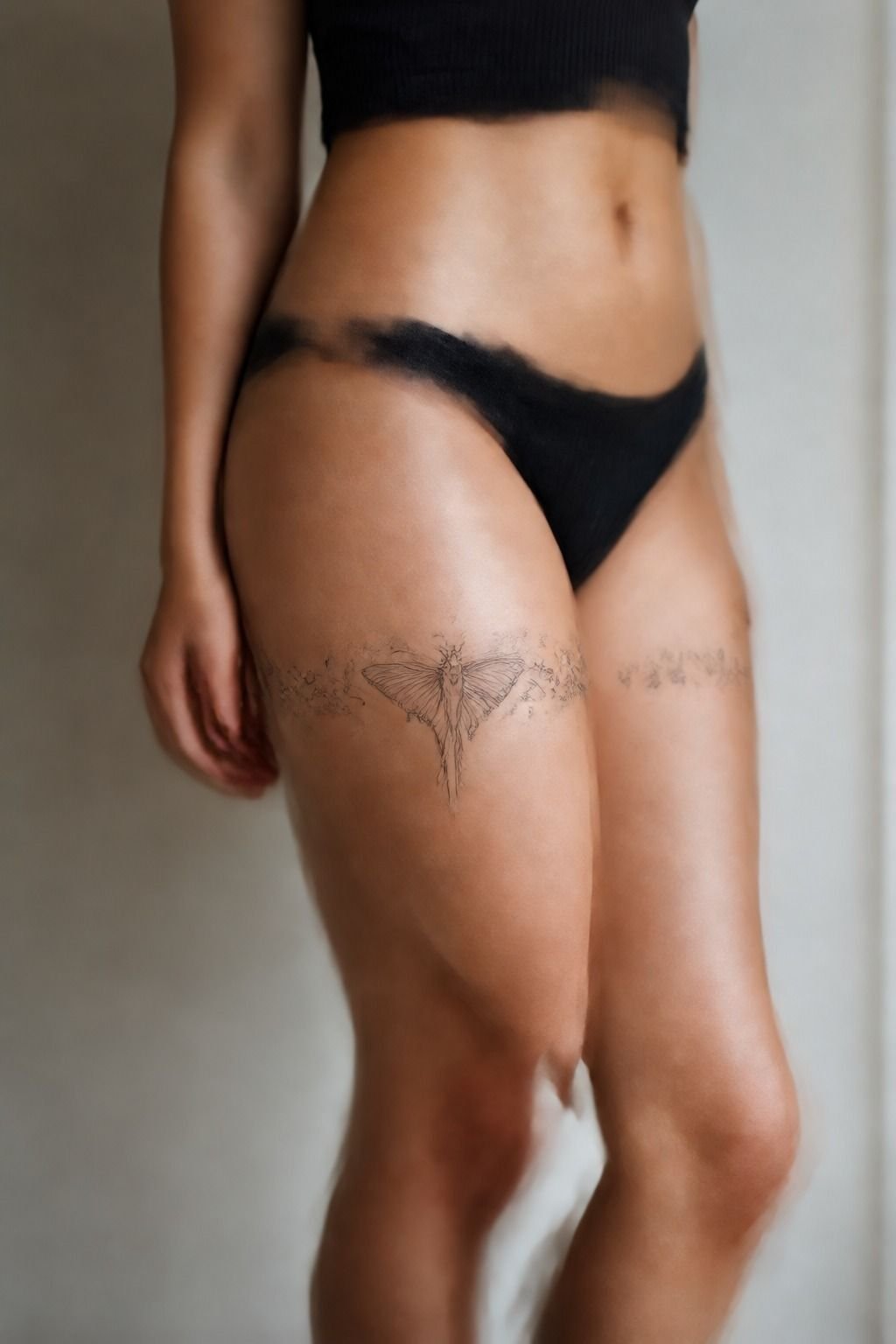
Let the thigh do what the wrist cannot.
The thigh placement gives you room for a bigger silhouette, cleaner stars, and softer shading without forcing every little detail into a tiny patch of skin. That makes the design more worth it if you care about longevity, because the tattoo can breathe and the size is doing the real work, not toward fighting a bad placement. A luna moth with stars usually lands best around 5 to 7 inches, and that extra scale shows.
I would keep the stars sparse and directional, more like night-sky accents than glitter filler. One or two bright points near the top wings can look dreamy.
Twelve tiny stars all around the body look busy. If you want a placement with the same soft feminine energy, thigh tattoos women black is a smart comparison set.
10Tiny Luna Moth Ankle Tattoo
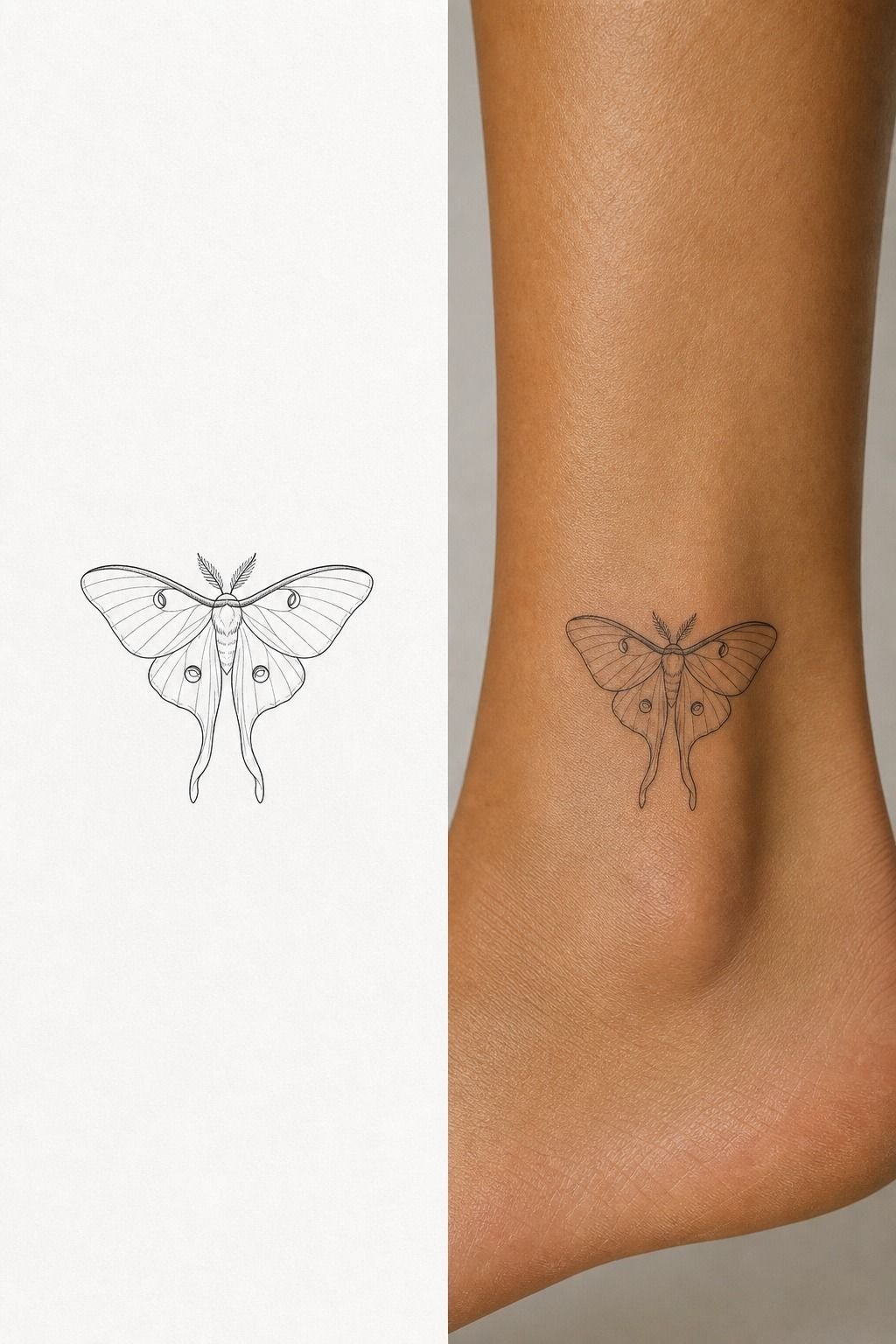
Shrink the idea, not the clarity. That is how you make an ankle moth work.
The split view between stencil and healed result tells the truth: tiny tattoos only hold when the design starts simple on paper. At the ankle, every extra mark is a future problem because socks, shoes, sun, and movement all beat on that area.
Keep this one around 1.5 to 2 inches, with just the wing outline, body, and maybe one inner wing shape. No dust cloud. No script under it.
No microscopic moon phases wrapping the bone. Ankles can be spicy during linework, then annoying during healing because friction is constant. For the first few days, treat it like the open wound it’s.
Loose socks. Clean bedding. No gym rub. No pool.
If you want a tiny tattoo with cleaner long-term hold, discreet tattoos are better for weighing subtle placement trade-offs.
11Neo Traditional Luna Moth Tattoo
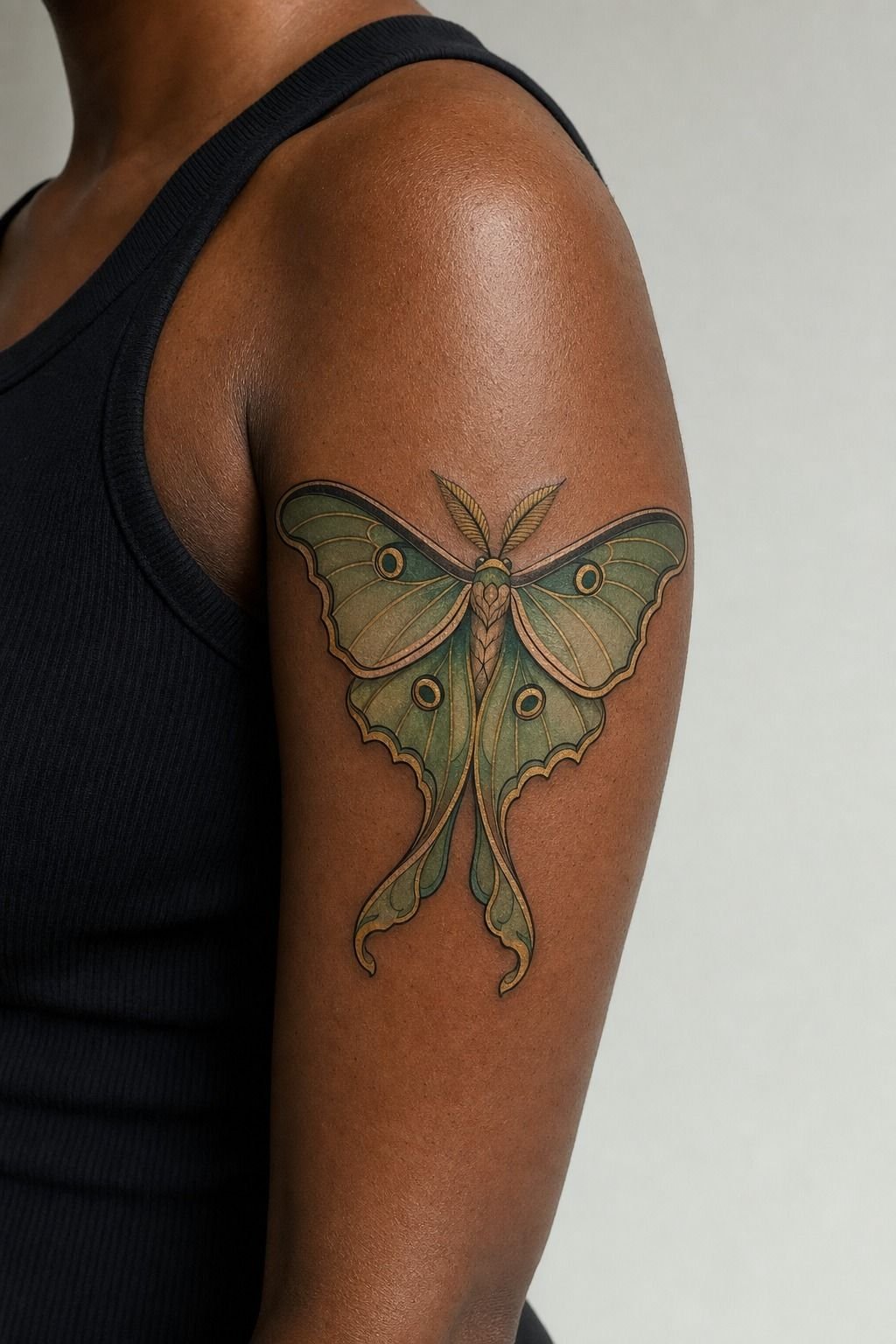
Push the contrast if you want a neo-trad luna moth that lasts.
Neo-trad gives you the best mix of softness and backbone when the artist knows how to simplify the wing cells and pack color without chewing up the skin. I like a luna moth here with bold black lining, richer green fill, and a warm gold eye spot or tiny red accent if the palette can handle it. Bold will hold.
That is the whole pitch.
This style usually costs more than a tiny fine line moth, but the neo-trad payoff is real because the read stays stronger over time. If you’re debating worth it versus delicate, ask yourself what you want the tattoo to look like in ten years, not ten days. For more high-contrast feminine work, compare it with hot tattoos ideas female.
12Luna Moth Chest Tattoo With Symmetry
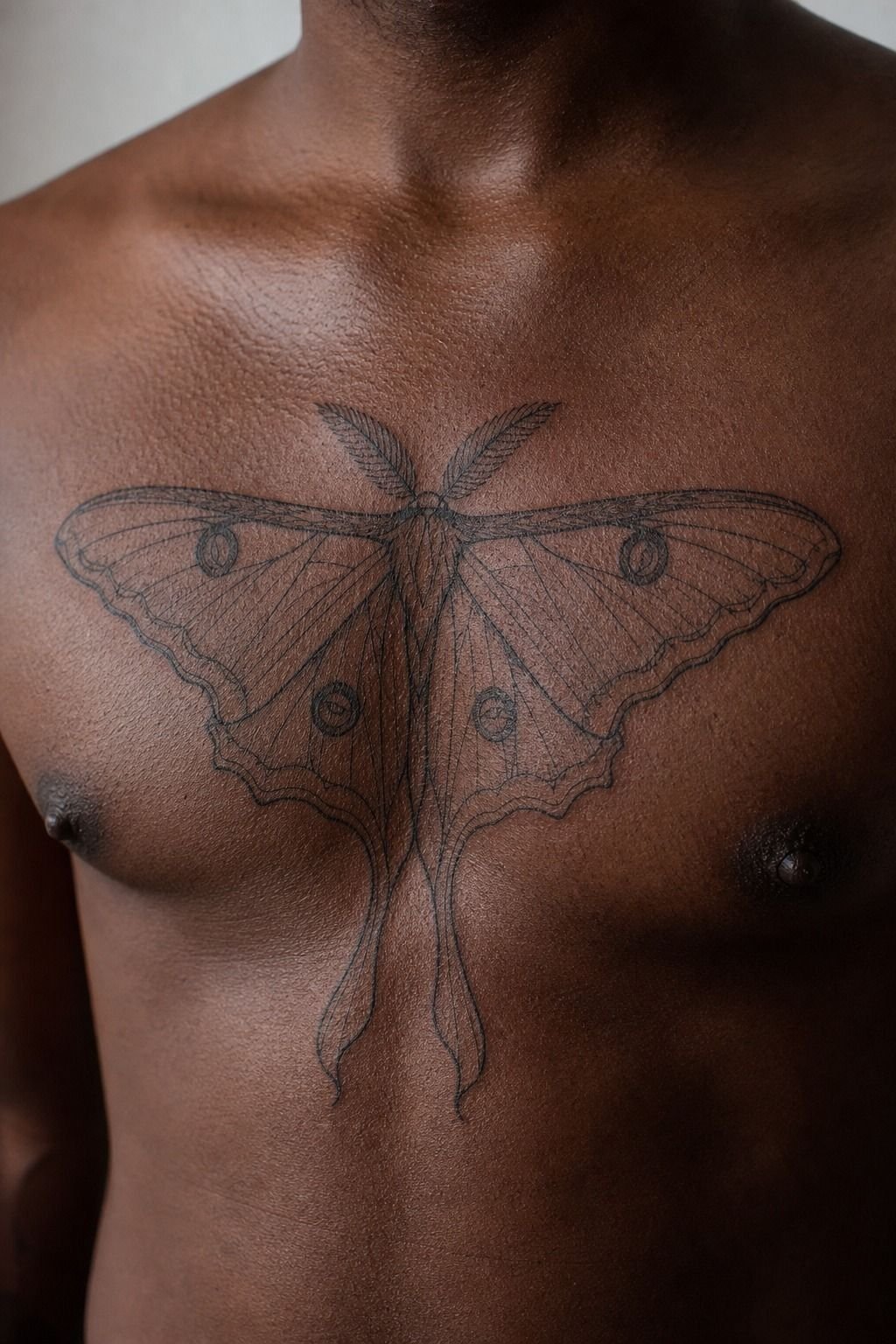
Center the moth on the chest only if symmetry matters to you more than comfort. Deep ebony skin makes a fine line chest moth look beautiful when the outer wings mirror cleanly and the body sits dead center.
That is the whole point here. If the design drifts even a little, your eye catches it forever.
Your artist should stencil you standing up, let you breathe, and recheck the wing tips before the machine turns on. I would avoid packing this concept with too many moon symbols because symmetry is already doing the storytelling. Balanced tails.
One quiet inner pattern if you need it. Chest tattoos can heal well, but bras, binders, and shirt friction matter, so plan your first 10 days like they matter too.
The honest cost goes up fast on chest work because clean symmetry takes time, and it should. This is not where you bargain-hunt. If you want a similar centerline feeling with a little more privacy, lower back tats are worth comparing before you choose.
13Dotwork Luna Moth Calf Tattoo
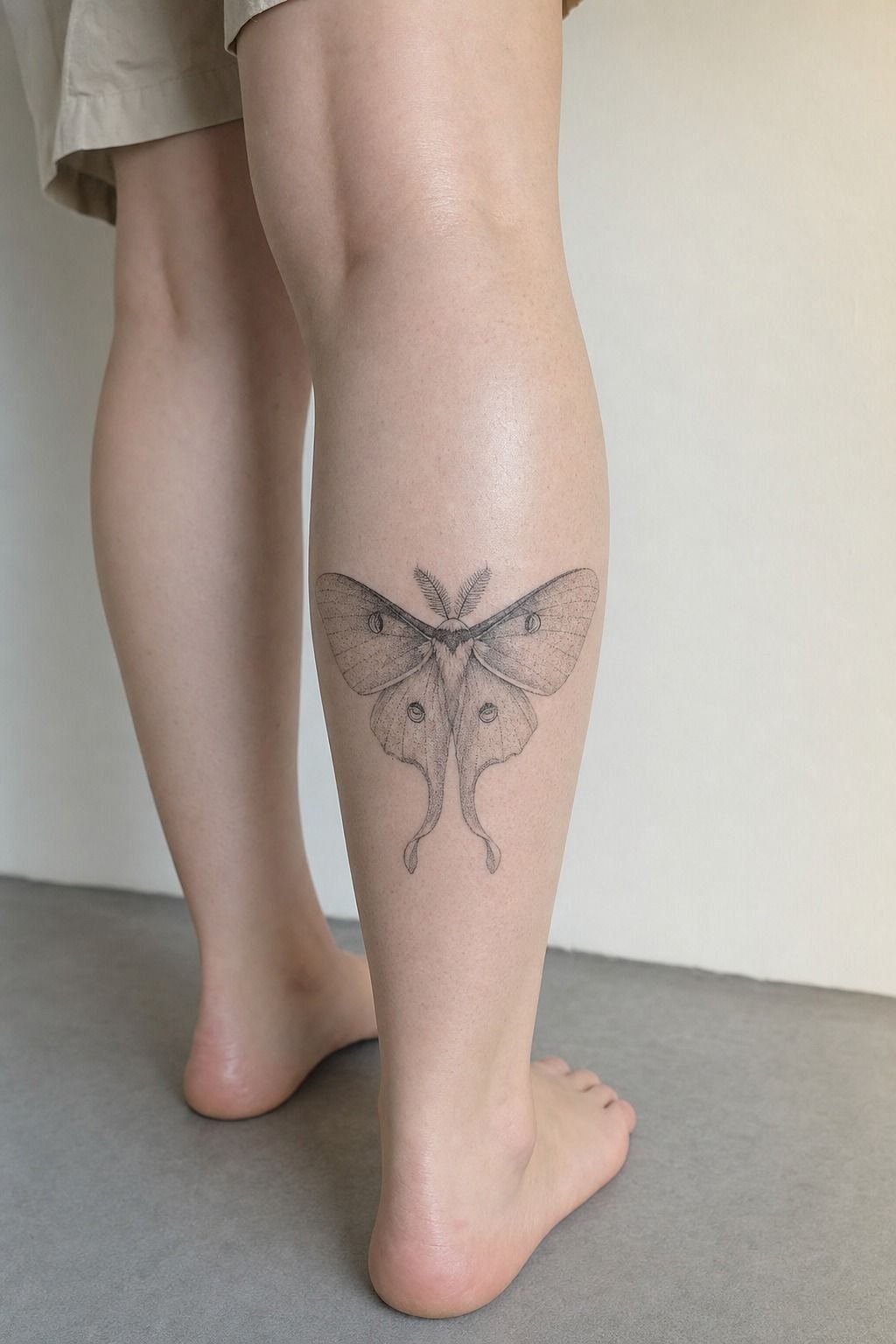
Use dotwork when you want softness without losing structure. A healed calf moth built with clean stippling can look velvety instead of harsh, especially on fair cool-pink skin where you can see the tonal fade from body to wing edge. This is where pepper shading earns its keep.
The calf gives you enough skin for texture that doesn’t instantly collapse.
I like dotwork luna moths at 4 to 5 inches so the dot fields have enough clearance to separate. Too small and the texture turns dusty. Too dark and you lose the airy moth feeling.
Ask for darker dots near the thorax and lighter falloff toward the wing edges. The calf is also one of the more tolerable placements for a lot of people, so you can sit long enough to get the shading done right.
If you want to compare other low-regret leg ideas, easy tattoos gives you another clean baseline.
14Luna Moth Hand Tattoo With Clean Lines
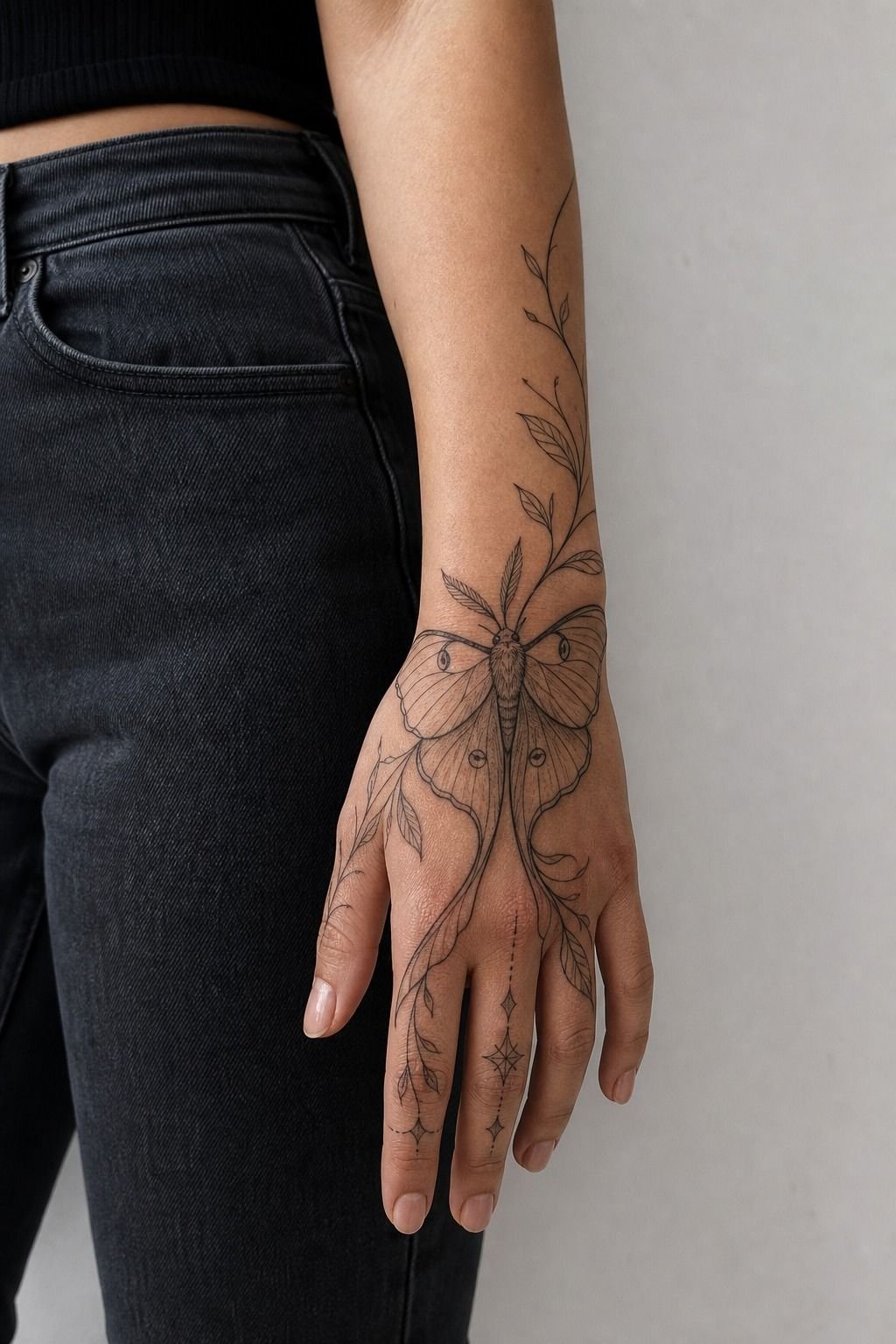
Skip the hand unless you already know you accept touch-ups.
Hand tattoos are high-wear, high-maintenance, and rarely the best choice if you’re chasing delicate linework. A luna moth can look beautiful there for a minute, sure, but the true cost is touch-up culture.
Soap, sun, friction, and movement beat on this placement every day. If you want the same airy silhouette with a smarter long-term plan, move it up the forearm and compare it with hand tattoo ideas.
If you still want it, keep the wings simple, the tails short, and the lines a touch bolder than your first instinct. Finger-adjacent skin doesn’t reward indecisive detail.
One clean pull beats fancy texture every time. That’s not me killing the vibe. That’s me trying to keep you out of the chewed-up stage later.
15Luna Moth Rib Tattoo With Delicate Antennae
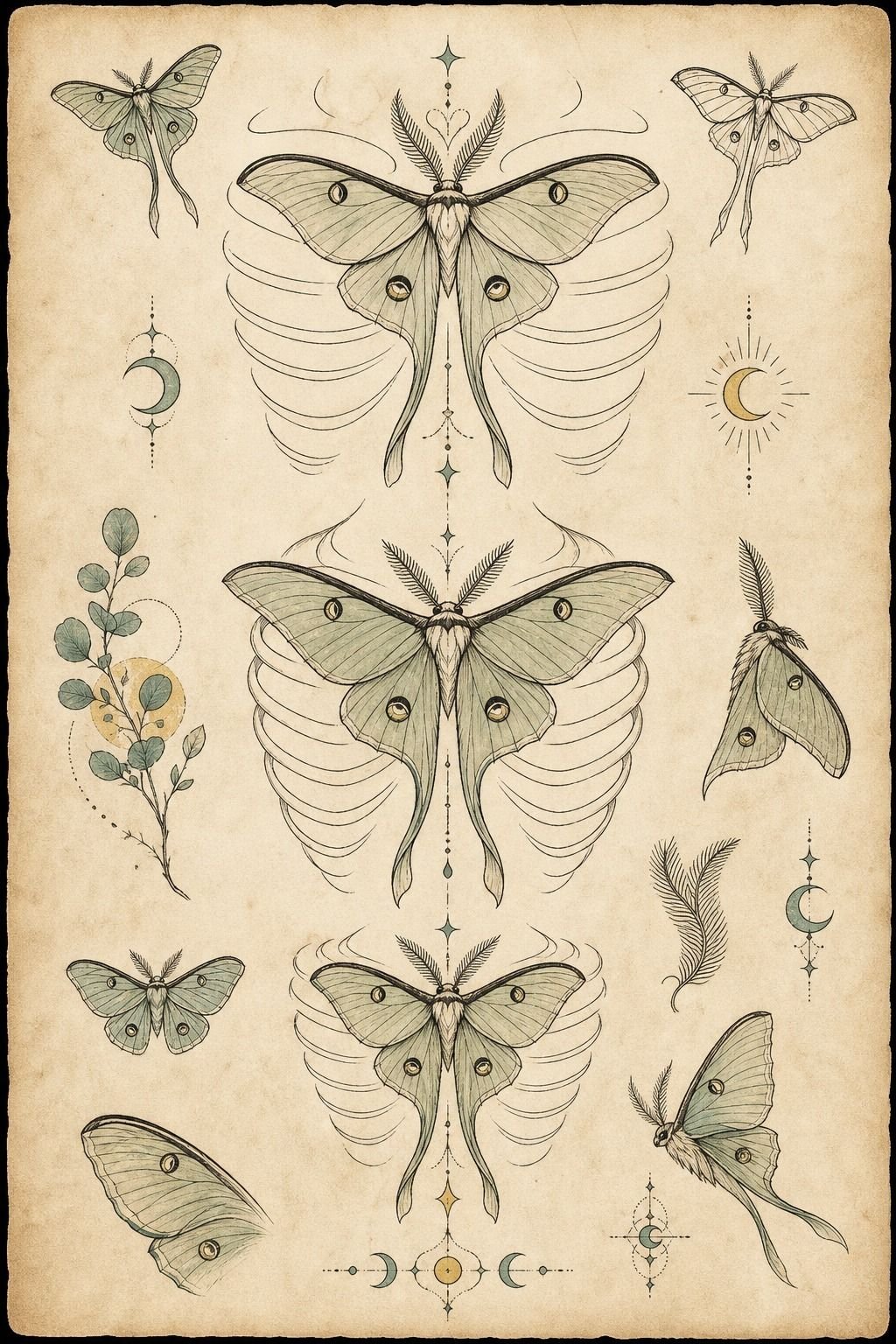
Treat rib antennae like fine jewelry. One clean curve, then stop.
Flash-sheet drawings work well for this concept because they force restraint before the tattoo ever hits skin. On ribs, delicate can be gorgeous, but delicate doesn’t mean weak. It means the artist knows where to simplify so the moth keeps its elegance while your body moves and breathes.
Ribs are spicy for most people, especially during linework. Shading feels more like a dull burn after that.
I would keep the moth 4 to 6 inches so the antennae have enough runway to stay graceful, and I’d not bury them in ornamental smoke. A little grey wash under the top wings is enough.
If you want a first tattoo, I’d not start here. You can, but I’d still steer you to forearm or thigh.
16Realistic Luna Moth Tattoo With Green Ink
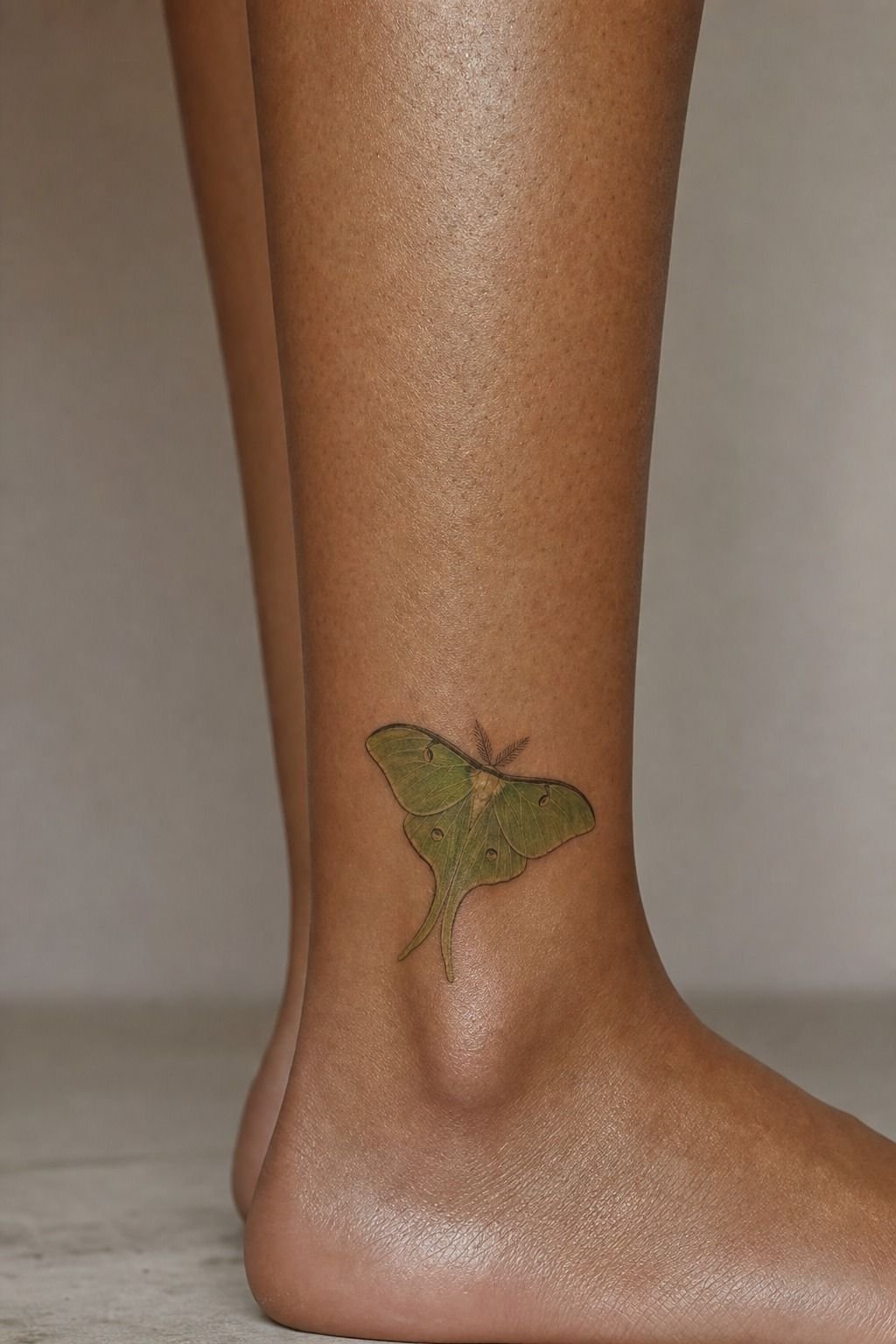
Use realism only if your artist’s portfolio proves they can hold texture without turning it muddy.
17Luna Moth Collarbone Tattoo With Fine Details
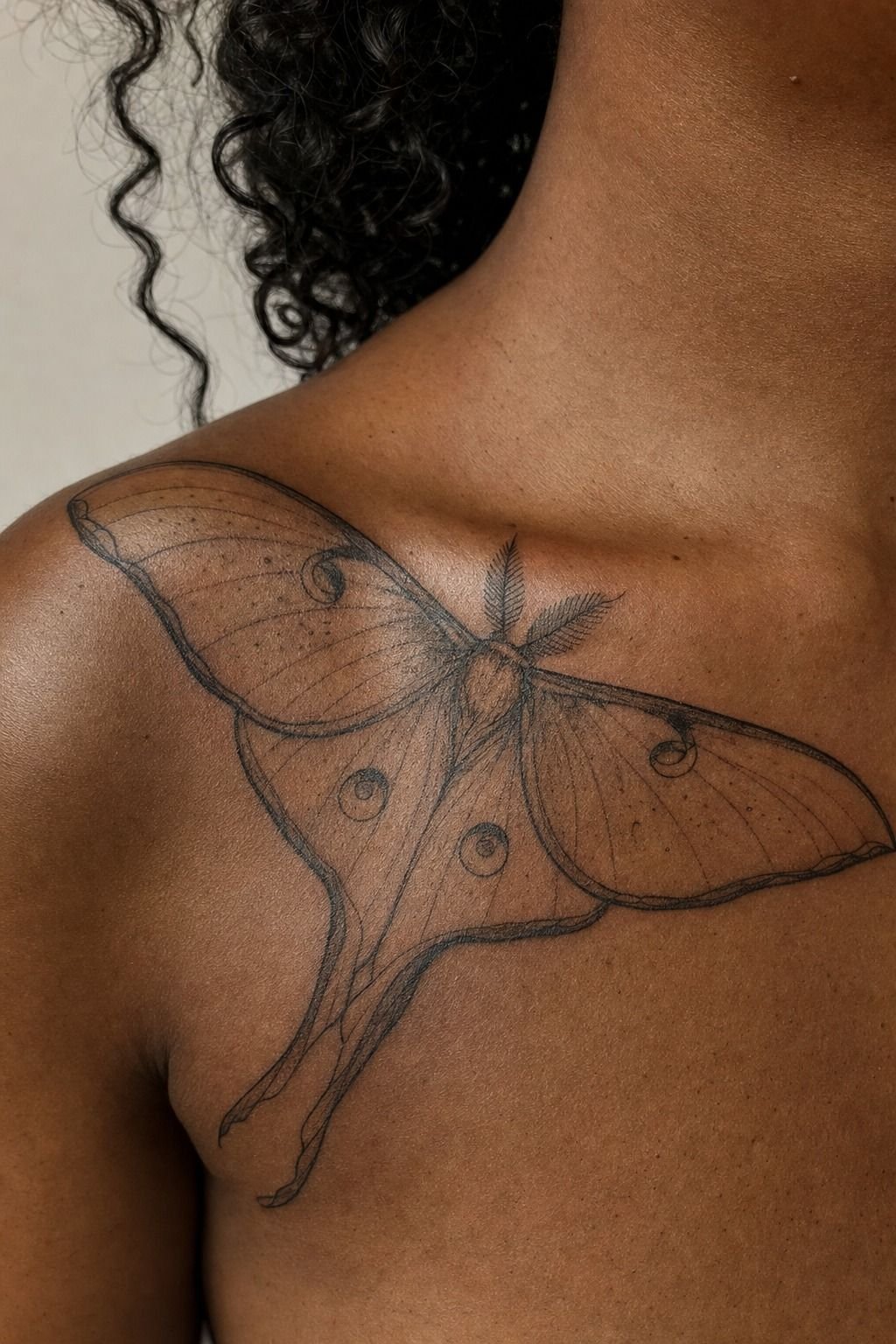
Stretch the wings across the collarbone only if you want the anatomy to be part of the design. On deep brown skin with a warm undertone, the macro close-up works because the fine details stay secondary to the silhouette.
That is smart. Collarbone tattoos can look airy and elegant, but they need disciplined detail or they turn fussy in a hurry.
I like a cleaner body, wing eyes kept minimal, and antennae placed to follow the collar line instead of fighting it. This zone is bony, so expect some sting.
But it also gives you a naturally flattering sweep if the moth is drawn for your shape, not copied reference-first. If someone promises Pinterest-exact, I would walk.
Vibe reference yes. Carbon copy, no.
If you’re torn between visible placements, face tattoos for women is useful for seeing how exposure changes the whole conversation.
18Matching Luna Moth Tattoos For Friends
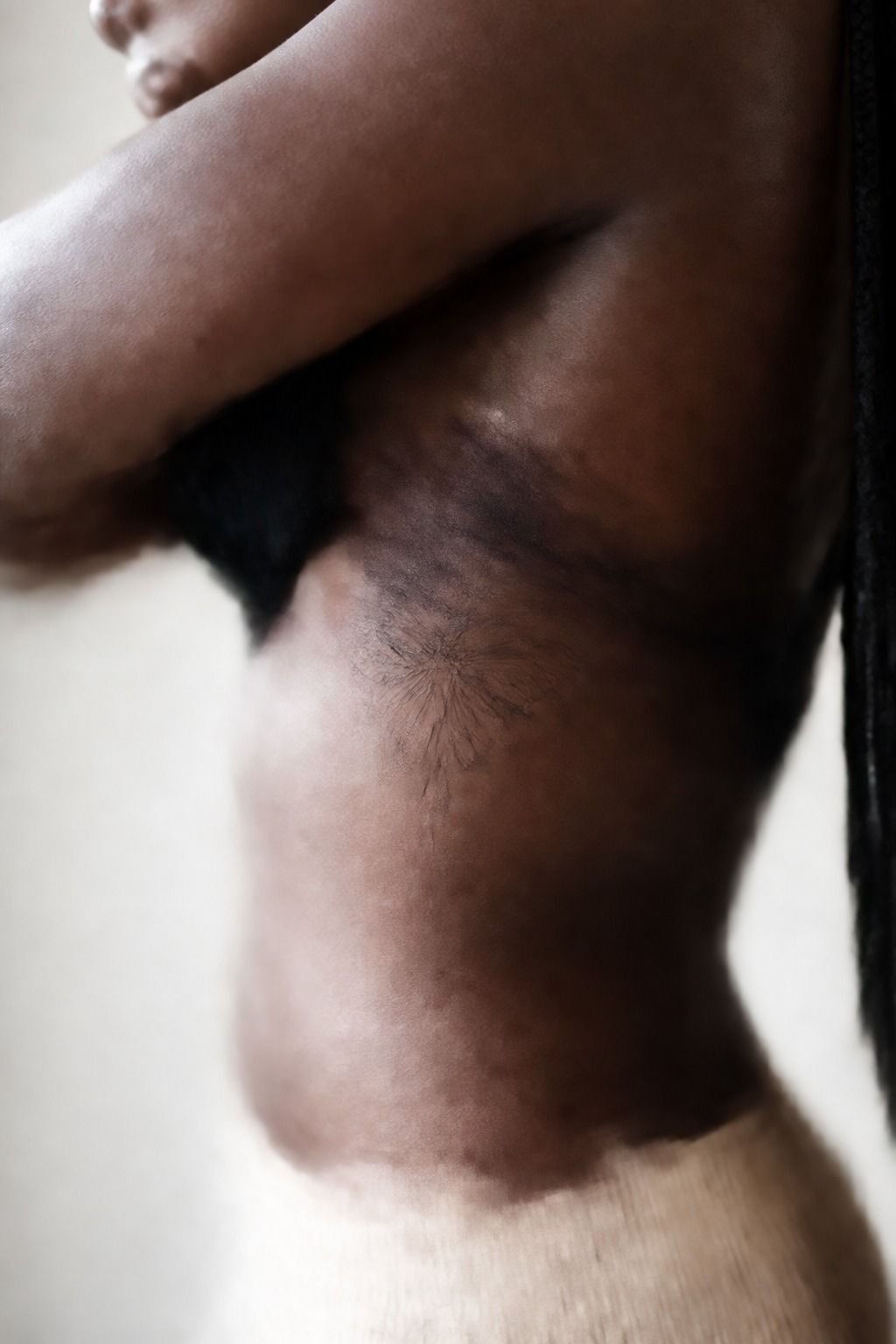
Match the concept, not every millimeter. That’s how friend tattoos stay personal instead of feeling like a camp stamp. A healed fine line luna moth on deep ebony skin can look gorgeous when each person keeps the same silhouette but tweaks one thing, like moon phase placement, tail length, or floral accent.
You still read the bond. You just don’t erase the individual.
I would put matching placements on ribs, forearms, or calves before I put them on hands or fingers. Those placements give the linework a better shot at aging well and usually hurt less than the tiny high-wear options people jump to first.
Keep the designs at least 3 inches if you want details to survive. For the symbolism side, I’d start with name tattoos for women and finger tats just to see how shared meaning can either stay classy or get cramped fast.
19Luna Moth Tattoo With Death And Rebirth Symbolism
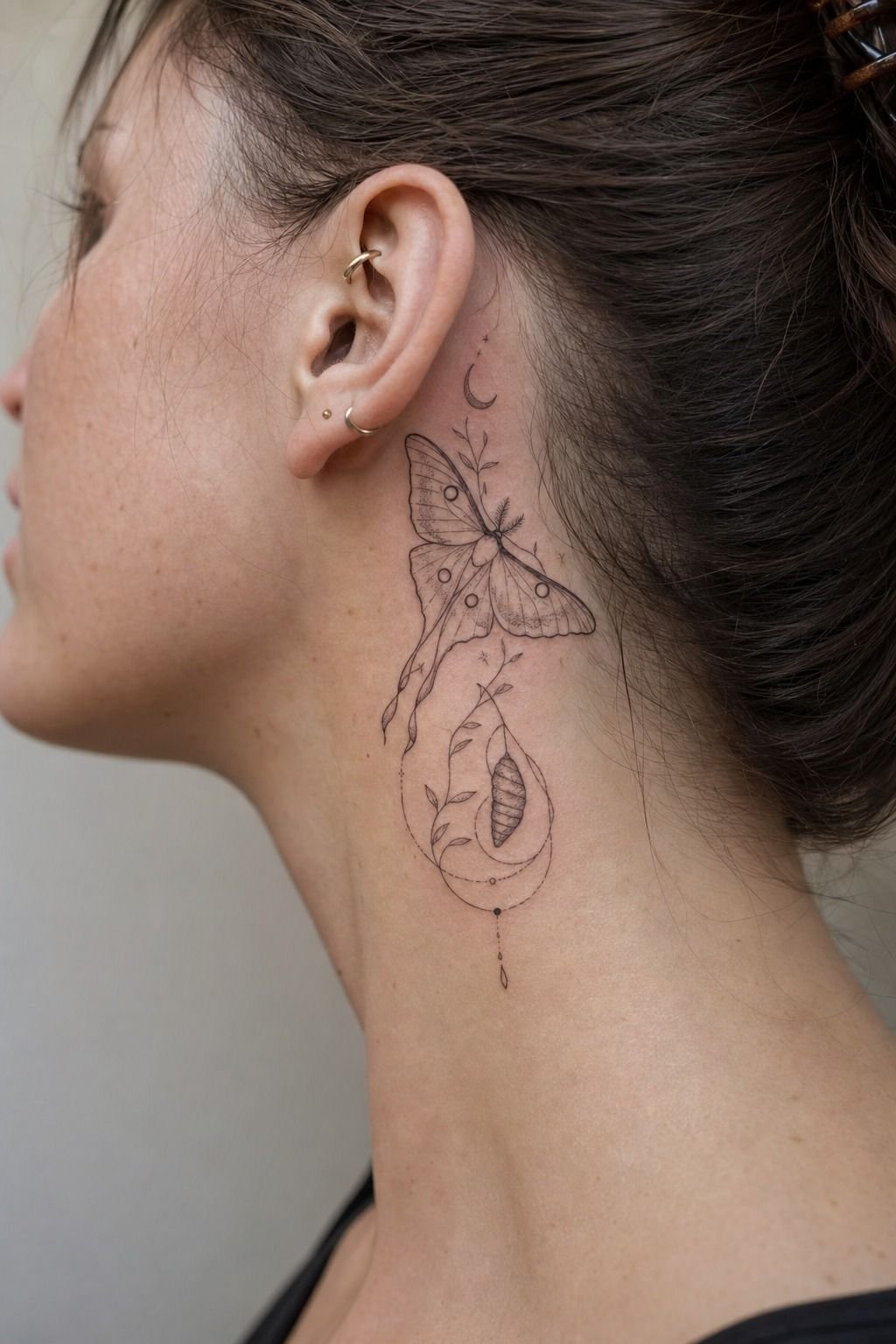
Lean into death-and-rebirth symbolism with restraint, not gothic clutter.
The Placement Ladder I Use for First-Timers
If you’re new, start where the tattoo has a fair shot to heal clean and stay clear. That’s usually outer forearm, upper arm, thigh, calf, or shoulder blade. Hands, feet, ribs, sternum, and behind the ear can be beautiful, but they’re either more painful, more friction-heavy, or both.
You don’t need to earn a harder placement to be legit. You just need a smart first win.
But placement logic is not just about pain. It’s about wear, sun, friction, and how much detail you’re asking the tattoo to carry. That’s the part people skip.
If you want the simplest planning path, tattoo ideas by placement and tattoo aftercare cover the two mistakes I see most.
The Clean-Wing Rule I Keep Coming Back To
Here’s the framework I keep using when clients bring me luna moth references. Keep the wing silhouette obvious. Keep the body central.
Keep the tails intentional. Then decide if the style should do the talking or if the symbolism should.
When people try to cram all of it into one tattoo, the piece loses its point. You stop seeing a moth and start seeing a pile of decisions.
I learned that the hard way early on. I used to think more detail made a design feel more finished, so I’d sketch extra texture into every wing cell and add little celestial bits because it felt romantic on paper.
On skin, some of those ideas healed fine, but the clearest ones always won. The tattoos that got compliments years later were the ones with a strong outer silhouette, a simple read, and enough open skin to let the shape breathe.
And that rule holds across styles. Fine line needs discipline because tiny marks spread.
Blackwork needs restraint because too much fill makes the moth heavy. Watercolor needs an anchor because color without line can wash out.
Geometry needs hierarchy because not every shape deserves equal volume. Even realism needs editing, or the wing texture turns flat once the fresh gloss is gone.
You can see the same symbolism principle in action too. A luna moth already carries metamorphosis, intuition, night energy, softness, and change.
Do you really need every moon phase, star cluster, quote, and birth flower attached to it? Usually no. If the tattoo means something serious to you, stripping it down often makes it hit harder.
A clearer tattoo ages better because your eye can still find the message fast. That’s why I still trust simple structure over extra ornament every time.
Why Does the Three-Year Read Test Matter?
Before you book, imagine the tattoo healed, settled, and seen in normal daylight three years from now. If the body disappears, the antennae blur, or the wings only make sense from six inches away, the design needs editing. That’s not me killing your vision.
That’s me protecting it. And yes, this test saves rework too, because a tattoo that still reads rarely asks for the same repair cycle as one that started too tiny. If you want another low-regret filter, simplistic tattoos and discreet tattoos both reward the same editing instinct.
What People Always Want to Know
How much does a Luna Moth usually cost?
About $100 to $300 is common for a small to medium luna moth, with many shops keeping a minimum around $50 to $100. Clean execution is the best value, not the cheapest quote. Size in inches, placement, artist demand, and detail level all change the cost.
Are Luna Moth a good idea for a first tattoo?
Yes, they can be, especially on forearm, upper arm, calf, or thigh. Clear wing shapes give you symbolism without forcing the design into visual soup. You get elegant linework and enough flexibility to keep the tattoo personal.
How do I choose a tattoo artist for Luna Moth?
Look for healed photos, crispy lines, and moths that still read clean once the shine is gone. Style match matters more than follower count.
Fine line, blackwork, neo-trad, and realism all ask for different hands, so match the artist to the exact build you want. If you need a prep step first, tattoo planning helps you sort references before you waste anyone’s time.
How much do Luna Moth hurt?
Forearm, thigh, upper arm, and calf are usually more chill. Ribs, sternum, hand, foot, and behind the ear are spicier.
Linework pain feels sharper, shading feels duller, and long sessions wear you down even when the placement is manageable. Tap out for five if you need it!
How long does a Luna Moth take to heal?
Surface healing usually takes about 2 to 3 weeks, and deeper settling can take 2 to 3 months. Gentle aftercare protects the linework.
Wash with unscented soap, use a thin layer of ointment, avoid pools and hard sun, and don’t pick the flakes. For the full skin-care rundown, read tattoo aftercare.
What is the best placement for Luna Moth?
Forearm and thigh are my top picks for most people. Balanced placement gives you visibility, manageable pain, and better long-term hold. You get enough skin for wing detail, lower daily friction than hand or ankle, and a design that still has a strong chance to age nicely.
Start With the Forearm Over the Hand
If I had to pick one, I’d start with the forearm. Forearm skin gives fine line and soft blackwork enough room to stay readable, the pain is manageable, and the long-term hold beats hand-level wear. Pin that route for later and compare it with tattoo ideas by placement before you book!