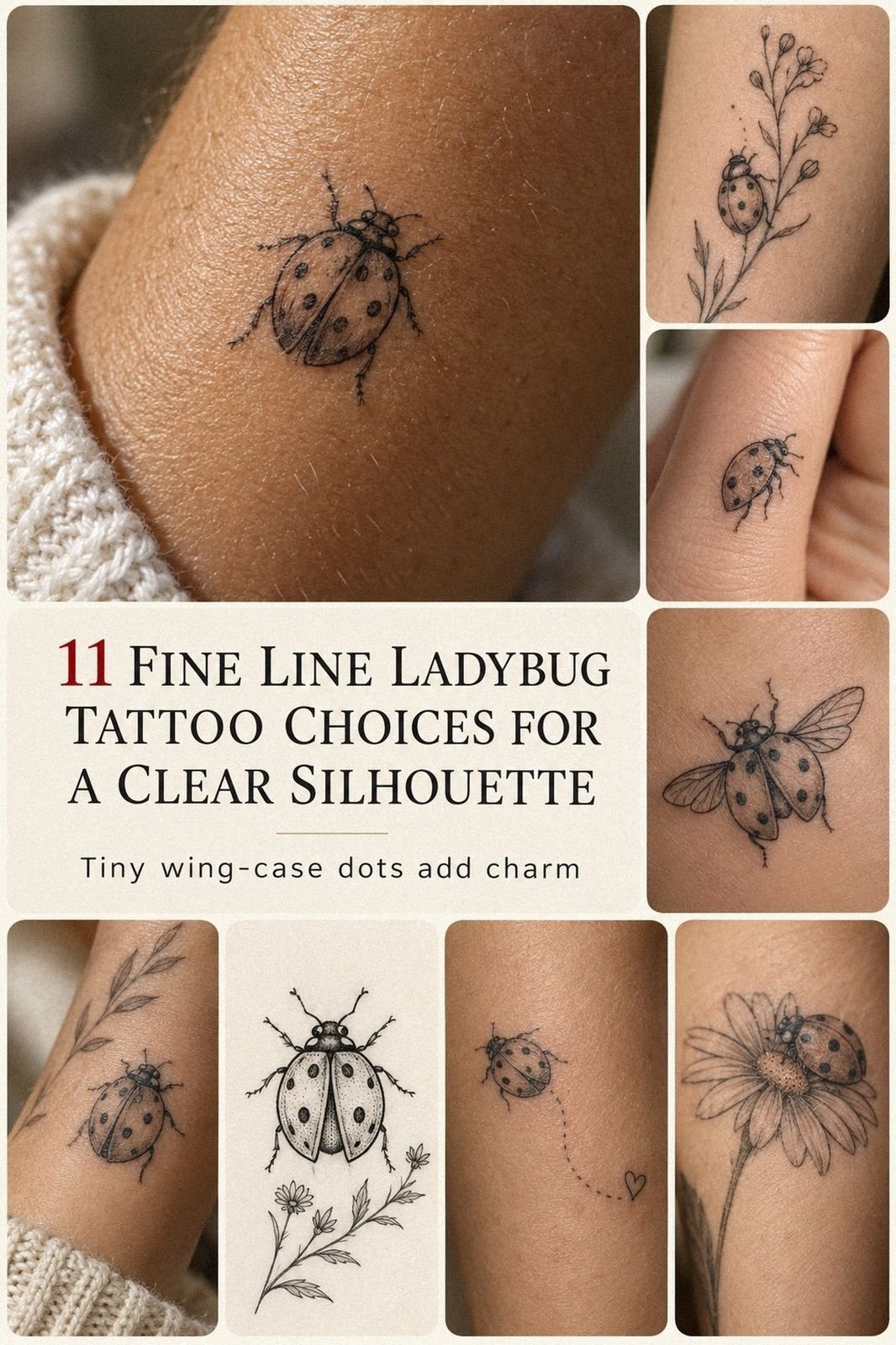
Fine Line Ladybug Tattoo designs can stay crisp for years when scale, placement, and aftercare work together. I learned that the hard way after choosing detail that was too tiny for skin. Your best reference should show the healed result, not only fresh ink. Start here. A healed result matters most!
Fine Line Ladybug on a Wildflower
A ladybug perched on a stemmed wildflower gives you a striking tattoo with a personal feel. The layered petals can echo the rounded shell.
A short stem keeps the design flowing along your thigh. I’d choose this ladybug-on-flower tattoo over a crowded bouquet because the negative space lets every contour breathe.
Ask your artist to keep the single-needle black ink light around the petals and slightly stronger on the shell. That contrast makes the insect readable from a distance. It won’t turn the flower into visual noise.
If you’re collecting botanical references, compare this idea with our fine line tattoo ideas guide before settling on the final stem.
The thigh gives you more room for an intricate design than a finger or wrist. You can use delicate petal veins, two small antennae, and open areas between the wings. I’d skip filling every petal with dots.
Tiny marks may soften as your skin changes.
For a more meaningful version, choose a wildflower connected to a birthday, family memory, or place you love. A fine-line botanical stem keeps the symbolism understated.
The ladybug adds a cheerful focus. If you want the design to feel softer, ask for graceful curves instead of rigid geometric petals.
Dainty Ladybug Tattoo Behind the Ear
A dainty ladybug tattoo behind the ear works when you want something discreet and quick to show. This spot can look sharp at first.
The area also moves and receives friction from hair, headphones, and collars. Your artist should design for that movement.
The strongest version uses hair-thin black linework for the legs and antennae. Give the shell a slightly darker outline. That hierarchy matters.
If every line has the same weight, the ladybug can disappear into a small blur after healing. You’ll want a healed portfolio image from the artist, not only a fresh appointment image.
Behind the ear is more sensitive than the thigh or upper arm. The session may feel intense, even when the design is tiny.
The discomfort is temporary. You shouldn’t choose this spot only because it looks fashionable.
I’d pick it when your goal is an understated mark that can stay private during work or formal events.
Keep the concept minimal: one ladybug, two antennae, and perhaps one tiny star or dot. Unfilled negative space gives your skin a visual pause. If you’re comparing feminine fine line tattoo placements, our feminine fine line tattoo collection can help you compare small designs near the ear.
Fine Line Ladybird on a Crescent Moon
A symbolic ladybird tattoo near a crescent moon gives you a storybook direction. The small insect can suggest change, luck, or returning to yourself. The moon creates a graceful arc along the collarbone.
I’d keep the moon open rather than solid because the design needs breathing space.
Use soft grey shading only where it supports the wings and crescent. Heavy shading can compete with fine lines.
Ask for a crisp shell outline, two open wings, and a few carefully placed dots. Those marks can make the ladybird feel airborne without creating a full night scene.
The collarbone is visible and elegant. It can also be sensitive because it sits close to bone. Your artist may need to adjust the size so the wings remain legible after healing.
What makes a ladybird tattoo memorable here? Restraint.
A bold silhouette with fewer marks usually survives better than a crowded miniature illustration.
If the moon carries personal meaning, choose its phase intentionally. Fine-line crescent detailing can represent a new beginning, a private ritual, or a quiet reminder. For more wording and symbolism, browse these fine line tattoo words before adding a date or phrase.
Minimal Ladybug Tattoo Along the Wrist
A minimal ladybug tattoo along the wrist is sleek and easy to recognize when the silhouette is planned well. The wrist doesn’t give you much width.
A side profile or shell profile works better than a full botanical scene. Let the ladybug carry the idea by itself.
Ask for black ink with open skin breaks between the shell, legs, and wings. Those gaps keep the image crisp. They also prevent the body from reading like one dark bead.
I’ve seen tiny wrist designs lose their charm when the artist includes every anatomical detail. I’d choose a clear outline over miniature realism.
This placement receives frequent washing, sunlight, and movement. Protect the healed result by following your artist’s care instructions. Limit direct sun.
Avoid premature rubbing or picking. Fine lines may widen gradually, but thoughtful placement and solid black accents can help the tattoo remain readable.
A small wrist design can still feel powerful when the shape has intention. Add one meaningful dot, a birth month symbol, or a tiny leaf.
Don’t stack several symbols together. If you’re researching line quality and longevity, read our fine line tattoo needles longevity placement guide before booking.
Intricate Ladybug with Botanical Linework
An intricate ladybug tattoo gives you more choices when you compare scale, posture, and surrounding foliage. A vintage flash reference may suggest a classic direction.
The tattoo itself still needs to suit living skin. Choose one composition rather than combining every option.
Look for traditional black flash linework with clear outlines, restrained dotwork, and open space around each concept. I’d avoid a crowded cluster of flowers, leaves, and insects at miniature scale. The details could merge as the tattoo settles.
A bold central ladybug with one curved stem often reads better than a busy panel.
This approach works well if you like an expressive design with history in its presentation. Your artist can redraw the flash for your chosen placement.
Ask how the lines will be spaced. Ask whether the smallest marks need to go.
A polished flash-inspired piece can feel iconic without looking copied. The reference style belongs in the inspiration stage. Your final tattoo should reflect your anatomy and preferences.
If you’ve had a disappointing tattoo before, our can you fix a bad fine line tattoo guide explains which problems may improve.
Tiny Ladybug Tattoo on the Finger
A tiny ladybug tattoo on the finger is playful and direct. A clear black silhouette can look crisp against deep ebony skin. Your artist should prioritize contrast, spacing, and a recognizable shell over decorative micro-details.
Fingers are demanding placements, so the smallest version isn’t always the wisest version.
Use solid black shell accents sparingly, with open wings or two fine interior marks. Hands experience washing, friction, sun, and constant movement.
Finger tattoos can fade or soften faster than tattoos on protected areas. I’d choose a compact symbol here, not an entire flower scene.
The finger can feel more uncomfortable than the upper arm or thigh. The skin sits close to bone and receives repeated contact. If you’re nervous, ask for a consultation first.
You won’t know how your skin will respond until the artist considers your exact placement and line scale.
A tiny design can feel meaningful without being delicate in spirit. Let the ladybug stand for luck, persistence, or a private reminder.
High-contrast black ink gives the tattoo a fierce anchor, while open skin keeps it from becoming a heavy band. You can also compare this idea with the symbolism in our straight line tattoo meaning guide.
Symbolic Ladybug and Birth Flower Design
A symbolic ladybug tattoo paired with a birth flower creates an obvious emotional connection. The upper arm offers enough space for a stem, layered petals, and a ladybug that doesn’t feel squeezed.
I’d use the flower as the structural base. Let the insect become the unexpected focal point.
Choose fine botanical black ink for the stem and petals. Let the ladybug receive the strongest outline. That order keeps the design harmonious.
You can use a flower linked to your birth month, a loved one, or a specific memory. The symbolism should mean something to you.
The upper arm is generally more tolerable than the hands, feet, ribs, or sternum. It also gives you flexibility if you expand the piece later. I’d leave open skin around the flower rather than planning a full sleeve immediately.
The original silhouette deserves to remain readable.
Don’t assume symbolic tattoos need a long explanation. A personal design can stay understated and still carry weight.
Layered petal linework adds an elegant rhythm. One ladybug gives the image a charming interruption.
If you want more ideas for combining words, flowers, and symbols, see these fine line tattoo words references.
Fine Line Ladybug Across the Collarbone
A fine line ladybug tattoo across the collarbone has elegant horizontal movement. It follows the body instead of fighting it.
You can place the insect near the center, slightly toward one shoulder, or along a short stem. The best option depends on how visible you want the tattoo to be.
Use single-needle contour work for the shell, legs, and antennae. Ask your artist to reinforce the outer body line.
That small change gives the design structure without making it harsh. I’d avoid placing fragile detail directly over the sharpest bone when the design can shift slightly.
Collarbone tattoos can be sensitive. Clothing may rub the area during healing.
Surface healing may take about 2 to 3 weeks. The tattoo can continue settling for roughly 2 to 3 months. Follow your artist’s aftercare instructions, wash gently, moisturize as directed, and avoid swimming or direct sun early on.
The healed result matters more than the freshly completed tattoo. Ask to see similar collarbone work after it has settled.
This matters most when your design uses very fine antennae or wing marks. Crisp healed linework is the standard I’d use, not temporary redness around new ink.
Playful Ladybird Tattoo with Open Wings
A playful ladybird tattoo with open wings gives your design movement. On the thigh, you can make the wings wide enough to read clearly while keeping the body small. The design works when the bird looks as if it has just lifted from the skin.
Choose open-wing black linework with a few small motion dots. Stop before the composition becomes cartoonish.
I’d skip a large collection of hearts and stars because the open wings already provide the action. Your artist can angle the body slightly so the pose feels alive.
The thigh is one of the more tolerable areas for many people. It gives your artist a generous surface for clean spacing. You can keep the tattoo private under clothing or show it when you choose.
That flexibility makes it a smart placement for a first tattoo.
A whimsical ladybird doesn’t need to be childish. Use an expressive pose, a sharp shell outline, and one symbolic detail.
Fine black wing contours keep the design graceful. The open shape gives it a daring lift.
If you’re comparing placements, our fine line spine tattoo guide shows how flowing designs respond to the body.
Fine Line Ladybug on the Ankle
A fine line ankle tattoo can show how a design changes before and after healing. The stencil and settled result should be compared when you review an artist’s work. Fresh ink can look sharper than the final result.
Use healed black fine-line ink as your reference standard. The ankle can experience friction from socks and shoes. It also receives regular sun exposure with open footwear.
I’d keep the design compact, with a strong shell shape and fewer interior dots.
The ankle is close to bone and may feel more intense than the upper arm or thigh. You can still choose it if the placement matters to you. Ask whether the design needs extra scale.
A slightly larger ladybug may age more gracefully than a tiny one that loses its legs.
Your aftercare matters here because rubbing can make early healing harder. Wear clean, loose clothing when possible.
Follow professional instructions. Wait until the surface has healed before judging the final lines.
Clear stencil-to-healed comparison gives you a more honest sense of longevity than freshly completed ink.
Meaningful Ladybug Tattoo with Dotwork Details
A meaningful ladybug tattoo with dotwork can feel refined when the dots support the shape. On deep brown skin with a warm undertone, the artist should consider contrast and line spacing. You deserve references across varied skin tones.
Ask for controlled black dotwork around the wings, shell, or nearby botanical detail. Dot placement should have a purpose. It might create a soft shadow or separate one form from another.
I’d avoid dense stippling across the whole insect. It can make a small design look muddy after healing.
The collarbone placement gives the tattoo visibility. It also brings sensitivity and movement close to bone.
Your artist may suggest shifting the design or increasing the shell size. That isn’t a failure of the concept.
It’s a practical adjustment that protects the idea you came in wanting.
A meaningful tattoo should still look good before you explain it. Choose one symbol, one insect posture, and one line language.
Soft stippled shading can make the ladybug feel expressive without turning it into a heavy blackwork piece. If your concept includes a word or short mark, review our line chin tattoo meaning page for symbolism prompts.
What Makes a Tiny Ladybug Worth It?
A tiny ladybug becomes worth it when the silhouette stays readable after healing. Tiny does not mean every detail must shrink.
Remove marks that need more room. Keep the shell, legs, and antennae clear.
Ask your artist to show the design at several stencil sizes. Check the smallest version from arm’s length.
If the shell becomes a dark dot, increase the scale. A slightly larger tattoo often gives better long-term value.
The most striking small designs use one idea. A crescent, leaf, or flower can support the ladybug.
Several symbols can compete. If you want more compact references, compare these ladybug tattoo ideas before your consultation.
My rule is simple. Choose detail that your skin can hold. Readable scale will serve you longer than a delicate concept that only looks perfect on appointment day.
Finger or Thigh: Which Placement Wins?
The finger gives you a bold visible mark with very little space. The thigh gives you more room and usually more flexibility.
Neither is automatically better. The right choice depends on how much maintenance you accept.
Finger tattoos face frequent washing, sun, and friction. They may need a touch-up sooner. The thigh can support botanical details, open wings, and stronger spacing.
That usually offers better value for a more intricate design.
Think about work, clothing, exercise, and visibility. A finger tattoo is hard to hide. A thigh tattoo can stay private.
If placement is your main concern, our tattoo ideas by placement guide can help you compare options.
I’d choose the thigh for a first ladybug with flowers. I’d choose the finger for a compact symbol. Placement control often matters more than the original sketch.
Choose Black Ink Before Red Accents
Black should create the crisp structure of your ladybug. It defines the shell, legs, and wing breaks. Red can add personality, but it should not carry the whole design.
Ask how red pigment behaves on your skin tone and placement. Sun exposure can affect color.
A controlled red accent may be worth the extra cost when the black structure remains strong. Full color may require more maintenance.
A red shell can look expressive and playful. It can also soften differently from black. Compare healed examples before deciding.
Our fine line tattoos references can help you discuss line and color choices.
My preference is simple: black first, color second. Controlled red detail should support the insect, not rescue a weak outline. If you want to explore a sharper approach, review this geometric line tattoo reference for structure.
Fine Line Ladybug Cost and Budget Guide
The cost of a ladybug tattoo depends on size, placement, artist experience, region, and shop minimum. A tiny design may still take consultation time. Custom botanical work usually costs more than a compact symbol.
Use this table as a planning guide, not a fixed quote. The best budget depends on the artist’s healed portfolio and the complexity you want.
A lower quote is not always better value. Ask what the session includes. Confirm the deposit, minimum, aftercare support, and touch-up terms.
Our fine line tattoo needles longevity placement guide can help you prepare better questions.
For most people, healed quality makes the investment worth it. I’d protect the budget for a skilled artist with strong healed work. Save money by removing extra symbols, not by choosing unsafe equipment or an unqualified artist.
The Crisp-Scale Rule I’d Use Before Booking
I used to think the most delicate tattoo would be the most timeless. That isn’t always true. Fine line work needs enough space for each line to remain separate.
Your skin isn’t a sheet of paper.
The Crisp-Scale Rule is simple: keep the idea intricate, but make the smallest mark large enough for your artist to place cleanly. Your ladybug might need more room for legs, antennae, or wing breaks than expected. Ask the artist to show the design at several sizes on a stencil.
Look for a portfolio with healed work. Fresh appointments can hide softened edges and fading.
They can also hide uneven spacing. You’ll learn whether the artist knows how to preserve negative space.
Black ink, good placement, and sensible scale tend to age better than fragile detail alone. Healed fine-line references are more useful than freshly completed ink.
If your artist can explain what they would remove, enlarge, or reinforce, that’s a good sign. That is the point!
My Fine Line Ladybug Opinion After Seeing Them Heal
My honest preference is a bold enough ladybug with delicate surroundings. I don’t love an ultra-tiny insect packed with microscopic marks.
I’ve seen minimal designs remain readable because their silhouettes were clear. More ornate pieces can lose their identity when every dot softens.
For most people, I’d start with the thigh, upper arm, or shoulder. Those areas are often more forgiving.
They also give you more control over scale. Finger, ankle, and behind-ear placements can work, but they ask more from your artist and aftercare.
The tattoo should match your tolerance for visibility and maintenance. A visible collarbone piece may feel empowering, but it will see more sunlight.
A covered upper-arm design may heal with fewer daily interruptions. Think about work, clothing, exercise, and ultraviolet exposure.
I’m drawn to the wildflower version because it has a personal story and readable shape. Crisp black shell detail gives it a sharp focal point.
The flower keeps the design romantic and flowing. That’s my pick over a crowded flash collage.
The Questions Worth Answering First
How much does a Fine Line Ladybug Tattoo usually cost?
A Fine Line Ladybug Tattoo usually costs about $100 to $300 in the United States. Size, placement, artist, and region all affect the quote.
Some shops set a minimum around $50 to $100. Hourly rates often sit near $100 to $250.
Artist experience matters more than insect size alone. Ask for a quote after sharing the placement and reference. A lower price is not useful if the portfolio lacks clean healed work.
Are Fine Line Ladybug Tattoo designs a good idea for a first tattoo?
Yes, they can be a good first tattoo when you choose a tolerable placement and enough scale. The upper arm, shoulder, and thigh are often easier starting points than fingers, feet, ribs, or sternum.
A clear silhouette makes the experience less stressful. You won’t need excessive detail to make the tattoo readable. Your artist can adjust the size after seeing your skin and placement in person.
How do I choose a tattoo artist for Fine Line Ladybug Tattoo work?
Choose an artist whose portfolio includes clean fine line tattoos, healed photographs, and work on skin tones similar to yours. Confirm that the studio follows appropriate hygiene practices and uses professional equipment.
Healed portfolio evidence is the strongest signal. Look for separated lines, readable small shapes, and consistent outlines weeks or months after the appointment. Compare needle and placement questions before booking.
How much do Fine Line Ladybug Tattoo designs hurt?
Pain varies by person and placement. Ribs, feet, hands, and sternum are often more painful. The forearm, thigh, shoulder, and upper arm are commonly more tolerable.
Placement comfort should be part of your decision. Behind-ear, collarbone, finger, and ankle designs can feel sharper because the skin sits close to bone. Ask your artist what they’ve observed in that exact area.
How long does a Fine Line Ladybug Tattoo take to heal?
The surface commonly heals in about 2 to 3 weeks. The tattoo can settle fully over roughly 2 to 3 months. Your artist’s instructions should guide cleaning, moisturizing, and activity limits.
Gentle aftercare includes washing as directed, avoiding scratching, limiting direct sun, and staying out of pools early on. Don’t judge final crispness while the skin is still changing.
What’s the best placement for Fine Line Ladybug Tattoo designs?
The upper arm, thigh, shoulder, and forearm are strong choices when you want easier healing and readable lines. Finger, ankle, foot, and collarbone placements create more visual impact. They may be less forgiving.
Placement longevity depends on scale, friction, sunlight, and technique. I’d choose the thigh or upper arm for a first piece if you want a botanical ladybug with more than a few marks.
What color works best for a Fine Line Ladybug Tattoo in 2026?
Black remains the most reliable choice for a fine line ladybug. A solid black shell and clear outline tend to read better as the tattoo settles. Small red accents can be expressive, but color may soften faster with sun exposure.
Black ink structure should come first. If you want red, use it as a controlled shell accent. Ask your artist how the shade performs on your skin tone.
Can I create a Fine Line Ladybug Tattoo myself on a budget?
You can sketch or print references for a consultation. You shouldn’t tattoo yourself or use an unlicensed setup. Needles, ink, sanitation, and skin depth require professional training.
A cheap mistake can become expensive to correct.
A safe planning budget can cover a consultation, a small professional design, and the shop minimum. Bring meaningful references, choose a sensible placement, and ask what detail can be preserved within your budget.
Where I’d Start First
If I had to pick one, I’d start with the fine line ladybug on a wildflower. The thigh gives the petals and shell enough separation to stay readable.
The design can carry meaning without microscopic detail. Save it, show your artist, and compare it with these ladybug tattoo ideas before booking.
Start there!