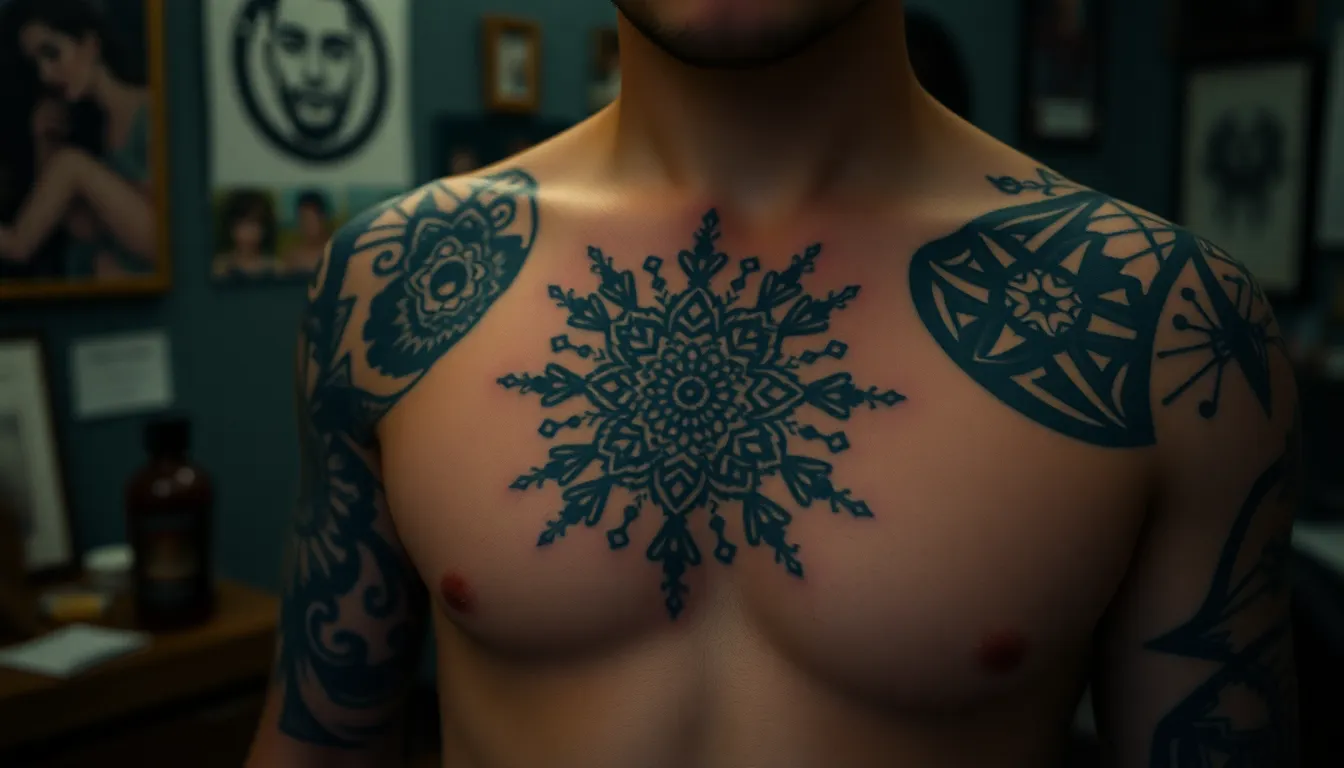
Blackwork is the oldest tattooing tradition on earth. The first tattooed human remains — Ötzi the Iceman, approximately 5,300 years old — carry solid black marks applied to specific body points. Polynesian tattoo traditions spanning millennia use dense black geometric forms as their primary visual vocabulary. The contemporary blackwork movement did not invent this idiom; it re-discovered and radicalised it, pushing black-only tattooing into a formal discipline with its own aesthetic principles, technical demands, and community of practitioners. This guide covers the key sub-styles, the technical realities, and the specific care requirements of large-scale blackwork — the style most collectors underestimate before committing to it.
The Blackwork Lineage: From Polynesia to Xed Le Head
The contemporary Western blackwork movement has multiple genealogies. The most direct artistic lineage runs through tribal and Polynesian traditions — the bold geometric patterns of Samoan pe’a (body suit), Māori tā moko (face and body tattooing), and Marquesan tattooing with their dense geometric fills. These traditions used blackwork not as decorative choice but as identity, status, spiritual protection, and genealogical record.
The contemporary fine art blackwork movement in the West crystallised in the 1980s and 1990s around a specific group of artists working in London, New York, and Los Angeles. Among these, Xed Le Head (Alex Binnie, working out of Into You in London) became the most influential. Binnie’s approach synthesised Polynesian patterning with sacred geometry, Islamic geometric design, and his own abstract visual language. His work — dense, total, treating the body as a field to be saturated rather than a canvas for discrete images — established the aesthetic foundation for what is now called blackwork or blackout tattooing.
Other foundational figures include Thomas Hooper (architectural geometric blackwork), Roxx of 2Spirit Tattoo (SF, whose large-scale abstract blackwork pushed the style toward pure fine art), and Maxime Buchi (Sang Bleu, London/New York, who brought high fashion design language into geometric tattooing). These artists collectively defined what blackwork meant aesthetically: black ink, geometric or abstract structures, the body treated as architectural space.
The Sub-Styles of Contemporary Blackwork
Dotwork / Pointillism
Dotwork tattooing creates gradients, shading, and tonal variation entirely through the density and spacing of individual ink dots rather than solid fills or line shading. The technique is borrowed directly from printmaking — pointillism in tattooing operates on the same optical principle as Seurat’s painting: the eye blends individual dots into continuous tone when viewed at normal distance.
The technical execution of dotwork requires extraordinary patience and consistency. Each dot must be placed at the correct depth, at the correct spacing, with the correct pressure. Too deep and the dot blows out into a small blob; too shallow and it fades during healing. The needle configuration typically used — a single needle or tight round configuration — means that large dotwork pieces accumulate thousands or tens of thousands of individual insertions.
Dotwork sessions are paradoxically described by many clients as less painful than equivalent solid black sessions. The intermittent, point-by-point nature of the technique differs perceptually from the continuous drag of a solid black shader. This is highly individual — for some clients, the repetitive pecking motion of dotwork is psychologically taxing even when not physically overwhelming.
Healed dotwork requires attention: the dots must not be packed so densely that they bleed together during healing, destroying the gradient effect. This balance — dense enough to create dark tones, sparse enough to maintain dot separation — is the central technical challenge of dotwork execution.
Mandala and Sacred Geometry
The mandala (Sanskrit: circle, wheel) is a radially symmetric geometric pattern with roots in Hindu and Buddhist spiritual art. In tattooing, it is used both in its traditional circular form and as a structural principle — compositions built on radial symmetry, repeating geometric modules, and the relationship between figure and ground.
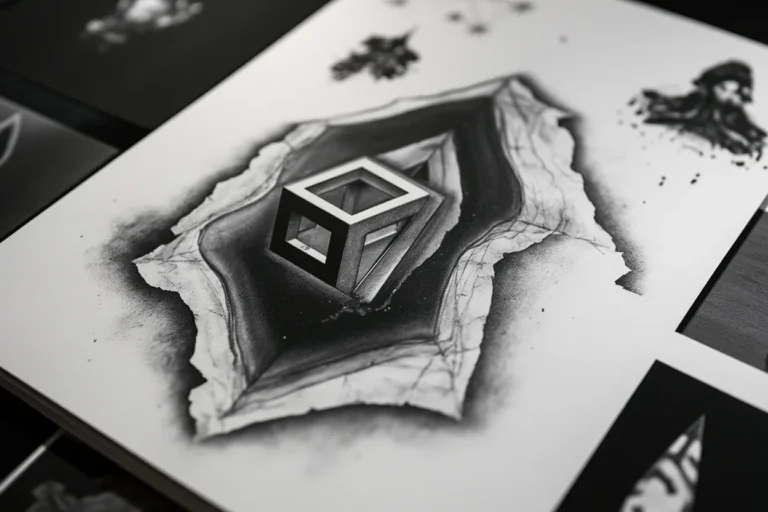
Sacred geometry — the visual language of geometric forms (Flower of Life, Metatron’s Cube, Fibonacci spiral, Platonic solids) — provides the compositional vocabulary for a significant portion of geometric blackwork. These forms carry their own symbolic weight in esoteric traditions: the Flower of Life as a symbol of creation and interconnection; the Fibonacci spiral as a manifestation of the mathematical order underlying natural growth; the Platonic solids as the fundamental building blocks of physical reality in ancient philosophy.
Mandala tattoos are typically placed on the upper back, chest, shoulder, or thigh — placements where the radial composition has room to expand and where the body’s own symmetry complements the design’s inherent symmetry. A mandala on the upper back, centered on the spine, creates a natural focal point that reads powerfully at distance. Scale matters enormously: a mandala below 15cm diameter loses the fine detail that makes the form distinctive.
Ornamental Linework
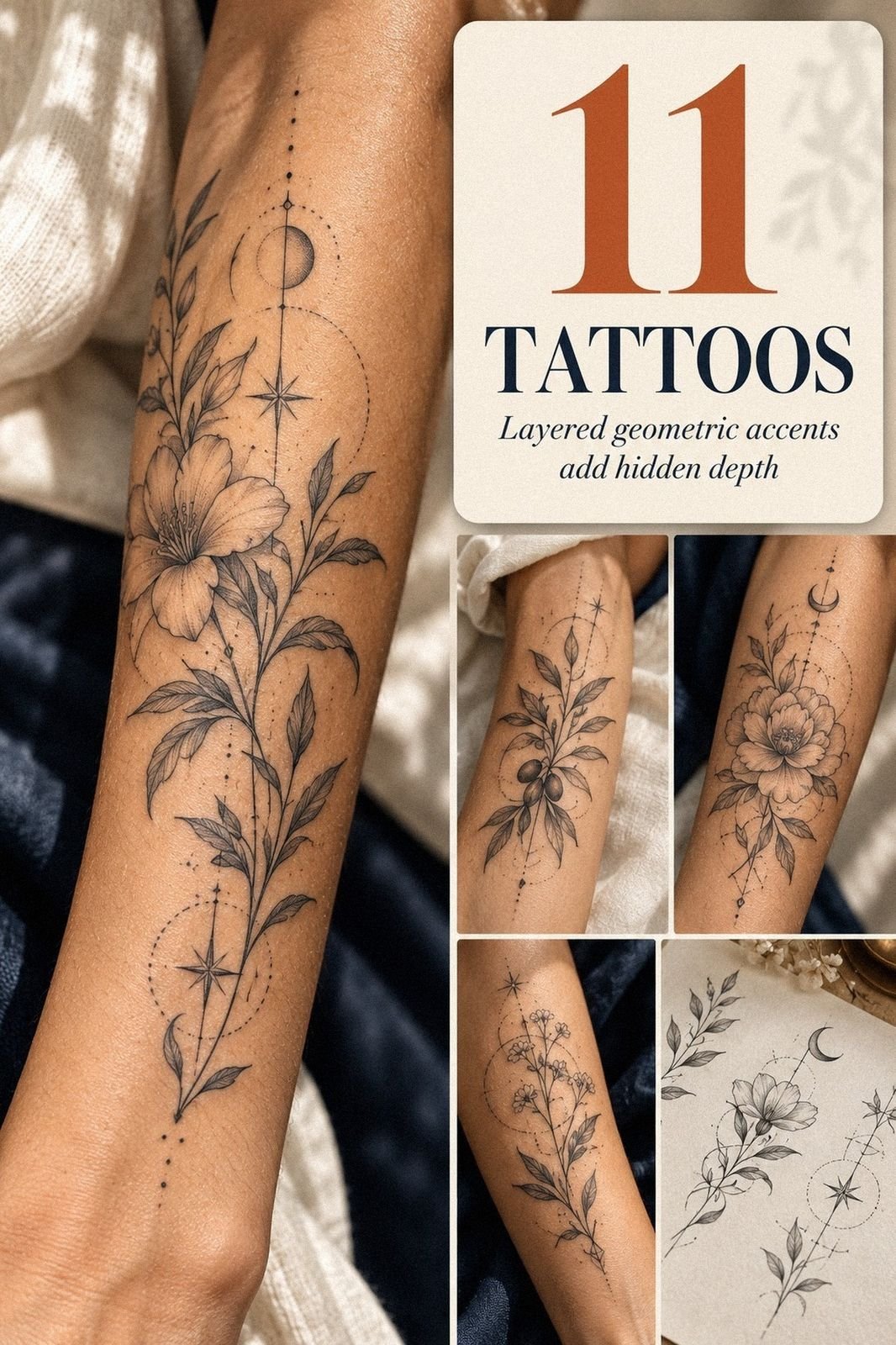
Ornamental linework draws on the decorative traditions of Islamic arabesque, Art Nouveau botanical ornament, and architectural filigree to create flowing, interlocking black line compositions. The style emphasises negative space as actively as positive line — the white skin between the lines is as much a compositional element as the ink itself.
Ornamental work is particularly effective as body-following composition: the lines adapt to the curves of the shoulder, the flow of the back, the elongation of the arm. Where mandala and geometric work creates imposed symmetry, ornamental linework creates organic coherence — as if the design grew from the body’s own structure rather than being placed upon it.
Blackout and Solid Fill
Blackout tattooing — covering large body areas with solid black ink — represents the most extreme expression of the blackwork aesthetic. Originally developed as a cover-up technique (solid black being the only reliable way to obscure previous unwanted work), blackout evolved into a deliberate aesthetic choice for collectors who want an extreme visual statement.
Blackout sessions are among the most physically demanding tattooing experiences available. Covering a full arm with solid black typically requires 15–25 hours of tattooing across multiple sessions. The saturation required — multiple passes to achieve true opacity — is significantly more taxing than outline or dotwork sessions of equivalent duration. This guide does not address blackout specifically beyond noting its existence; it requires specialist consultation with an artist who has specific experience with large-area solid fill.
Session Lengths: Planning for 6–10 Hours
Blackwork geometric sessions are among the longest in tattooing for their category. Unlike traditional American work, where a 2–3 hour session can produce a complete, visually satisfying piece, blackwork and geometric compositions frequently require extended single sessions or long sequential sessions to maintain compositional consistency.
- Small geometric piece (palm-sized, wrist/shoulder) — 2–4 hours. The minimum investment for a piece with genuine geometric complexity.
- Medium piece (A5 size, forearm/calf) — 4–7 hours, often across 1–2 sessions.
- Large piece (A4 size, upper back/thigh) — 8–15 hours, typically 2–3 sessions. The mandala format in this size range requires consistent artist technique across sessions to maintain geometric precision.
- Very large piece (half-back, full arm) — 20–50+ hours. Multi-year projects for dedicated collectors. Geometric consistency across sessions of this scale is a significant technical challenge.
The pain profile of blackwork geometric sessions differs from other styles. The fine linework that characterises geometric and mandala work uses thinner needles than traditional bold-line work — the initial contact is less intense. However, the extended duration of precise, repetitive linework over many consecutive hours is cumulatively taxing. Long sessions on geometric work tend to be manageable for the first 4–5 hours, after which fatigue and skin sensitivity both increase.
Planning recommendations for long blackwork sessions:
- Break sessions at the 5–6 hour mark if the artist agrees — the quality of linework typically degrades after extended fatigue on both sides.
- Eat and hydrate aggressively before the session. Geometric precision requires concentration that depletes rapidly without adequate fuel.
- Accept that large geometric compositions may take multiple sessions to complete — this is standard, not a failure. The healing interval between sessions also allows the artist to evaluate the settled piece before adding the next layer.
Pain Profile: Why Geometric Blackwork Is More Manageable
Contrary to expectations generated by session length, blackwork geometric tattooing is frequently reported as more manageable pain-wise than equivalent-size traditional or Japanese work. Several technical factors explain this:
- Needle configuration: Geometric linework typically uses finer needle groupings than bold traditional outlines. Less skin disruption per pass means less immediate acute pain response.
- Intermittent technique: Dotwork in particular involves discontinuous contact — the skin has brief recovery moments between insertions rather than continuous drag.
- No heavy saturation shading in base sessions: Many geometric pieces have minimal or no solid-fill areas, avoiding the heavy shading passes that generate the most intense pain in traditional work.
This does not mean blackwork geometric sessions are painless — no extended tattooing session is. At the 6+ hour mark, fatigue amplifies sensitivity across all styles and all placements. The 6–10 hour sessions typical of large geometric work require genuine physical endurance regardless of the technique’s relative gentleness.
Specific Aftercare for Saturated Black Ink
Large blackwork geometric pieces — particularly those with solid fill areas or dense dotwork — require aftercare that differs in emphasis from fine line or light-coverage work. The specific concerns are:
Ink Purge and Weeping
Heavy black saturation produces more ink purge during healing than lighter work. The first 24–72 hours after a dense blackwork session will involve more plasma and excess ink weeping through the surface than a light linework session. Clean the area gently with fragrance-free soap and lukewarm water more frequently — every 4–6 hours during the first two days — to prevent excess ink and plasma from forming a heavy scab that could pull ink out during removal.
Moisturiser Application for Dense Coverage
Apply an unscented, alcohol-free moisturiser (standard recommendation: Bepanthen or equivalent fragrance-free healing cream) twice daily during the 2–4 week healing period. For dense blackwork, the skin barrier is more significantly disrupted over a larger area — keeping the skin consistently hydrated reduces the risk of peeling that pulls ink unevenly. Do not over-apply moisturiser; a thin layer that fully absorbs is correct. Heavy cream application suffocates the skin and creates healing complications.
Sun Protection: Non-Negotiable for Black Ink Longevity
Black ink is the most UV-resistant pigment in tattooing — but this does not mean it is UV-immune. Long-term sun exposure without protection causes black to soften and acquire a blue-green tint as the ink breaks down and is absorbed by the lymphatic system over time. For large blackwork pieces, SPF 50+ mineral sunscreen on any exposed area is the single most impactful long-term care decision you will make.
Apply sunscreen daily to exposed tattooed skin as part of a standard morning routine — not only on beach days. The cumulative effect of daily UV exposure without protection is the primary driver of premature ink degradation over a 5–15 year timeframe.
Avoiding Submersion During Healing
For large-area blackwork, the standard “no swimming for 2–4 weeks” guidance applies with additional urgency. A large healing blackwork piece represents a significant open wound surface area. Pool chlorine, sea salt, and bacteria in natural water bodies all present genuine infection and healing complication risks. Showers are safe; submersion is not until the piece is fully healed (all peeling resolved, no open skin).
Touch-Up Planning
Dense dotwork and geometric linework frequently require touch-up after the initial healing — particularly in areas with complex density gradients where individual dots have healed unevenly or where fine lines have partially faded. Budget a touch-up session at the 6–8 week mark (once healing is complete) for any large geometric or dotwork piece. This is standard practice, not a sign of poor execution — it is the final calibration of the piece before it is considered complete.
Finding Geometric and Blackwork Artists in France
The French blackwork and geometric tattoo scene is concentrated in Paris, Lyon, and Nantes, with strong individual artists scattered across Bordeaux, Toulouse, and Lille. The international reputation of several Paris-based blackwork artists (particularly those working in the lineage of Sang Bleu magazine’s aesthetic influence) has made the French scene a reference point for geometric work in Europe.
Key search parameters when evaluating a blackwork or geometric artist:
- Geometric precision: Lines in geometric work must be mathematically consistent. Review the artist’s work closely for even spacing, consistent line weight, and radial symmetry in mandala forms. Small errors in fresh photographs become more visible after healing.
- Healed work portfolio: As with all fine work, healed photographs reveal the actual quality of execution. Dense blackwork that heals with blowout, uneven density, or patchy coverage indicates a technique problem.
- Scale experience: A geometric artist who has completed large-scale back pieces or full arm work has demonstrated the endurance and consistency required for ambitious projects. Artist portfolios showing only small pieces are insufficient evidence for booking a large commission.
- Custom capability: Many geometric artists work from flash or templates. For a piece designed specifically to your body’s geometry, confirm the artist’s experience with body-mapping compositions — designing the piece to follow specific anatomical contours rather than imposing a standard design.
Instagram tags #blackworkfrance, #geometrictattoo, #dotworktattoo, and #mandalatattoo filtered to location provide a practical starting point. The Tattoodo artist directory allows filtering by style and location for structured research.
The Commitment Required by Blackwork
Large-scale blackwork — whether mandala, dotwork, ornamental, or geometric linework — asks more of a collector than most other styles. The sessions are long. The healing is demanding. The visual statement is significant and not easily concealed. The symbolic weight of the tradition, from Polynesian pe’a to Binnie’s abstract saturation, is substantial.
It also offers something that no other style quite matches: the complete absence of colour creates a visual purity where form, structure, and negative space carry the entire compositional weight. A great geometric blackwork piece — well designed, precisely executed, properly placed — is among the most powerful permanent visual statements a human body can carry.
The collector who approaches blackwork with the right preparation — understanding session demands, choosing an artist with genuine large-scale experience, committing to aftercare, and protecting the investment with daily sun care — will have a piece that holds its power for decades. Related: Fine Line Tattoo Guide | Irezumi: Japanese Traditional Style.
Sources: Binnie, Alex (Xed Le Head) — Into You studio documentation; Hooper, Thomas — interview archives Tattoo Life magazine; Sang Bleu Magazine volumes 1–6 (2006–2018); Alliance of Professional Tattooists aftercare guidelines; Haute Autorité de Santé wound care protocols.
Hustle Butter Deluxe — La crème cicatrisante référence des tatoueurs professionnels
4.8/5
(+5 000 avis Amazon | tatoueurs pro)
- ✓ Formule vegan : beurre de mangue, karité, coco, arnica — 100% naturel
- ✓ Utilisable pendant et après la séance + pendant toute la cicatrisation
- ✓ Preserve l’éclat des encres et prévient le dessèchement
- ✓ Sans paraben, sans lanoline, sans produits pétroliers
* En tant que Partenaire Amazon, nous percevons une commission sur les achats remplissant les conditions requises. Aucun surcoût pour vous. Conformément à la loi DGCCRF et au règlement DSA 2024, tout lien d’affiliation est identifié par la mention sponsored. Politique de transparence.
Our Pick
Professional Tattoo Ink Set
Blackwork and geometric tattoos demand ink with high pigment concentration and long-term stability. Our top pick is a professional-grade black ink that heals consistent, stays bold over years.
Shop Tattoo Ink Sets on Amazon →
Amazon affiliate link — price and availability may vary