The best cover-up tattoo ideas are large, dark, and full of texture. Dense florals, blackwork, dragons, roses, mandalas, and snakes hide old ink because they give the artist room to drop solid black exactly where the old lines are loudest.
Quick answer: Designs that cover old ink well share three traits: they run bigger than the old tattoo, they carry enough black, and they pack enough detail to break up the old shape. Dense roses and peonies, blackwork, mandalas, snakes, dragons, and large leaves are the safest motif families. Very dark or saturated old tattoos usually need one to three laser sessions first so the new design does not have to be pure black.
A cover-up is not a fresh tattoo on blank skin. The new ink mixes optically with the old ink underneath, so the final look is the two layers added together. That single fact decides almost every design choice below: which motifs work, how dark they need to be, and how much bigger the new piece has to grow. This page is a gallery of cover-up design directions and how to pick one. If you want the full process from consultation to healing, read the cover up tattoo guide, and browse the full set of styles in the cover-up tattoos collection.
Match the cover-up idea to the old tattoo
Reading what is already there
Start from what is already on the skin. The old tattoo’s color, darkness, age, and shape narrow your options before you ever pick a motif. A faded fine-line name leaves far more room than a saturated black tribal. Use this as a starting map, then confirm everything with an artist who can see the skin in person.
| Old tattoo | Cover-up ideas that fit | What to watch for |
|---|---|---|
| Small faded script name | Single flower, small mandala, leaves, a discreet symbol | If it is very light you can stay near the original size |
| Medium black name (3 to 8 letters) | Dark rose, snake head, partial mandala, black-and-grey ornament | Plan for at least double the size |
| Bold black phrase or large lettering | Blackwork, large dark floral, dragon or snake with heavy shading | Often needs laser first; expect a lot of black |
| Small dark symbol (star, infinity, logo) | Flower with leaves, mandala, small textured animal | The symbol can be absorbed into one element of the new piece |
| Tribal with solid black fills | Blackwork, large black flowers, dragon, XL mandala | Usually needs to grow a lot, sometimes light laser |
| Faded color piece (old-school, watercolor) | Color florals over black, colored mandala, neo-traditional animal | The most freedom of all; color blends well here |
When the old tattoo limits you
Some constraints are hard walls. Old white ink, heavy scarring from a previous artist, or blowout that has spread under the skin all change what is possible. An honest artist will tell you if the skin itself has been damaged too much for a clean result. Sometimes the better path is partial laser fading combined with a design that incorporates the scar tissue into texture rather than fighting it.
Motifs that cover old ink best
Why certain designs succeed
The best cover-ups do not try to hide bad tattoos behind tricks. They bury old pigment under something with enough visual weight to stand on its own. These motif families repeat across good cover-up work because they let an artist place black and texture wherever the old tattoo still shows.
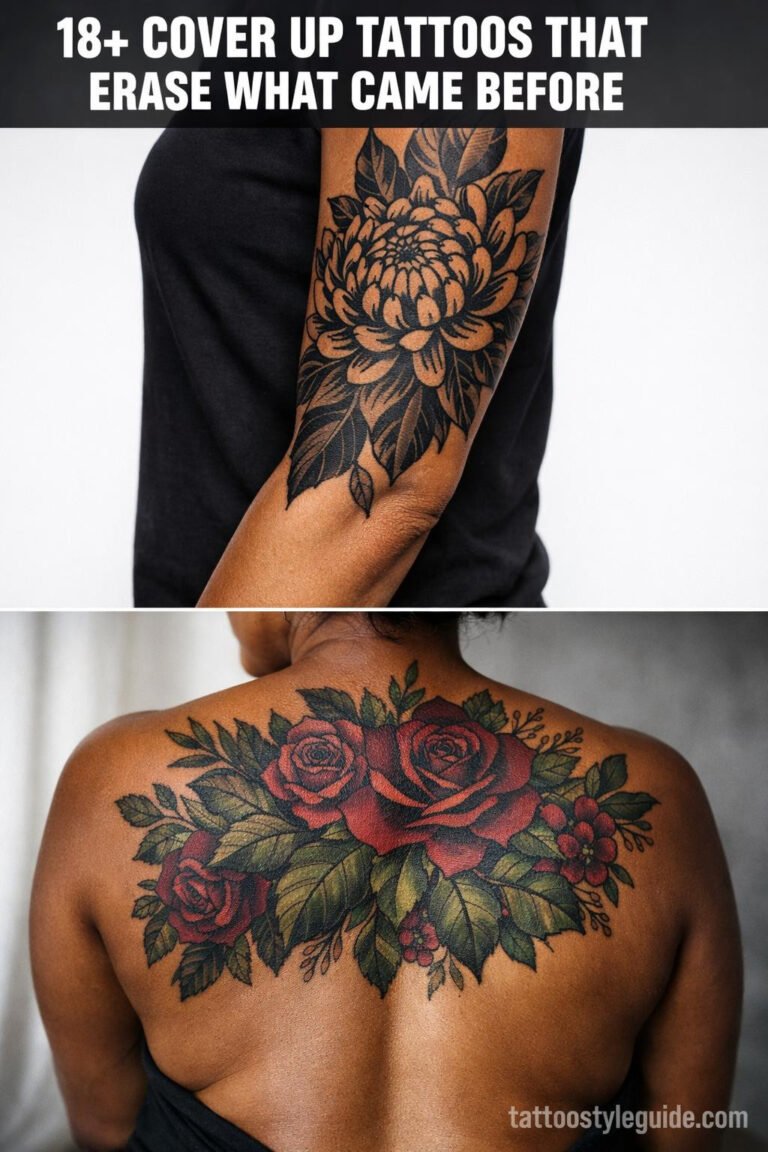
- Dense florals (roses, peonies, dark bouquets). Petals, leaves, and shadow zones let the artist drop black exactly over the loudest old lines while the bloom still reads as one clean image.
- Blackwork and dotwork. Solid black masses and dense dotwork swallow old contours. This is the strongest option for saturated black ink and old tribal work.
- Mandalas and ornamental geometry. Repeating patterns, big black fills, and grey transitions break up an existing shape so the eye stops reading it.
- Snakes and dragons. Long curving bodies plus scale and shadow texture wrap around old lines and hide them inside the form.
- Textured animals (feathers, fur, scales). Birds, big cats, and koi carry enough surface detail to distract from whatever sits underneath.
- Large leaves and botanical fills. Foliage follows the lines of the old motif and adds the veins and shadow needed to fold its edges into the new design.
What to avoid
Light, airy styles work in the opposite direction. Minimalist fine line, watercolor with no black, and small open pieces almost never cover a dark old tattoo, because there is not enough pigment to overpower what is already there. If you love those styles, plan for laser fading first, or accept that the old tattoo will ghost through in certain light.
Why density and darkness do the work
The optical reality
Three simple rules explain every motif choice above. First, you cannot lay light ink over dark ink and expect to see the light color; the old ink shows through. Second, a cover-up has to be as dark as or darker than what it hides. Third, detail is distraction: the more texture, shadow, and small elements you pack in, the harder it is for the eye to find the old shape.
How artists place the black
In practice that means the most saturated parts of the new design (black, midnight blue, deep burgundy) go exactly where the old tattoo is most visible. Grey washes, hatching, and texture then blend the old edges into the new piece so nothing reads as a hard border. A good artist will map this out before touching needle to skin, often drawing the old tattoo’s outline onto their stencil so they know precisely where the danger zones sit.
Black cover-ups vs color cover-ups
Black and grey as the default
Black and grey gives you the most covering power and usually the most even aging, which is why it is the default for tribals, heavy lettering, and very saturated old work. Over time, black settles and softens in a relatively predictable way. Color opens up more artistic options and can pull the eye away with reds, purples, and dark greens, but light or flashy colors will not hide black on their own.
The hybrid approach
A common solution is heavy black-and-grey over the critical zones where old pigment sits thickest, then brighter color in the open areas where little or no old ink remains. This gives you coverage where you need it and vibrancy where you can afford it. Ask your artist to show you healed photos of hybrid cover-ups specifically, not just fresh work. Fresh color always looks bolder than it will in two years.
Size, placement, and when to consider laser
The rule of expansion
Artists repeat the same three words: bigger, darker, more detailed. A cover-up generally needs to run two to three times larger than the original so there is room to hide, distract, and rebuild flow. Sometimes the better move is to extend the piece onto neighboring skin, turning a small forearm name into a larger floral sleeve segment, or a shoulder tribal into a full back piece. The shape of your body and the flow of muscle matter here. An experienced artist will design around your movement, not just the old tattoo’s footprint.
Placement realities
Some spots cover more easily than others. The upper arm, thigh, back, and shoulder blade offer flat, broad surfaces where a design can spread without fighting bone or thin skin. Wrists, ankles, ribs, and fingers are harder. The skin is thinner, the old tattoo is often smaller and more constrained, and the artist has less room to work. If your unwanted ink sits in one of these tight spots, be prepared for either significant expansion onto adjacent skin or a conversation about laser.
Laser as a tool, not a failure
Laser fading is not an admission that the cover-up is impossible. It is a tool that expands your options. Very dark or saturated old tattoos often need one to three sessions to break up the densest pigment so the new design does not have to be a wall of pure black. Even partial fading can mean the difference between a floral piece you love and a blackwork design you settled for. Most reputable artists will refer you to a laser clinic they trust, or work with one directly, rather than promise a miracle on skin that is clearly too saturated.
Working with the right artist
Portfolio red flags and green lights
Not every talented tattoo artist is a good cover-up artist. Look for healed photos specifically, not just fresh work. Ask how many cover-ups they have done in the last year. An artist who hesitates or shows you only one or two examples is telling you something. The ones who do this regularly will have dozens of before-and-after images and will talk about the old tattoo’s constraints before you even mention them.
What to bring to consultation
Bring clear photos of the old tattoo in natural light, not flash. Know roughly what you want, but stay flexible on size and exact motif. The artist needs room to solve the problem their way. If you are locked on a tiny watercolor butterfly to cover a dense black tribal, you are setting up both of you for disappointment. Trust the process, but verify that the artist has actually solved problems like yours before.
Before You Decide
Honest expectations
A cover-up is a compromise between what you want and what your skin will allow. The best results come from respecting that compromise rather than fighting it. You may not get your dream design on the first try. You may need to live with a larger piece than you planned, or a darker palette, or a few laser sessions before the real work starts. What you will get is skin you no longer feel the need to explain or hide.
The long view
Cover-up ink ages differently than fresh work. The old layer continues to shift and fade underneath, and the new layer settles over it. A design that looks perfect at two years may reveal subtle ghosts at ten. Plan for touch-ups, protect the work from sun, and choose an artist who thinks in decades, not just Instagram posts. The goal is not perfection. The goal is a tattoo you are glad to wear.
Frequently Asked Questions
What is the best tattoo design for a cover-up?
Dense florals, blackwork, mandalas, snakes, and dragons work best because they give the artist room to place solid black and texture exactly where old ink shows through. The specific design depends on your existing tattoo’s size, darkness, and placement.
Can any tattoo be covered up?
Most can be covered or significantly improved, but very dark, saturated, or scarred tattoos may need laser fading first. Extremely light or minimalist styles rarely cover dense old ink without significant expansion or pre-treatment.
How much bigger does a cover-up need to be?
Generally two to three times larger than the original tattoo, though faded or very light old work can sometimes stay closer to the same size. The artist needs enough canvas to hide old edges and rebuild visual flow.
Is a cover-up more painful than a regular tattoo?
Often yes, because the needle passes through scar tissue and existing ink deposits. The sensation is usually denser and more intense, especially over areas that were already heavily worked. Healing also tends to take longer.
How much does a cover-up tattoo cost?
In the US, expect roughly $200 to $800 or more depending on size, complexity, and how dark the original tattoo is. Artists often charge more for cover-ups because they require additional design time and technical problem-solving.