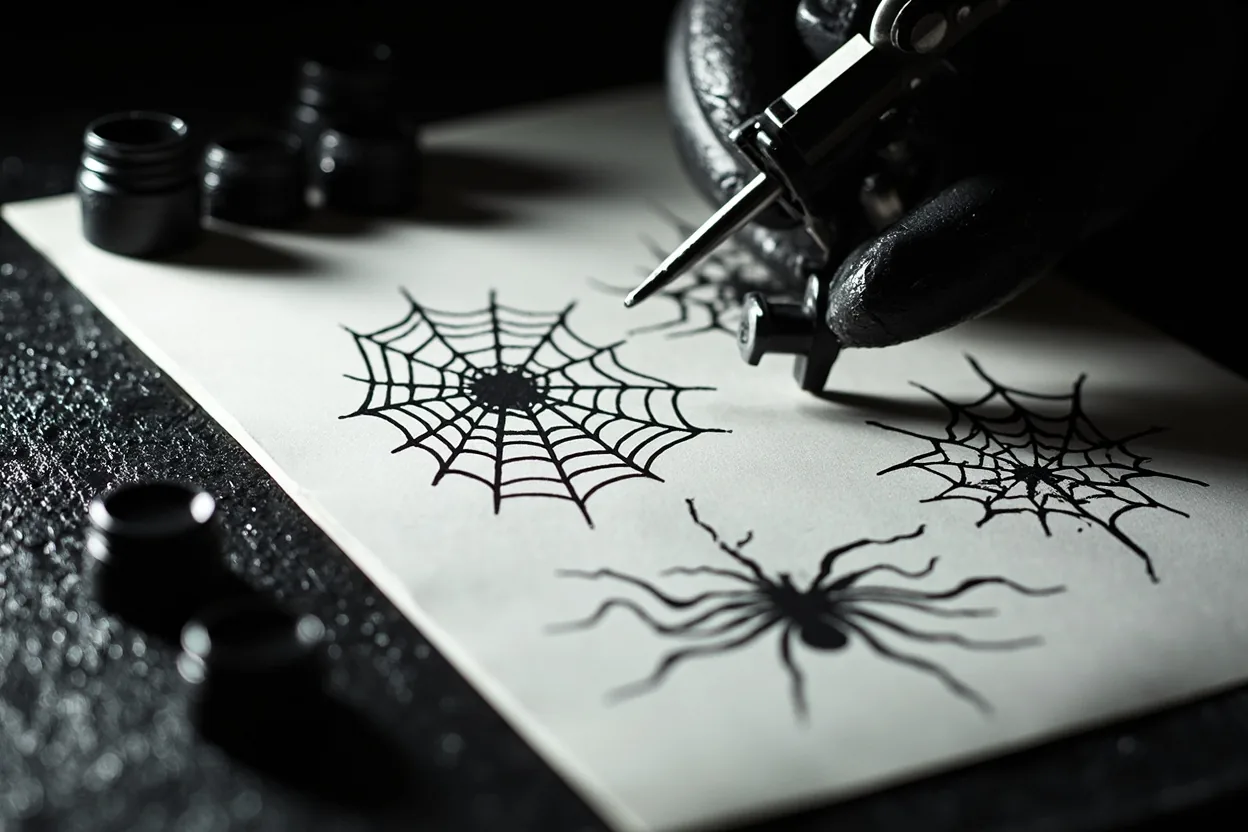
Spider web tattoos are visually strong because the design already understands skin: radial lines, negative space, tension, and a natural fit around elbows, knees, shoulders, and hands. The meaning is more complicated. Depending on context, a web can suggest time, being trapped, survival, patience, dark beauty, prison associations, or simply a classic elbow filler.
Quick answer: A spider web tattoo can mean being trapped, time served, survival, patience, struggle, gothic style, or old-school tattoo tradition. Elbow spider webs are the most iconic, but the placement can carry prison or subculture associations.
Spider web tattoo meanings by design choice
The same web can read very differently depending on where it sits and what you add to it.
| Idea | Best for | Watch out for |
|---|---|---|
| Elbow web | Classic joint tattoo and old-school filler | Can carry prison or subculture associations |
| Web with spider | Patience, danger, predator energy | Can become too literal |
| Gothic web | Dark decorative style | Needs contrast, not clutter |
| Broken web | Escape or survival | Meaning must be clear |
| Web with flower | Softened dark symbol | Balance delicate and dark elements |
| Knee web | Bold joint statement | Pain and symmetry risk |
Why the elbow spider web is so recognizable
A spider web on the elbow says something, make sure you mean it.
The elbow works for spider webs because the joint already gives the design a center. The web can radiate outward and still look intentional when the arm bends. That is why elbow webs became one of the classic joint tattoos.
But recognizable does not mean neutral. In some settings, spider web tattoos have been associated with prison, time served, gangs, or old-school tough-guy imagery. Not every web means that, but people may still read it through that history.
If you want the design for gothic, traditional, or visual reasons, decide how much of that context you are comfortable carrying.
Modern spider web designs
A modern spider web tattoo can be cleaner than the old elbow stereotype. Shoulder webs, knee webs, ornamental webs, hand webs, and web-and-flower combinations all shift the mood.
Fine line webs look delicate, but they need spacing. If the lines are too close, the web can heal like a grey patch. Bold traditional webs hold structure better because the design uses stronger lines and open skin.
Adding a spider makes the tattoo more literal and darker. Adding a flower or jewel can turn the web into a decorative frame. A broken web can suggest escape, but only if the composition actually shows a break.
Placement and aging notes
Elbows and knees are difficult placements. They bend, swell, scab, and rub. A web can handle that better than many designs, but only if the lines are bold enough and the center is placed correctly.
Hands and fingers make the design more visible and more likely to fade. Shoulder, upper arm, and calf placements give the artist more control and usually carry fewer social assumptions than elbow or hand placement.
Check the stencil with the joint bent and straight. A web that looks balanced in only one position is not ready.
How to make it personal without ignoring the context
If the meaning is about survival or escape, show that through the web structure: a broken strand, open center, flower growing through it, or a spider moving away from the trap.
If the meaning is purely aesthetic, own that. A blackwork or gothic web can be a style choice. The important part is not pretending the symbol has no history.
Ask your artist what people in your area might assume from the placement. A good tattoo decision includes how the symbol reads outside your own moodboard.
Editorial note: Spider web meanings vary by person, place, and subculture. This guide avoids claiming one universal meaning because that would be misleading.
Spider web tattoo styles compared
Traditional spider webs use bold lines and open skin. They age well because the web remains readable even when the line softens slightly.
Fine line spider webs feel more delicate and gothic, but they need more space than people expect. A tiny web with too many strands can heal into a grey patch.
Blackwork webs can be dramatic, especially on elbows, knees, shoulders, and hands. The danger is making the design too dark. The web needs negative space to stay web-like.
What to ask before choosing an elbow web
Ask the artist how the web will look with the joint bent and straight. The elbow is not flat, and the center point needs to land correctly.
Ask how much social context the placement carries in your area. A spider web on the elbow reads differently from a web on the shoulder or upper arm.
Ask whether the design should be part of a larger sleeve. Elbow webs often work better when they connect to surrounding tattoos instead of sitting alone.
Reader questions before you book
Does a spider web tattoo always mean prison?
No. It can mean many things or simply be a traditional design. But prison and time-served associations exist, especially around elbow webs, so the context should be considered.
Is an elbow spider web a bad idea?
Not automatically. It is bold, painful, visible in short sleeves, and culturally loaded. Choose it only if you are comfortable with that weight.
What is a softer version of a spider web tattoo?
A shoulder, upper arm, or floral web can feel less aggressive than an elbow web. Fine line can soften it, but it still needs enough spacing.
Do spider web tattoos age well?
They can, especially with bold open lines. Tiny, dense webs are more likely to blur or lose their clean structure.