
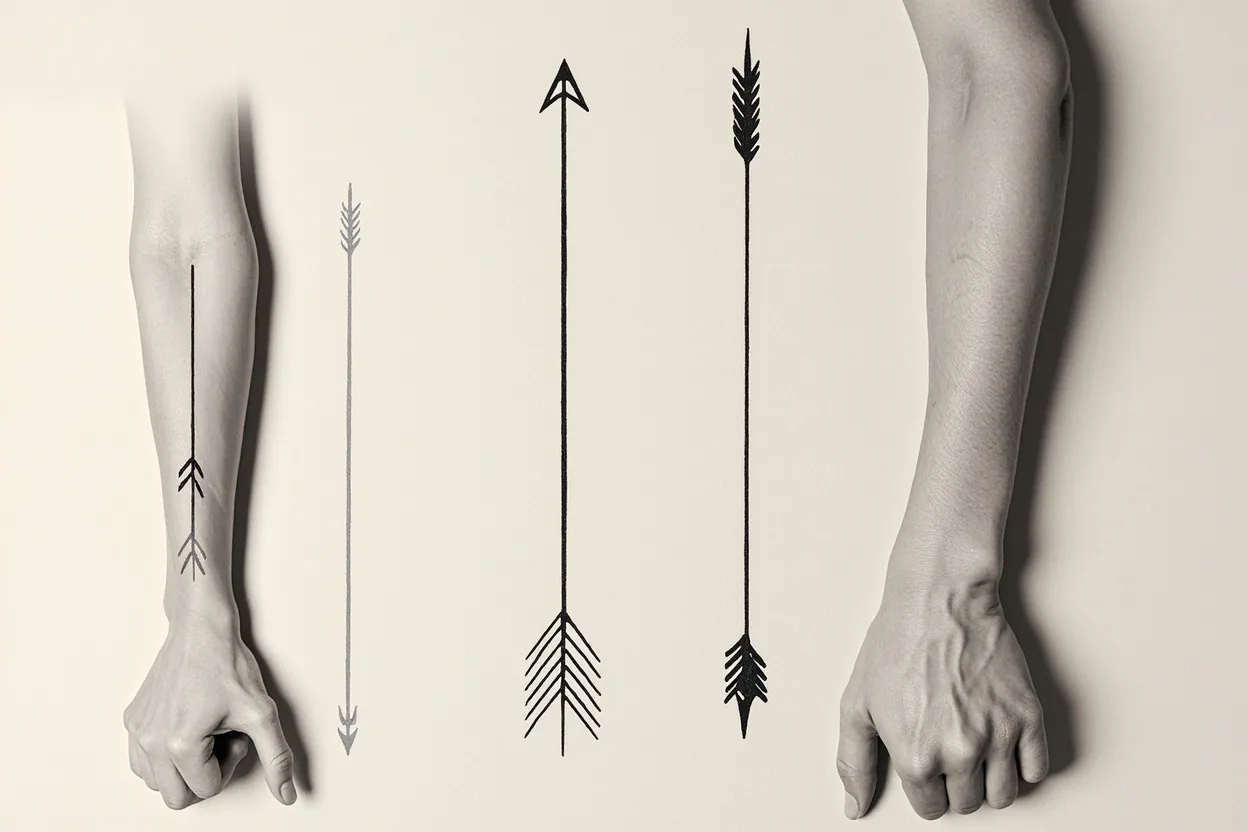
An arrow tattoo usually means direction, focus, protection, forward motion, purpose, and the discipline to aim at one path. The best version is not just the symbol copied from a reference board. It is the symbol shaped around placement, style, scale and the amount of context you want other people to read.
What the Symbol Actually Means
The arrow is one of the oldest tools humans made, and that history lives in the tattoo. Before it was a decorative mark, it was survival: food, defense, distance made manageable. A tattooed arrow carries some of that weight even now, though the meaning you choose is what matters.
Direction is the most common reading. The arrow points somewhere, and you choose where. Focus comes from the single line, the shaft that does not waver. Protection is often linked to Native American traditions, though specific tribal meanings vary and should be researched with care rather than borrowed casually. Forward motion is the simplest read: arrows fly, they do not retreat. Purpose and discipline are quieter meanings, the private commitment to one path rather than many.
Do not treat the meaning like a fixed dictionary entry. A symbol changes when it is drawn as a tiny outline, a heavy blackwork piece, a traditional flash design, a soft fine line tattoo, or part of a larger sleeve. The strongest designs have one clear emotional center. If you want the tattoo to mean everything at once, the final image can become crowded and vague.
Design Ideas That Hold Up on Skin
Single Arrow
The cleanest version. One line, one direction, one meaning. Works on forearm, rib, spine, ankle, or wrist. The risk is blandness: a single arrow without personal adjustment can look like clip art. Counter this with line weight variation, a subtle curve, or a placement that follows your body’s natural geometry.
Crossed Arrows
Often linked to friendship, alliance, or shared direction in various traditions. Two shafts meeting at an angle can feel balanced and reciprocal. The composition needs careful spacing; too close and they blur, too far and they read as separate accidents.
Broken Arrow
Sometimes interpreted as peace, release, or the end of conflict. The break must be deliberate in the design, not ambiguous. A cracked shaft that looks like a mistake ruins the meaning. This version needs enough detail to show intentionality.
Arrow with Supporting Symbols
Compass, north star, flower, wave, sun, or script can sharpen the meaning, but the design should not become a travel collage. One addition is usually enough. Two is the maximum before the arrow stops being the main event.
Placement and What It Changes
Visible Placements
Forearm, wrist, hand-adjacent, and neck placements invite questions. Choose these if the tattoo is part of your daily identity and you are comfortable explaining or not explaining. The arrow on a forearm becomes a gesture, a direction you point with your whole body.
Private Placements
Rib, hip, inner arm, ankle, back shoulder, and sternum placements let the tattoo stay yours. These work well for memorial meanings or commitments you do not need to perform for others. The rib and sternum hurt more and move more with breathing, which affects how straight lines settle.
Direction on the Body
Ask whether the arrow should point up, down, forward, or toward a specific body line. Up reads as aspiration or spirituality. Down reads as grounding or descent. Forward, along a limb, reads as motion. Toward the heart is intimate; away from it is outward-facing strength.
Ask the artist to show the stencil at the actual size on the body. A design that looks balanced on a screen can feel too small once it is sitting on real skin. Straight lines reveal mistakes; curved skin makes straight lines harder than they appear.
Style Choices and Aging
Fine Line
Can look refined, especially on wrist, inner arm, ankle, collarbone, or ribs. The risk is blur: tiny details soften after healing, and what reads as delicate on day one can become a soft grey mark in five years. Keep the detail open. Avoid hair-thin shafts without surrounding negative space.
Traditional and Blackwork
Bolder versions work better on forearm, upper arm, thigh, calf, shoulder blade, or chest. The heavier ink load gives the symbol more staying power. Traditional flash arrows with bold outlines and limited color age predictably. Blackwork versions with solid fills need careful planning so the arrow does not become a black rectangle.
Illustrative and Dotwork
More atmospheric but harder to maintain. Dots can migrate slightly over time, blurring precision. Feathers and detailed fletching need simplification at small sizes. If you want ornate feathering, use a longer placement such as forearm, rib, or calf where the detail has room to breathe.
Making It Feel Like Yours
Add one personal decision instead of five decorative extras. That could be a specific flower with private meaning, a direction tied to a place, a date rendered in a way only you recognize, a style reference from art you love, a color choice with personal resonance, or a placement tied to a specific story.
If the symbol has cultural, historical, or subcultural baggage, ask what strangers may assume. You can still choose it, but you should choose it knowingly. The arrow has been used by countless groups across time; some of those associations may not be yours.
Bring references for mood, not copies. A good artist can keep the meaning while changing the line weight, angle, supporting details, and size so the tattoo belongs to you. The worst consultations are the ones where the client says “I want exactly this” and points to someone else’s skin.
How to Brief Your Artist
Tell the artist which meaning should lead: direction, focus, or moving forward. That choice should influence the pose, line weight, supporting symbols, and how much negative space the design keeps.
Ask for one version that is stripped back and one version with more atmosphere. For an arrow tattoo, the simpler version often ages better, while the atmospheric version may photograph better on day one. Most experienced artists prefer to tattoo the version that will look good in ten years, not just on Instagram.
Before approving the stencil, check whether the tattoo still reads without a caption. If someone has to zoom in or ask what the symbol is, the design probably needs a clearer outline or a larger placement. The arrow is a simple shape; it should remain simple.
Common Questions Before You Book
Is this a good first tattoo?
It can be, if the design is not too tiny and the placement matches your comfort with visibility. Ask for a stencil size that will still read after healing, not just in the mirror on the day. Many first-timers go too small; arrows need enough line to stay arrows.
What style ages best?
Clean outlines, enough contrast, and simplified details age better than cramped micro detail. Fine line can work, but it needs realistic scale. A line that is bold enough to see across a room will still be there in a decade.
Where should I place it?
Work backwards from your daily life. Do you want to see it? Do you want others to? Do you need to hide it for work? The forearm is honest and visible. The rib is hidden and hurts more. The spine is dramatic but requires trust in your artist’s ability to keep lines straight over bone.
How do I avoid a generic arrow?
One specific choice. Not five. A direction that means something. A line weight that matches your body. A placement that follows your movement. A single addition with private significance. Generic comes from copying; personal comes from deciding.
Before You Decide
The arrow tattoo works because it is simple, but that simplicity is also its risk. Anyone can draw an arrow. The question is whether your arrow carries weight beyond the shape.
Start with the meaning, not the Pinterest board. Know why you want it, where you want it, and what you want it to say when you are not there to explain. Then find an artist who can subtract rather than add, who understands that the best arrow tattoo is the one that needs no caption.
Straight lines are harder than they look. Meaning is harder than straight lines. Both are worth getting right.
Frequently Asked Questions
Is an arrow tattoo a good first tattoo?
It can be, if the design is not too tiny and the placement matches your comfort with visibility. Ask for a stencil size that will still read after healing. Many first-timers go too small; arrows need enough line to stay arrows over time.
What style ages best for arrow tattoos?
Clean outlines, enough contrast, and simplified details age better than cramped micro detail. Fine line can work, but it needs realistic scale. A line that is bold enough to see across a room will still be there in a decade.
Where should I place an arrow tattoo?
Work backwards from your daily life. Do you want to see it? Do you want others to? Do you need to hide it for work? The forearm is honest and visible. The rib is hidden and hurts more. The spine is dramatic but requires trust in your artist’s ability to keep lines straight over bone.
How do I avoid a generic arrow tattoo?
One specific choice. Not five. A direction that means something. A line weight that matches your body. A placement that follows your movement. A single addition with private significance. Generic comes from copying; personal comes from deciding.
What does a broken arrow tattoo mean?
Sometimes interpreted as peace, release, or the end of conflict. The break must be deliberate in the design, not ambiguous. This version needs enough detail to show intentionality so it does not look like a mistake.









