
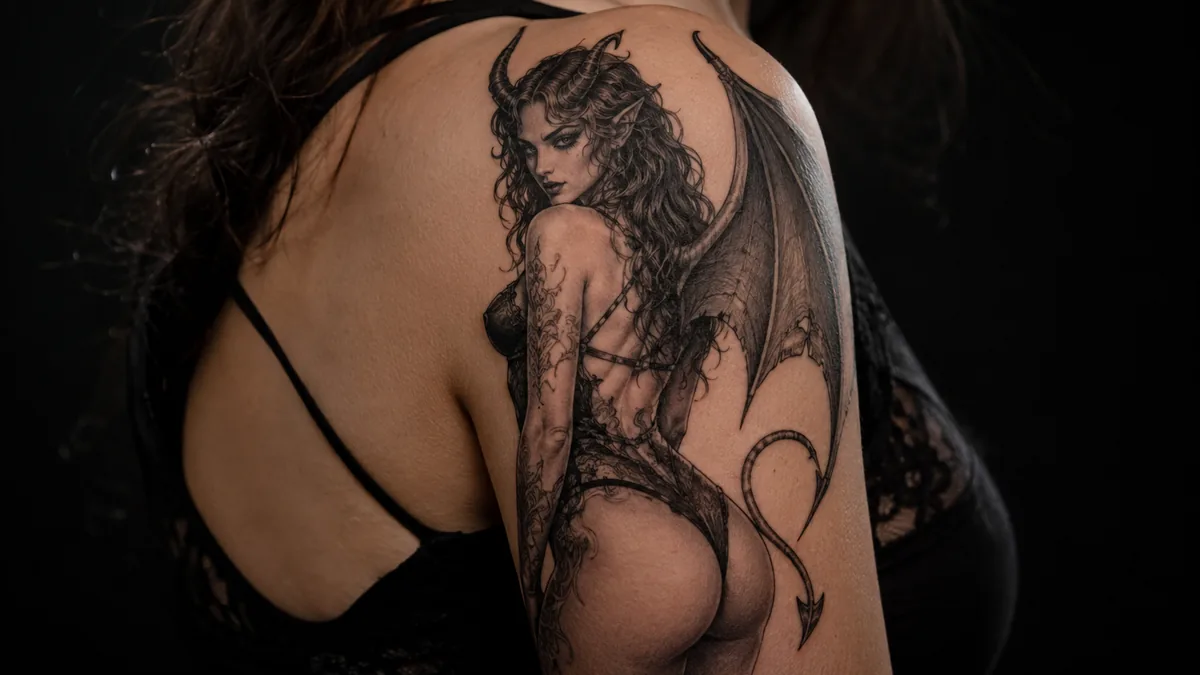
A succubus tattoo is a bold statement about power, desire, and the parts of yourself you refuse to apologize for. The succubus is a demon from folklore, traditionally a female spirit who seduces men in their sleep. As a tattoo, she’s less about literal demonology and more about owning your darker, more magnetic energy.
People get this tattoo to represent seduction without shame, feminine power with teeth, and the refusal to be tamed. It’s a piece that says something real about the person wearing it. Whether you lean into the horror side or the ethereal side, the meaning stays grounded in one core idea: power wrapped in something beautiful and dangerous.
Core Meaning: Temptation and Dark Feminine Power
The main reading of a succubus tattoo is unapologetic seductive power. She represents desire as a force, not a weakness. People wear this to reclaim sexuality on their own terms. She doesn’t ask permission. That’s the whole point.
There’s also a shadow-self angle here. Jungian psychology talks about the shadow as the parts of yourself you suppress. A lot of people who get this tattoo are specifically owning those suppressed parts. The hunger, the ambition, the refusal to shrink. The succubus puts all of that on the surface and dares you to look.
Folklore and Historical Background
She is not the villain. She is the desire you were told to be afraid of.
The succubus comes from medieval European and Judeo-Christian demonology. She appears in texts like the Malleus Maleficarum, described as a demon who drained men of life force through erotic dreams. In Jewish folklore, Lilith is the proto-succubus, Adam’s first wife who refused to submit and was cast out, later reimagined as a demon queen. That Lilith connection is real and well-documented.
Over centuries the succubus archetype showed up in art, literature, and religious fear campaigns. She was a convenient way to blame male desire on an external supernatural force. Today’s tattoo culture flips that narrative. The person getting the tattoo reclaims her as a symbol of strength, not sin. That historical reversal is part of what gives the piece so much weight.
What the Succubus Represents Beyond the Obvious
Beyond seduction, the succubus tattoo carries meanings around self-determination and refusal to conform. She operates outside societal rules. That resonates with a lot of people who feel like outsiders, who live outside the lines society drew for them. The piece becomes a marker of that identity.
Some people also use it to represent surviving something. A predator turned protector. You went through fire, you came out changed, and now you wear something that reflects that transformation without softening it. The demon imagery isn’t gratuitous in that context. It’s honest about what the experience cost and what it built.
Design Variations and Popular Styles
The most common approach is a winged female figure with horns, a tail, and dramatic expression. Traditional American style gives her bold outlines and saturated reds and blacks. She reads from across the room, which is exactly what you want with a piece this loaded with personality. Japanese-influenced designs sometimes incorporate her into a larger scene with flames or serpents.
Fine line and blackwork are gaining ground fast. A fine line succubus in black and grey goes dark and moody, heavier on detail in the face and wings. Neo-traditional versions push the colors and give her an illustrative quality that feels like a dark comic cover. Illustrative realism is popular too, especially for chest and back pieces where you have room to build shadow and depth properly.
Color vs. Black and Grey
Color saturated pieces hit harder visually. Deep reds, purples, and blacks make her feel alive and dangerous. Saturated work like this needs good skin prep and a skilled hand on the machine because those pigments have to be packed solid to hold over time. Bold will hold here, and in high-wear zones crispy lines from day one matter most.
Black and grey opens up a different mood. She becomes more atmospheric, more mysterious. Whip shading and smooth gradients let the detail in her face and wings really carry the piece. A lot of collectors prefer this route because it ages more predictably and still looks sharp years later. Both approaches are valid. The choice comes down to whether you want her to feel like a warning or a ghost.
Best Placements and How It Ages
The thigh is the most popular placement for this design, and it makes sense. You’ve got room to build the full figure, the wings, the background elements. It’s a lower-wear zone, so fine details survive better there. The back and chest are solid choices for larger compositions. Ribs work if you want it more private and can handle the pain, which is pretty spicy in that area.
Hands, neck, and inner forearm are high-wear zones with more sun exposure and friction. Simpler designs with bold lines hold better there. Fine line succubus pieces in those spots will need touchups sooner. Behind the ear and ankle are doable for small minimalist takes, but you lose most of the narrative detail at that scale. Plan the size and placement together, not separately.
Who Gets This Tattoo and How to Make It Personal
A wide range of people get succubus tattoos. Women reclaiming sexuality and power. People exploring their identity outside traditional gender boxes. Horror fans who genuinely love the creature design with no deeper agenda required. Survivors using dark imagery to mark something they’ve processed. The meaning is layered enough that it works for all of them without contradiction.
To make it personal, think about what she’s doing in the image and what’s around her. Is she ascending or descending? Is she holding something? Is there a moon, a sigil, a specific color palette that ties to your own story? Work with your artist on that composition before you commit. A succubus tattoo that reflects your actual story hits a hundred times harder than a generic design.









