
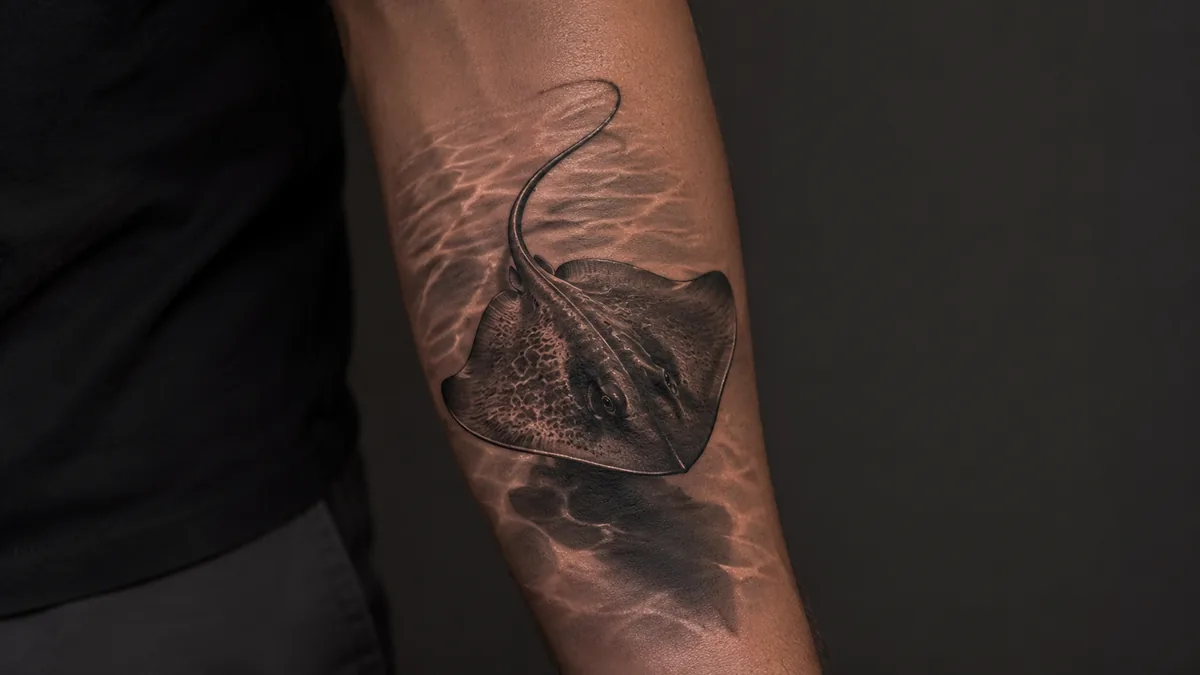
The stingray is one of those ocean creatures that earns respect without asking for it. Glides silent, moves with purpose, and carries a hidden defense most people never see coming. That energy translates directly to skin.
As a tattoo, the stingray pulls from a mix of Polynesian tradition, maritime culture, and personal symbolism around adaptability and quiet strength. People who get this piece are almost never doing it for trend. They know what they want it to say.
Core Meaning: What the Stingray Tattoo Actually Symbolizes
The stingray tattoo most commonly represents grace under pressure. The animal moves through water without effort, without noise, without aggression, yet it carries a venomous barb for when things go sideways. That combination reads as calm on the surface, dangerous when pushed. A lot of people connect to that.
Protection is another major reading. The barb is a last resort, not a first strike. So the stingray often stands for someone who is peaceful by default but fully capable of defending what matters. Adaptability and camouflage come up too, since rays blend into the seafloor until the moment they choose not to.
Polynesian and Pacific Island Roots
It doesn't attack first, it just never gets caught off guard.
The stingray holds real cultural weight in Polynesian tattooing, particularly in Hawaiian, Samoan, and Maori traditions. In Hawaiian culture, the stingray, called hihimanu, meaning ‘majestic bird,’ was seen as a guardian spirit and a protector of fishermen. Wearing it was a way to carry that protection into dangerous water.
In broader Polynesian tatau traditions, the stingray shape appears in geometric patterns representing the ocean, navigation, and the ability to move through life’s currents without losing direction. If you’re getting a Polynesian-style stingray, that lineage matters. A tattooist who specializes in this style will tell you the same. Research the symbols, respect the source.
Freedom, Flow, and Hidden Strength
Outside of any specific cultural context, the stingray tattoo is widely read as a symbol of freedom and flow. Rays don’t fight the current. They ride it, shift with it, use it. People going through major life transitions, career changes, grief, reinvention, often land on this image because of that quality.
The hidden strength angle resonates with introverts, with people who’ve been underestimated, with anyone who operates quietly and effectively without needing validation. It’s not a loud tattoo symbolically. It says what it says to the people who look closely.
Design Variations: From Realism to Geometric
Realism stingrays are popular for back pieces and thighs, where there’s enough real estate to render the skin texture, the spotted pattern on a spotted eagle ray, or the mottled grey of a southern stingray. The detail work in a solid realism piece is serious, and it rewards the investment. A good artist will catch how light bends across the wing edges.
Geometric and blackwork stingrays are all over right now, and they hold up clean. The flat, wide shape of the body lends itself to mandala-style fills, dotwork shading, and bold linework. Neo-traditional versions pump up the color saturation and exaggerate the proportions for a graphic, illustrative look. Polynesian style uses the silhouette as a container for traditional pattern fills. Every one of these reads differently on skin.
Color vs. Black and Grey
Black and grey is the dominant choice for stingray tattoos and makes sense given the subject. The real animal lives in muted tones, greys, browns, spotted whites, and a skilled black and grey artist can render that texture with whip shading that heals beautifully and stays readable for years. The contrast between the dark body and lighter belly detail gives the piece depth without needing color.
Color opens up options, especially for spotted eagle rays, which carry bold white spots on deep charcoal skin, or for artists going stylized with teal and navy gradients. Saturated color in a stingray can look crisp and bold when fresh, but color fades faster than black ink, particularly in high-wear zones. Talk to your artist about what holds in your specific placement before committing to a palette.
Best Placements and How It Ages
The stingray’s flat, wide silhouette works exceptionally well on the back, the thigh, the chest, and the shoulder blade. These are lower-wear zones with enough surface area to let the shape breathe. A full back stingray with the wings spread is one of those pieces that reads from across the room with zero ambiguity. It’s a statement without being loud.
Avoid fine-line stingrays in high-wear spots like the inner wrist, fingers, or foot. Those zones flex constantly, get sun and friction, and fine detail blurs faster than you want. If the placement is spicy, like ribs or sternum, the piece will earn its placement but factor that into your session prep. Bold outlines will hold longer than hairline work regardless of placement, and a solid fill ages more gracefully than heavily blended gradients with no anchor lines.
Who Gets a Stingray Tattoo and How to Make It Personal
Surfers, divers, and people with a deep connection to the ocean are obvious fits, but this tattoo spans well beyond that. Teachers, nurses, parents, anyone who operates with quiet authority and doesn’t broadcast their edge, shows up in the chair for this one regularly. It’s a piece with built-in personality that doesn’t need a paragraph to explain itself.
To make it personal, think about what specific quality you’re carrying with you. Add a meaningful element to the background, open water, a specific reef, a moon above the surface. Choose a species that means something, the manta ray for scale and majesty, the spotted eagle ray for visibility, the southern stingray for its camouflage quality. Brief your artist on the story and let them build around it. That’s how you get a piece that’s yours.
Talking to Your Artist Before You Book
Come in with reference images covering style, not just subject. A stingray in a realism photo versus a geometric illustration versus a Polynesian pattern are completely different conversations technically. Your artist needs to know which direction you’re going before they quote time and scale, since a detailed realism ray on the back is a multiple-session commitment.
Ask specifically about linework longevity for your chosen placement. A good artist will tell you straight if your design is too fine for your skin tone or your zone. They’ll also let you know if the sizing needs to scale up so the piece stays crispy after healing. Pushing back on size for the sake of placement is how people end up with a blurry shape five years out. Trust the advice, go bigger when the artist says to.









