
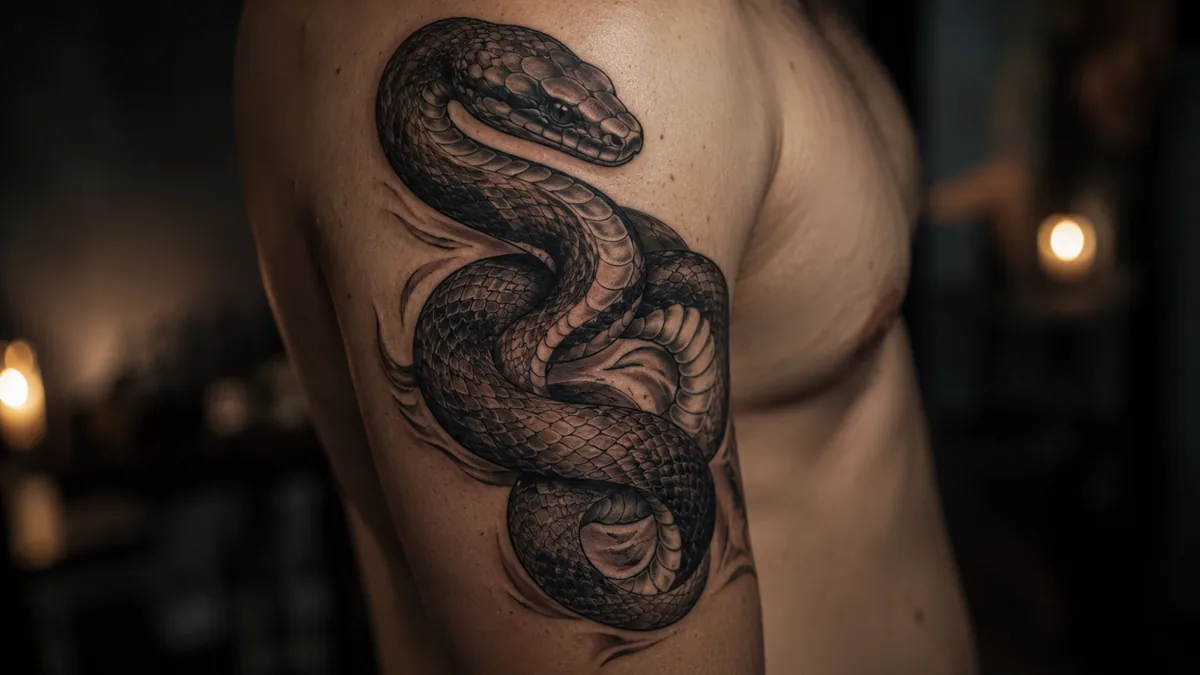
The serpent is one of the oldest tattoo subjects on the planet. People have been inking snakes on their bodies for thousands of years, and the reasons haven’t changed that much. The serpent stands for transformation, cycles of life, danger, healing, and raw primal power. It’s a symbol that carries weight without needing a caption.
What makes the serpent tattoo stick around isn’t just that it looks incredible on skin. It’s that it means something different depending on how you wear it, where it comes from, and how you frame it. One snake can tell a dozen honest stories. That’s rare in tattooing.
Core Symbolism: What the Serpent Actually Represents
The serpent’s most universal meaning is transformation. Snakes shed their skin, and that resonates with people who’ve gone through serious change, loss, recovery, or reinvention. You’re not the same person you were. The serpent gets that. Rebirth is the cleanest read, and it holds across almost every culture that has ever tattooed.
Second is duality. The serpent is both healer and destroyer, wisdom and temptation, life and death. It doesn’t sit comfortably on one side of a line. That ambiguity is exactly why it appeals to people who see the world in more than black and white. It’s a symbol for people comfortable with complexity.
Deep Roots: History and Cultural Context
Every culture that ever existed drew a serpent and meant something different by it.
In ancient Greece, the serpent was tied directly to medicine. The Rod of Asclepius, one snake coiled around a staff, is still the real symbol of healthcare. Snakes in Greek tradition meant healing, knowledge, and protection. Hermes carried the caduceus, two snakes on a winged staff, connecting serpents to communication, travel, and transitions between worlds.
In Norse mythology, Jormungandr is the World Serpent, a creature so vast it encircles the earth and bites its own tail. In Aztec culture, the feathered serpent Quetzalcoatl represented creation and divine wisdom. Hindu traditions link the serpent to Kundalini energy, a coiled force at the base of the spine representing awakening. These aren’t fringe readings. They’re ancient, documented, and still drive real tattoo choices today.
The Ouroboros: The Snake That Eats Itself
The ouroboros, a serpent consuming its own tail in a circle, is one of the most tattooed symbols in the world for a reason. It represents infinity, the eternal cycle of death and rebirth, and the idea that endings and beginnings are the same thing. It reads clearly from across the room and works in almost any style.
The ouroboros hits differently as a tattoo because it’s self-contained. No external meaning required, the image explains itself. Fine line versions look sharp on wrists and forearms. Bold traditional takes hold up better long-term, especially on areas that see a lot of sun and friction. Keep the linework crisp and the proportions tight.
Popular Design Variations and Styles
Traditional American serpents are thick-lined, boldly colored, often shown with open mouths and fangs. They hold beautifully over decades. Bold will hold. Japanese-style snakes, often rendered in tebori or heavy black and grey, show the serpent mid-coil with scales detailed enough to count. They’re usually paired with peonies, chrysanthemums, or cherry blossoms, adding layers of meaning around courage, beauty, and mortality.
Fine line serpents are trending hard right now. Delicate, precise, sometimes wrapped around florals or a dagger. They look clean fresh out of the studio but require a skilled hand and realistic aftercare expectations. Fine line on high-wear zones like fingers, hands, and inner wrists will fade and blur faster. On the forearm or upper arm, a well-done fine line snake can hold its shape for years with proper sun protection.
Color vs Black and Grey
Black and grey serpents are timeless. The contrast reads strong, the shading gives the snake dimension and movement, and the style ages consistently well across most skin tones. A whip-shaded coiled serpent in black and grey on the forearm is a classic for a reason. It’s clean, it’s bold, and it still looks intentional ten years out.
Color adds another layer of meaning. A red serpent signals danger, passion, or aggression. Green connects to nature, venom, and primal energy. Gold or yellow reads as wisdom or divine power in many traditions. Saturated color pops fresh but needs touch-ups. If you go color, choose a saturated palette over pastels. Pastels fade into the skin fast, especially on anything above the elbow.
Placement and How It Ages
The serpent is one of the most placement-flexible tattoos you can get because the shape bends. It follows the body. Wrapped around the forearm, coiled on the upper arm, running down the spine, curling around the thigh or calf. Each placement changes how the design moves when you move. A snake on the forearm reveals itself slowly as you rotate your arm. That’s not an accident.
On the ribs and sternum, the serpent reads as intimate and intentional. Those spots are spicy but the skin holds ink well. The hand and finger placements are high-wear zones with real blowout risk over time. Avoid super fine detail in those spots unless you’re committed to touch-ups. The upper arm and thigh are low-wear, heal nice, and give the artist room to make the design actually breathe.
Who Gets Serpent Tattoos and How to Make It Yours
People drawn to serpent tattoos tend to share a few things: they’ve been through something, they think in cycles rather than straight lines, and they’re comfortable with symbols that don’t have a clean moral. Survivors get serpents. People in medicine get them. People rebuilding after addiction, grief, or a bad chapter get them. It’s not a tattoo that needs explaining, but it rewards a story behind it.
To make it personal, decide what the serpent means to you before you sit down with your artist. Are you going for transformation? Pick the ouroboros or a shedding skin motif. Healing and protection? Look at the Asclepius rod or a coiled guardian pose. Power and duality? Open mouth, fangs out, coiled tight. Bring references, talk to your artist about where it lives on your body, and let the placement and pose carry the meaning. The serpent is flexible. Use that.









