
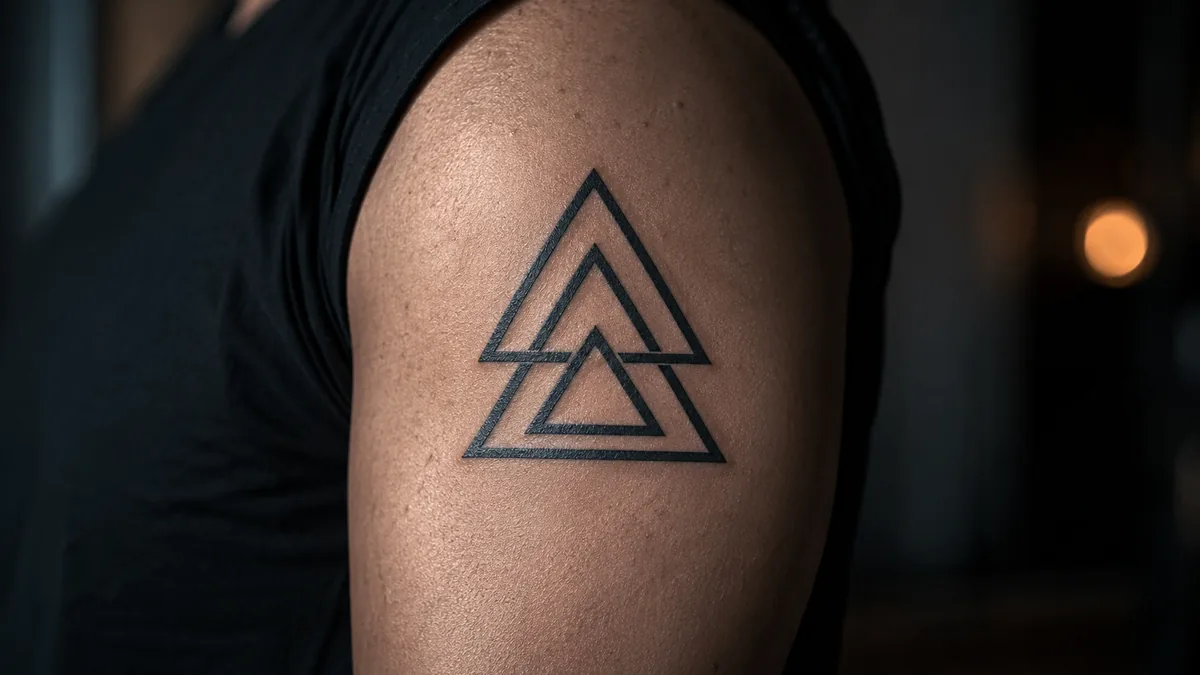
Three triangles on skin carry serious weight. Whether they’re stacked, nested, interlocked, or arranged in a row, this design shows up in studios constantly, and clients always have a reason. It’s not just a shape people grab because it looks cool, though it does look cool. There’s real symbolism underneath it.
The three triangle tattoo can point to Norse mythology, the concept of body-mind-spirit unity, sacred geometry, or simply the power of threes. Context matters a lot here. How you arrange those triangles changes everything about what the piece communicates.
The Power of Three: Core Symbolism
The number three is one of the oldest symbolic numbers humans have used. Past, present, future. Birth, life, death. Creation, preservation, destruction. When you stack three triangles into a single piece, you’re tapping into that ancient shorthand. Three represents cycles, balance, and completeness across dozens of unrelated cultures.
A single triangle already carries meaning: direction, aspiration, strength. Three of them amplifies it. People get this tattoo to mark a personal trinity that matters to them, family, faith, self. Or they’re drawn to the idea that life moves in cycles and they want that philosophy sitting on their skin permanently.
The Valknut: Norse Roots and Real History
Three triangles say more in negative space than most tattoos say with a full sleeve.
The most recognized three-triangle design in tattoo culture is the Valknut. Three interlocking triangles forming a nine-pointed knot. This symbol appears carved into Norse runestones and burial artifacts, often alongside images of Odin. Scholars connect it to the slain warriors Odin claimed, and to the world of the dead.
The Valknut is not decorative filler from some design trend. It’s a documented historical symbol with genuine Norse origins. Some people get it as a tribute to Norse heritage or as a personal connection to Odin’s mythology. Others just respect the geometry. Either way, know what you’re wearing before you sit down.
Sacred Geometry and the Spiritual Angle
Outside of Norse tradition, three triangles appear in sacred geometry as a symbol of divine proportion and universal structure. The triangle itself represents the simplest stable shape in geometry, and repetition of it suggests harmony, pattern, and order beneath the visible world. Spiritual communities, particularly those interested in occult or metaphysical traditions, have used this imagery for centuries.
Clients who gravitate toward this reading usually connect the three triangles to mind, body, and spirit. Or they see it as representing the self in relation to something larger. This tattoo works well for people coming through a major life shift, someone who’s rebuilt themselves and wants a geometric marker for that transition.
Design Variations: What the Arrangement Actually Says
Three triangles stacked vertically read as upward momentum, like steps or tiers climbing toward something. Nested triangles, one inside the other, suggest depth, layers of meaning, or the idea that everything contains something smaller within it. Three separate triangles in a row feel balanced and equal, more like a triptych than a hierarchy.
The Valknut interlocking form is the tightest read, clearly referencing Norse symbolism. Fine line versions give it a delicate, meditative feel. Bold blackwork makes it read from across the room, clean and solid. Geometric dotwork adds texture without losing the sharp silhouette. Your artist can make three triangles hit completely differently depending on line weight and arrangement.
Black and Grey vs. Color: Which Holds Better
This design is built for black ink. The strength of three triangles is in the precision of those clean lines and the geometry of the negative space. Black and grey lets the shape do all the talking. A skilled artist who can pull crispy, consistent lines will make this tattoo look sharp for years. Solid black fill inside the triangles adds weight and helps the piece hold as it ages.
Color can work if you’re intentional. Deep navy, forest green, or red accents inside one triangle can signal hierarchy or emphasis without muddying the geometry. Avoid pastel fills, they fade fast and blur the lines over time, especially in high-wear zones. If you want saturated color, go bold or don’t bother. Faded half-color triangles look rough within a few years.
Placement and Longevity: Where It Lives Best
Three triangles scale well, which is why placement options are wide open. Forearm, chest, back of the neck, inner bicep, and shoulder blade all work. The design reads cleanly even at smaller sizes, so you’re not locked into a large piece. That said, going too small with fine line on a high-wear zone like the wrist or finger is a recipe for blowout and fading.
The upper arm and outer forearm are solid choices for longevity. Skin stays relatively stable there, the piece stays visible, and you avoid the constant friction that breaks down work on hands, fingers, and feet. If you want it on the chest or sternum, it heals nice and ages well. Ribs are spicy but the skin quality there holds ink consistently if your artist has the right hand pressure.
Who Gets This Tattoo and How to Make It Yours
Mathematicians, philosophers, people with Norse ancestry, minimalist tattoo collectors, and people marking major life chapters all find their way to this design. It’s one of those pieces where the geometry is universal enough that anyone can wear it, but the meaning is personal enough that it stays meaningful.
To make it yours, bring your specific interpretation to the consultation. Tell your artist which arrangement resonates and why. Combine it with a rune, a date in roman numerals, or a subtle texture that references your background. Or keep it stripped down to pure geometry. Either direction works. The three triangle tattoo earns its place on skin because it’s simple, durable, and it means something real to the person wearing it.









