
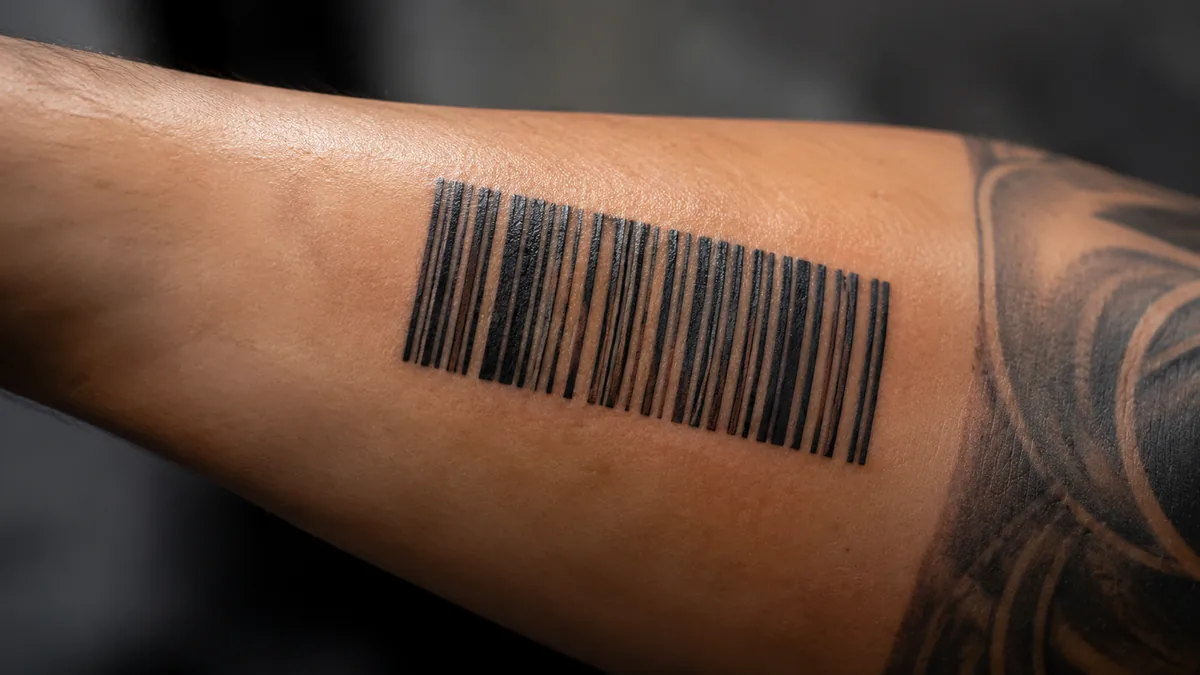
The barcode tattoo is one of those designs that hits differently depending on who’s wearing it. it’s a statement about identity, consumerism, and what it means to be tracked, categorized, or owned in a modern world. Simple in form, heavy in meaning.
You’ve seen it on necks, wrists, forearms. Sometimes it’s got a number underneath. Sometimes it scans. Sometimes it’s pure art. Either way, it’s not a casual choice. People who get barcodes usually have something specific to say, and the design backs it up without screaming it.
Core Meaning: Identity, Control, and Rebellion
The most common reading of a barcode tattoo is resistance against being reduced to a number. The idea that modern society, corporations, governments, turns people into products. Something to be scanned, tracked, and consumed. Wearing a barcode on your skin flips that. You’re owning the label instead of letting it own you. It’s reclaiming the symbol of commodification and making it personal.
For some people it goes deeper into anti-establishment or anti-capitalist territory. The barcode becomes a protest against surveillance culture, consumer identity, and the way big systems process individuals. That said, it doesn’t have to be political. Some people just resonate with the idea that they refuse to be defined by a code someone else assigned them.
Cultural and Historical Context
You are not a product. But you get to decide what the barcode says.
The modern barcode was patented in 1952 and became widespread in retail through the 1970s. By the 1980s and 90s, it had started appearing in punk and cyberpunk subcultures as a symbol of corporate control. Movies, dystopian fiction, and sci-fi lit picked it up hard, most notably in the Halo video game franchise where the character Master Chief has a barcode on the back of his neck. That image alone drove a significant wave of barcode neck tattoos.
The symbol landed in tattoo culture through the same anti-authoritarian current that fueled tribal and traditional work in the underground scene. It wasn’t a mainstream image until the mid-2000s, when fine line work started making it more accessible. The dystopian and cyberpunk associations have stuck. It reads as tech-aware, socially conscious, and edgy without being cartoonish.
Popular Design Variations
The cleanest version is a straight black barcode, realistic enough to look scannable, sometimes with a number sequence underneath. That number is almost always meaningful: a birthdate, a coordinate, a memorial date, an area code. Some people encode their actual name using barcode generators online and tattoo the result. That’s a solid way to make the design personal without adding extra visual noise.
Other variations lean into the surreal. Barcodes that melt or drip at the bottom. Barcodes wrapped around a wrist like a bracelet. Barcodes integrated into larger sleeves with circuit board patterns, binary code, or biomechanical elements. There’s a version where the bars transition into a skyline or a natural landscape, which softens the industrial feel and adds a personal narrative. Watercolor effects exist but they don’t age as clean.
Fine Line vs Bold Black: Style Matters
Most barcode tattoos are done in straight black and grey, and that’s the right call. The design is geometric and mechanical, so it lives in that world. Fine line barcodes look crispy fresh out of the shop but the thin bars can spread over time, especially on softer skin. If you’re going fine line, placement is everything. Stick to low-stretch zones with good skin tension.
Bold barcodes with thicker bars hold significantly better over a decade. The lines stay sharp, the contrast stays high, and it reads from across the room the way a good geometric piece should. If you want color in the mix, some artists incorporate red scanning lines as a design element, which nods to the laser scan visual. That can look clean in a cyberpunk or tech-themed sleeve but it’s a niche choice.
Best Placements and How It Ages
The back of the neck is the most iconic spot for a barcode, and it works because the skin there is relatively stable and the flat surface suits the horizontal geometry of the design. Wrists and forearms are also popular, giving you a placement that’s easy to show or cover. Inner forearm skin ages decently if you’re not constantly in the sun. The ribs and sternum are options for larger pieces, though those are spicy sessions.
High-wear zones like fingers and hands will break down faster regardless of how good the artist is. The feet are rough territory too. Avoid placing fine line barcodes anywhere that gets daily friction or heavy sun exposure without consistent sunscreen. A well-done bold barcode on the forearm or neck should hold its integrity for years. Touch-ups might be needed on the thinner bars after five to ten years depending on your skin type.
Who Gets This Tattoo and How to Make It Yours
Barcode tattoos cross a wide range of people. Tech workers who identify with the cyberpunk aesthetic. Former military, sometimes referencing service numbers. People who’ve experienced systems that made them feel like a number, incarceration, institutionalization, bureaucratic nightmares. Artists and musicians using it as commentary. Gamers, Halo fans specifically. The design is flexible enough that the personal story behind it can vary wildly without changing the visual.
To make it yours, customize the number. Use your birthdate in a specific format, coordinates of a place that matters, a memorial date for someone you’ve lost. Some clients bring in a word or phrase they want encoded using an online barcode generator, then the artist works from that file. That way the tattoo actually contains something real. Talk to your artist about bar weight before you commit. A few test prints on paper at different thicknesses will save you from a result that blows out or fades early.









