
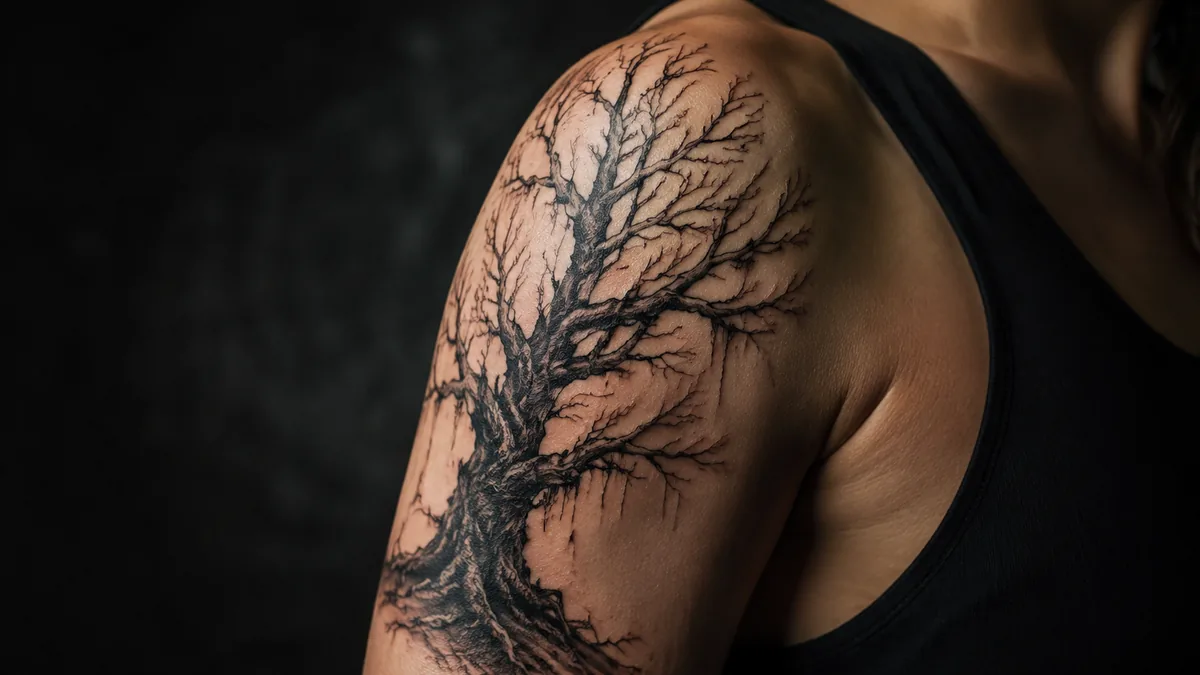
A dead tree tattoo isn’t morbid for the sake of it. It’s one of the most honest symbols you can put on your skin. No leaves, no life in the conventional sense, just bare branches reaching into nothing. That stark image carries real weight, and people feel it.
The meaning shifts depending on the person wearing it, but the core themes are consistent: death, survival, transformation, the passage of time, and the kind of strength that doesn’t need to look pretty to be real. This is a tattoo with teeth.
Core Symbolism: What a Dead Tree Tattoo Actually Means
The most universal read is mortality. A dead tree is a reminder that everything ends, which sounds dark until you realize that’s also freeing. Plenty of people get this piece as a memento mori, keeping death visible on their skin so they stop sleepwalking through life. It’s the same impulse behind skull tattoos, just more subtle and a lot more striking as body art.
The second big reading is resilience. A dead tree is still standing. It weathered whatever killed it and it’s still there, roots in the ground, branches up. For people who’ve been through serious loss, illness, addiction, or grief, that image resonates hard. The tree didn’t fall. Neither did they.
Transformation and the In-Between State
A dead tree still stands. That is the whole point.
Dead trees sit in liminal space. They’re not alive, not fully gone. That in-between state speaks to people going through major life transitions: the end of a relationship, leaving behind an old identity, recovering from something that nearly broke them. The tattoo marks that threshold. You were one thing, now you’re something else, and this is the moment between.
Some clients pair the dead tree with other elements to push this reading further. A single crow perched on a branch, a moon overhead, scattered roots going deep underground. The roots matter especially because they suggest potential. Even a dead-looking tree can be rooted. That’s not nothing. That’s the whole point.
Cultural and Historical Context
Trees have carried symbolic weight across pretty much every human culture, so there’s real historical grounding here. In Norse tradition the world tree Yggdrasil connected all realms, and its decay would signal the end of everything. Celtic cultures tied trees directly to ancestry and the cycle of seasons, dead branches included as part of a natural cycle rather than a failure. Japanese art has a long tradition of depicting bare winter trees, finding beauty in stripped-down forms.
Gothic and Romantic art movements in the 18th and 19th centuries leaned heavily on dead or bare trees as shorthand for melancholy, the sublime, and the transience of human life. You see it in paintings, literature, cemetery iconography. When this imagery moved into tattooing it brought all that weight with it. The visual language was already loaded before your artist ever picked up a machine.
Popular Design Variations and Styles
Black and grey realism is the dominant style for dead tree tattoos, and it earns that dominance. A skilled artist can render bare bark texture, twisted branches, and deep shadow that make the piece look three-dimensional on skin. Fine line work is popular for smaller, more delicate takes, especially on forearms and ribs. The challenge with fine line on a subject this detailed is longevity. Hair-thin branches blur over time, so make sure your artist builds some line weight variation in from the start.
Illustrative and neo-traditional styles give the design more graphic punch. Bold outlines, deliberate stylization, sometimes a limited color palette: grey bark with a single red moon or deep blue sky. Blackwork is another strong option, silhouette dead trees against a solid black background read beautifully from across the room and hold up over years. Some clients go geometric, incorporating the bare tree into mandala or sacred geometry structures. It all works as long as the linework is crispy and your artist plans for how it heals.
Color vs. Black and Grey
Most dead tree tattoos stay in black and grey, and for good reason. The subject matter calls for it. Stripped bare, no leaves, no color, the visual logic of a dead tree is already monochromatic. Black and grey honors that. A great black and grey dead tree with solid whip shading in the bark, clean negative space in the branches, and good contrast will still look solid fifteen years from now if it’s placed well.
That said, color can work when it serves the concept. Some artists incorporate a deep twilight sky, purples and dark blues behind bare branches, creating a scene rather than just a standalone symbol. Winter color palettes: pale grey bark, white snow on branches, a cold sky above, can be stunning in the right hands. What doesn’t usually work is bright, saturated color on the tree itself. It fights the symbolism and tends to muddy the read.
Best Placements and How It Ages
The thigh, back, ribs, and upper arm are your best bets for a detailed dead tree piece. You need real estate to let branches spread naturally without cramming the design. A full back piece or a thigh sleeve lets the tree breathe, and low-wear zones like those protect fine linework over time. The back especially is low-wear, low-sun, and gives your artist room to build a full composition with ground, roots, sky, the works.
Hands, fingers, and feet are high-wear and spicy, and fine-line branches in those zones will blow out faster than you’d like. Inner bicep and ribs are spicy too but heal cleaner than extremities. If you want a forearm piece, build in some line weight so the branches stay readable as the skin moves and ages. Placement on the spine, running the tree vertically from lower back up between shoulder blades, is one of the most striking options and anatomically smart for this subject.
Who Gets This Tattoo and How to Make It Personal
People who’ve lost someone close get this one a lot. It’s grief made visible without being a portrait or a name, which some people prefer. It holds the loss without announcing it to every stranger who sees your arm. Survivors of serious illness or mental health crises gravitate to it for the resilience angle. Artists, writers, and people drawn to darker aesthetic traditions pick it for the visual power and the art history behind it.
To make it personal, give your artist context. Are the roots important to you? Do you want something reaching skyward or something low and sprawling? Does it stand alone in empty space or does it have ground beneath it? Adding a meaningful detail, a specific bird species, a constellation overhead, initials carved into bark, a particular moon phase, sharpens the piece into something uniquely yours without cluttering it. Trust a solid artist with the composition. The best dead tree tattoos are clean, confident, and leave room for the viewer to feel something.









