
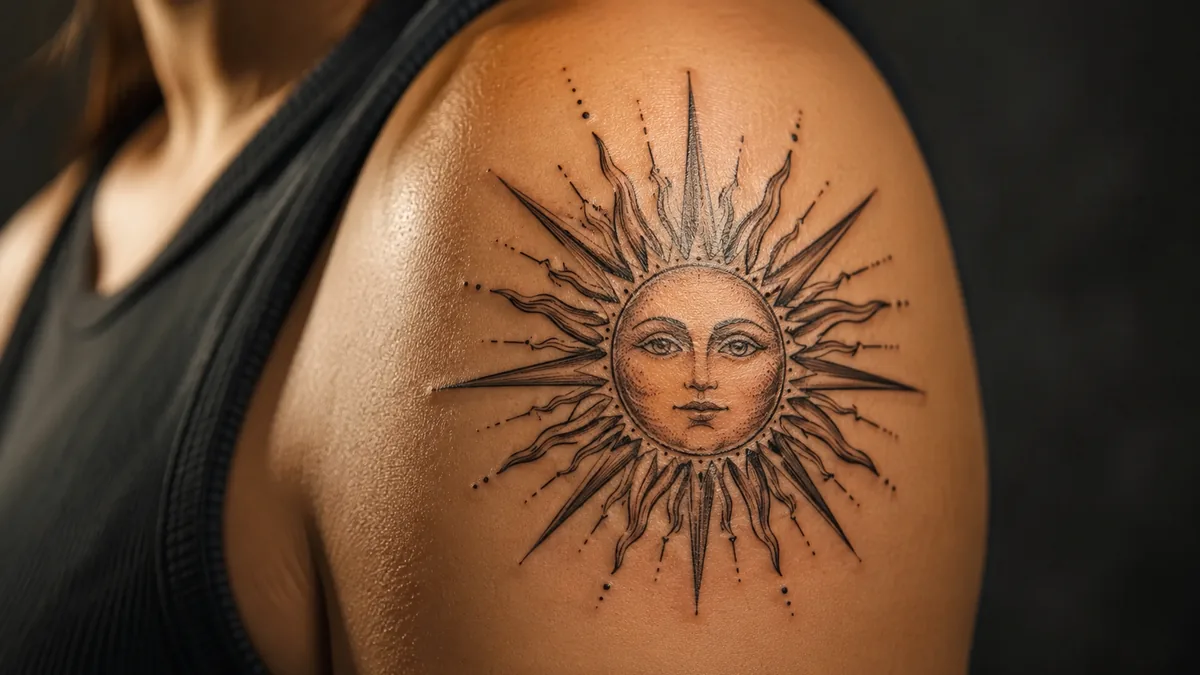
A sunshine tattoo is one of those pieces that means exactly what it looks like, and that’s the point. People get the sun because it’s universal. Warmth, life, hope, new beginnings. It doesn’t need a deep backstory to land. You know what the sun does. It shows up every morning no matter what happened the night before.
That said, there’s real depth here if you want it. Cultures across every continent have attached meaning to the sun for thousands of years. Modern tattoo collectors layer in personal reads too, from mental health recovery to a tribute to someone who was their light. Here’s what the sunshine tattoo actually means, how it’s worn, and how to get it done right.
Core Symbolism: What a Sunshine Tattoo Represents
The sun is the most fundamental symbol of life on the planet. As a tattoo, sunshine most commonly stands for positivity, warmth, energy, and optimism. It’s about being a light source, for yourself or for others. A lot of people describe their sun tattoo as a reminder to keep going, to find the bright side, or to be the person who radiates rather than drains. Simple, honest meaning.
It also carries strong associations with clarity and truth. The sun illuminates what’s hidden. People use it to represent an honest nature, a clear mind, or emerging from a dark period. Survivors of depression, grief, or addiction often choose a sunshine tattoo to mark a turning point. It’s not cliche. It’s direct. And direct symbols make the best tattoos.
Historical and Cultural Background
The sun rises every day, this tattoo reminds you that you do too.
The sun has been a symbol of divine power and protection across virtually every ancient civilization. In ancient Egypt, Ra was the sun god, the supreme force of creation and order. The Aztec sun stone represents cosmic cycles and the fifth sun era humans live in. In Greek mythology, Helios drove the solar chariot, and Apollo governed light and reason. Indigenous cultures across the Americas, Africa, and Asia tied the sun to harvests, healing, and spiritual authority.
In Japanese tattooing, the rising sun, or Asahi, carries meaning tied to vitality, military heritage, and national identity, though that particular rayed design has political baggage worth knowing before you commit. Scandinavian paganism honored Sol, the sun goddess. None of this means your sunshine tattoo needs to be a history lesson. But knowing the roots gives the symbol weight, and it helps you choose which version actually fits your story.
Popular Design Variations
The design range is huge. Classic options include a simple circle with rays, a smiling sun face, a geometric or mandala-style sun, a tribal sun, and a rising sun with horizon lines. Celestial designs pair the sun with the moon, stars, or planets for a cosmic feel. Floral suns wrap petals into the rays. Fine line suns use single-needle work for a delicate, illustrative look. Neo-traditional suns go bold with thick outlines and saturated color.
Sunshine tattoos also appear as part of larger scenes. A sun cresting over mountains, a hand holding a sun, a sun behind clouds breaking through, or a small single-ray starburst on the wrist. The smiling sun face, sometimes called the happy sun, leans playful and is a popular first tattoo choice. Each variation shifts the tone slightly, from spiritual to cheerful to cosmic. Pick the one that reads like you, not just the one you saw on Pinterest.
Color vs. Black and Grey
Color suns look incredible fresh. Yellow, orange, and red gradients pop hard, and a well-saturated sun in traditional or neo-traditional style reads from across the room immediately. That’s the goal. But color fades faster than black, especially yellows and oranges in high-sun exposure areas. If you’re outdoors constantly or go hard on SPF, talk to your artist about whether color is worth it for your lifestyle. A faded yellow sun turns muddy fast.
Black and grey suns hold longer and age more gracefully on most skin tones. Whip shading in the rays gives movement without relying on color. Fine line black suns are clean and crispy fresh but need a skilled hand because those thin lines can blow out or fade to almost nothing on certain placements. Solid blackwork suns are the most durable option. Bold will hold. Whatever you choose, get it touched up at the one-year mark and keep it out of the sun until it’s fully healed.
Best Placements and How the Tattoo Ages
The chest, sternum, upper arm, and shoulder blade are all strong placements for a sunshine tattoo. They offer enough flat surface for the design to breathe, they’re relatively low-wear on the skin, and they age well. A sun on the outer forearm reads clean and stays visible. The back of the neck works well for smaller pieces. Ribs are spicy and the skin moves a lot, so detailed fine line work in that zone is risky for long-term crispness.
High-wear zones like hands, fingers, and feet will fade and blur faster regardless of how talented your artist is. That’s just friction and cell turnover doing their job. A small fine line sun on a finger is cute but plan for touchups. Placement also affects how the design interacts with your body. A sun centered on the sternum or chest feels intentional and personal. A sun on the ankle or behind the ear feels lighter, more casual. Both are valid. Match the scale and placement to the weight you want the piece to carry.
Color Skin Tone Considerations and Style Fit
Sunshine yellow can disappear on lighter skin tones without a solid outline or contrasting shades layered beneath it. A good artist will add warm oranges and browns to give the yellow something to sit against. On deeper skin tones, bold blackwork and strong contrast work best because lighter colors like yellow and white don’t show up with the same saturation. Neo-traditional and traditional styles, with their thick black outlines, are the most versatile across skin tones.
Illustrative and fine line suns look stunning on lighter to medium complexions where the detail stays legible. Geometric suns with clean linework work across most tones as long as the lines are bold enough. Whatever your complexion, ask your artist for healed examples of similar work on similar skin. A portfolio piece fresh off the gun looks different than a piece six months and a summer later. That healed photo is what you’re actually signing up for.
Who Gets Sunshine Tattoos and How to Make It Personal
Sunshine tattoos pull a wide crowd. First-timers drawn to the upbeat symbolism, people marking a mental health milestone, parents getting a sun to represent a child nicknamed Sunshine, surfers and outdoor people honoring the lifestyle, and collectors who want a classic symbol done with real craft. It’s one of the least gatekept tattoos out there. That’s not a knock on it. Universal symbols earn that status by being genuinely meaningful to a lot of different people.
To make it feel personal rather than generic, think about what specifically you want it to say. Add a birth date in the rays. Incorporate a birth flower. Put it in a traditional style to honor your heritage. Choose a sunrise instead of a full sun if you’re marking a beginning. Have your artist work in elements from a place that matters to you, mountain ridgeline, ocean horizon, a specific skyline. The sunshine tattoo is a strong foundation. Build something on top of it that’s yours.









