
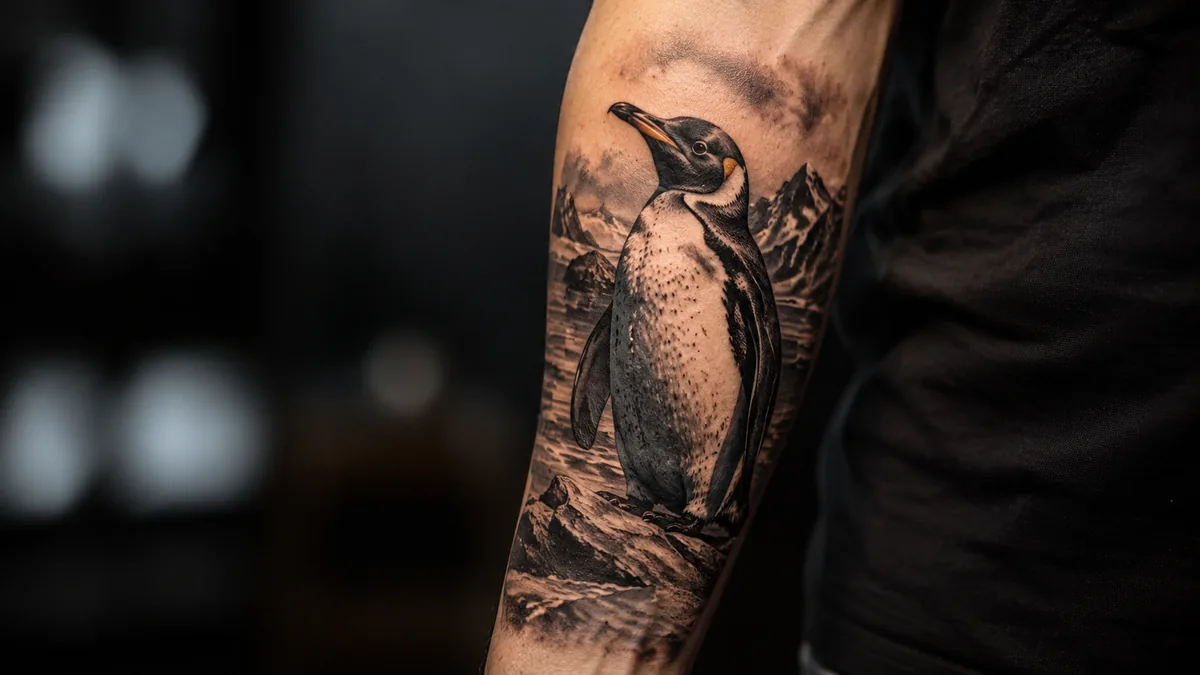
Penguins don’t fly, but they thrive. That’s the whole point. A penguin tattoo is about resilience, adaptability, and showing up no matter what the conditions throw at you. It’s one of those animals that looks soft on the surface but carries real weight as a symbol.
People get penguin tattoos for a wide range of reasons, from honoring a tight-knit family bond to marking a personal comeback story. The meaning can be lighthearted or deeply personal, and that range is exactly what makes this design so versatile on skin.
Core Symbolism: What a Penguin Tattoo Actually Means
Penguins are loyal animals. Many species mate for life, and they take turns keeping their eggs warm in brutal Antarctic cold. That loyalty translates directly into tattoo meaning. People get this design to represent a partner, a family, a commitment that doesn’t break under pressure. It’s a quiet declaration, not a loud one.
Beyond loyalty, penguins symbolize adaptability. They’re birds that don’t fly, yet they dominate their environment by working with what they’ve got. That reads as perseverance, resourcefulness, and forward motion despite limitations. A lot of people connect with that on a personal level.
Playfulness and Humor as Intentional Meaning
A penguin walks through blizzards without complaint, that is the whole point.
Not every tattoo needs to carry heavy symbolism, and penguin designs embrace that fully. Penguins are genuinely funny looking. The waddle, the tuxedo pattern, the deadpan expression. A lot of clients want something that makes people smile, and a well-drawn penguin delivers that without being childish.
Humor as a tattoo theme is underrated. Some people get a penguin because it’s their personality, their spirit animal in the most literal casual sense. Maybe they’re the goofy one in the group who still holds it together. That’s a real meaning, and it’s worth owning it without apology.
Family, Partnership, and the Mating for Life Angle
Emperor and Adelie penguins are known for forming strong pair bonds, and that fact has made penguins a popular couples tattoo choice. Two penguins side by side, sometimes in matching placements, is a genuine declaration of partnership. It’s not as common as infinity symbols or coordinates, but it’s way more original.
Family-focused versions often show a parent penguin with chick, or a small huddle representing a specific family unit. Some people add the number of kids in the design, or customize the chick sizes to reflect real ages. It’s a clean concept that reads clearly and holds up visually over the years.
Popular Styles: From Fine Line to Neo-Traditional
Fine line black and grey penguins are extremely popular right now. The natural contrast of a penguin’s coloring translates well into detailed grayscale work, with the white belly rendered through negative space and the black back executed in solid fill or soft whip shading. It reads sharp and heals clean in the right placement.
Neo-traditional takes it in a bolder direction, with saturated color, thick outlines, and exaggerated features. Watercolor penguin tattoos show up often too, usually with splashes of blue and teal around a solid black figure. Cartoon and illustrative styles, think vintage storybook or bold graphic, are also solid choices if you want something with personality that holds long-term.
Color vs. Black and Grey: How Each Ages
Black and grey is the safer long-term bet for most placements. A well-executed black and grey penguin with solid blacks and clean transitions will still read clearly in ten years. The bold will hold. Avoid going too fine in the detail work on high-wear zones like hands or the inner wrist, because those areas chew through delicate linework fast.
Color adds life to the design, but bold blues and whites require more touch-up over time, especially in sun-exposed spots. If you’re going color, talk to your artist about ink brands and saturation strategy. A properly saturated piece with good aftercare looks incredible, but color fades faster than solid black, period.
Placement and Pain: Where It Works Best
The upper arm, forearm, calf, and thigh are the most forgiving spots for a penguin tattoo. Good skin, relatively consistent texture, and they hold detail reliably. A mid-size penguin, around three to five inches, sits perfectly on the outer forearm or the back of the upper arm without getting cramped.
If you want something small and delicate, the ankle, inner wrist, or behind the ear work but expect it to be spicy. Those spots are bony and thin-skinned. Ribs are a notorious pain spot and also move a lot with breathing, which makes fine line trickier to execute cleanly. Hip and thigh placements are popular and much more comfortable.
Who Gets Penguin Tattoos and How to Make Yours Personal
Penguin tattoos pull a broad crowd. Parents who see themselves in the protective huddle behavior. People who’ve been through something hard and came out the other side. Couples who want a shared symbol that doesn’t scream romance in an obvious way. People who just love penguins and want that on their skin forever, which is completely valid.
To make it yours, build in one specific detail that means something. A particular species, like a rockhopper or a little blue penguin, changes the whole feel. Add a background element tied to a real place or memory. Work with your artist on pose and expression, because a penguin’s stance communicates a lot. A confident upright pose reads differently than a small huddled figure, and that difference matters.









