The koi fish tattoo is one of the most requested pieces in any shop, and for good reason. It carries real weight, real history, and it looks incredible on skin. Before you book that appointment, it helps to know what you’re actually committing to.
Quick note on the name: it’s koi, not coy. ‘Coy fish’ is a super common misspelling, but the fish is the koi, a domesticated carp bred in Japan for color and pattern. The meaning stays the same no matter how you spell the search. What matters is what this fish represents and what it’s going to look like on you for the rest of your life.
The Core Meaning of the Koi Fish Tattoo
The koi tattoo stands for perseverance, strength, and the drive to push through adversity. The symbolism comes from an old East Asian legend about a koi swimming upstream against a powerful current, never quitting, never drifting back. The fish that reaches the top of the waterfall transforms into a dragon. That story alone explains why this tattoo resonates with so many people who’ve come out the other side of something hard.
Beyond transformation, koi also represents good luck, abundance, and personal ambition. These aren’t invented meanings. They’re widely recognized across Japanese and Chinese tattooing traditions and carried over into Western tattoo culture with that same understanding intact. If you’ve survived something brutal, built something from nothing, or you’re grinding toward a goal, a koi tattoo hits different. It says something true without saying a word.
Cultural and Historical Roots
A koi swimming upstream doesn't ask if the current is too strong.
Koi fish have been bred in Japan since at least the 1820s, developed from common carp into the vivid, patterned fish we recognize today. In Japanese culture, koi are associated with samurai spirit, masculine strength, and the courage to face adversity head-on. Koi ponds became symbols of prosperity in Japanese gardens, and the fish themselves were considered omens of good fortune. That cultural weight moved directly into irezumi, traditional Japanese tattooing.
In Chinese culture, the koi draws from the legend of the Dragon Gate, a waterfall on the Yellow River. Only the fish strong enough to make the jump transforms into a dragon. It’s a metaphor for scholars passing imperial exams, for social advancement through sheer effort. Both traditions feed into modern tattoo culture, and most clients today are drawing on both without separating them. That’s completely fine. The meaning stacks.
Direction Matters: Upstream vs. Downstream
This is the detail most people don’t know walking in. Which way your koi swims carries meaning. A koi swimming upstream traditionally means you’re still in the struggle, pushing against the current, fighting toward something. It represents active perseverance and an ongoing battle. A koi swimming downstream can mean you’ve already conquered the challenge, that you’ve come through it and the current is with you now. Neither reading is better. They’re just different.
Some clients want that upstream koi because they’re in the middle of recovery, a career grind, or rebuilding their life. Others want downstream because they’ve put something behind them and they’re not looking back. When a client asks about this in the shop, I always ask what’s going on in their life. The answer usually tells me exactly which direction that fish should be swimming. It’s a small design call that changes the story entirely.
Color Symbolism: What Each Color Means
Color choice isn’t just aesthetic with koi. Each color carries its own layer of meaning. Red and orange koi are tied to love, courage, and the mother figure in Japanese tradition. Black koi represent overcoming struggle, often chosen by people who’ve battled addiction, grief, or serious hardship. Gold koi symbolize wealth and prosperity. Blue koi connect to masculinity, reproduction, and tranquility depending on the regional reading. White and red koi together, the classic Kohaku pattern, represent career success.
You don’t have to lock every color to its traditional meaning, but it’s worth knowing before you pick your palette. Some clients go traditional, some go full creative. Both work. What I’d caution against is picking colors purely for what looks good in a reference photo without considering how they’ll saturate and hold on your specific skin tone. A saturated red will behave differently on dark skin than on light. Talk to your artist about color viability on your actual skin before you’re locked in.
Popular Styles and Design Variations
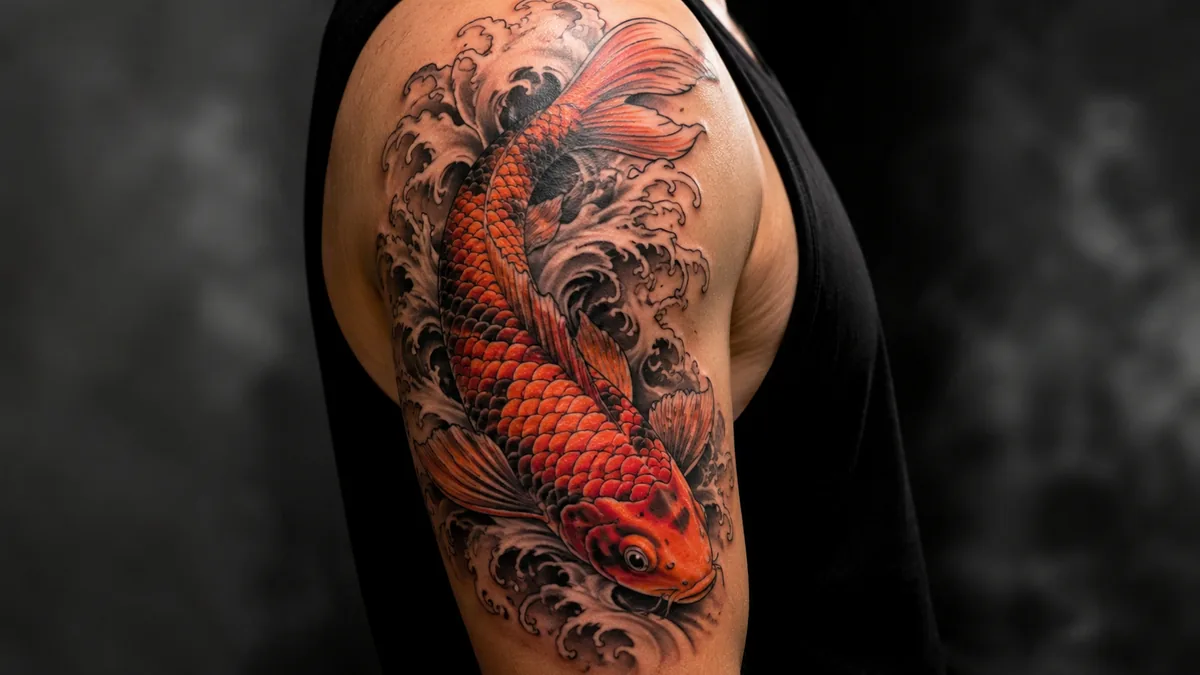
Traditional Japanese style is the gold standard for koi. Bold outlines, solid black shadows, clean fills, water elements like waves or whirlpools, and often lotus flowers or cherry blossoms as background. These tattoos are built to last. Bold will hold. The linework reads from across the room ten years out. Neo-traditional keeps that structure but pushes the color palette and adds a more illustrative, almost painterly quality. Both age well with proper care.
Black and grey koi are a different animal entirely. You lose the color symbolism but gain incredible depth through shading, contrast, and texture. A skilled artist doing black and grey koi with good whip shading and crisp linework can make the fish look like it’s moving. Fine line koi exist and they look stunning fresh, but fair warning: fine line on a high-wear zone fades and spreads. A hairline-thin scale pattern on the wrist will not look the same at five years. Know what you’re signing up for.
Placement and How Koi Tattoos Age
A koi tattoo works best on real estate that gives the fish room to move. The back, thigh, ribs, sleeve, and calf are ideal. These are larger canvases where the koi’s natural elongated body shape flows with your anatomy. A koi wrapping around a thigh or climbing a forearm into a sleeve looks natural because the design mirrors how the body moves. Placement and size need to match. A tiny koi on a large expanse of skin looks lost. A large koi crammed into a wrist pocket looks chaotic.
In terms of aging, koi tattoos hold up well when done right. High-wear zones like hands, fingers, and feet will fade faster and may blur. The inner arm and inner wrist are spicy to tattoo and see more friction from daily life. The thigh, calf, and upper arm are lower-wear and age the cleanest. Whatever you choose, sunscreen is non-negotiable. Color tattoos left in UV with no protection turn into a smeared mess inside a few years. Protect it and it’ll look solid for decades.
Who Gets Koi Tattoos and How to Make It Yours
Koi tattoos attract people who’ve been through something and need to mark it on their skin. Recovery from addiction, surviving abuse, immigration and starting over, grinding through years of school or training, losing someone, coming out, rebuilding after a breakdown. The fish fits the story. That’s why it stays popular without feeling trendy. It’s not a fashion piece. It’s a declaration.
To make it personal, think about the details that are specific to you. The color combination, the direction the fish swims, what it’s swimming through, whether you add lotus for rebirth or waves for chaos or just let the fish stand alone. Bring reference images but tell your artist the actual story. A good artist uses that context to push the design further than any reference photo could. The koi is a strong enough symbol to carry whatever you put into it. Trust the process, trust your artist, and let it be something real.