
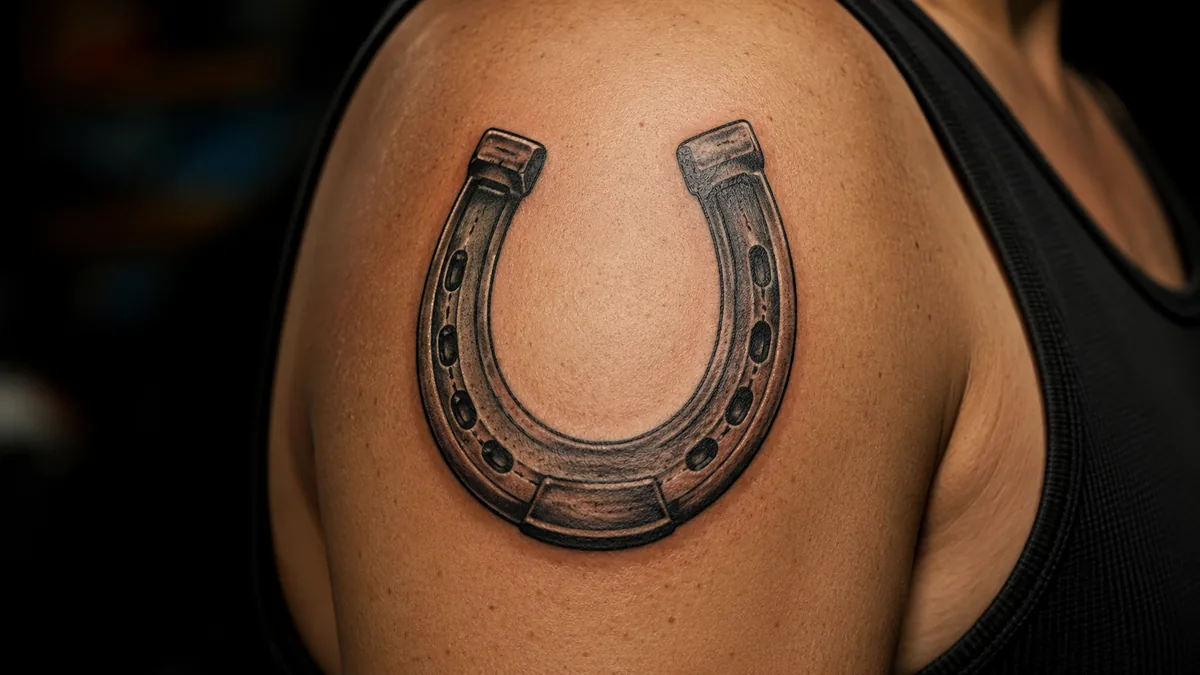
The horseshoe tattoo is one of the oldest good luck symbols in the tattoo world. It shows up in traditional flash, fine line sleeves, and everything in between because the meaning is simple and universally understood: luck, protection, and a little bit of defiance against bad fortune.
But there’s more nuance here than most people think. The direction the horseshoe faces, whether it’s open or closed, what’s packed inside it, all of it shifts the read. Here’s what it actually means and how to make it land right on skin.
The Core Meaning: Luck and Protection
The horseshoe is fundamentally a luck talisman. People have carried them, hung them over doors, and worn them as amulets for centuries. As a tattoo, the meaning carries over directly. You’re putting a symbol of good fortune permanently on your body, which is about as committed to the idea as you can get. It reads as protection from bad luck, an invitation for good luck, or both at once.
Most people who get this tattoo want to keep the positive energy close, literally under their skin. It’s not ironic or complicated. It’s a straightforward declaration: I want luck on my side. That kind of honest, direct symbolism is part of why this design has lasted so long without going stale.
Up or Down: The Direction Debate
A horseshoe points up to hold luck in, points down to share it with everyone you meet.
This is the most asked question about horseshoe tattoos and it genuinely matters. Horseshoe opening facing up means luck is collected inside, contained, held for you. Think of it like a bowl catching good fortune before it spills out. This is the more common orientation and widely considered the luckier of the two.
Opening facing down means luck is pouring out, being shared with the world, or spilling onto others around you. Some people choose this intentionally to symbolize giving good energy outward rather than hoarding it. Neither is wrong, but you should pick deliberately. Your artist will ask, and you should have an answer ready.
Historical and Cultural Background
Iron horseshoes have been considered lucky across European cultures since at least the early Middle Ages. Iron itself was believed to ward off evil spirits, and the horseshoe shape, made by a blacksmith who worked with fire, carried extra protective weight. Sailors nailed them to ships. Homeowners hung them over doorways. The association is old, widespread, and genuinely rooted in folk tradition across Ireland, England, Germany, and beyond.
In American tattoo history, the horseshoe is classic sailor and carnival flash. It shows up alongside dice, four-leaf clovers, and lucky sevens in old-school Americana panels. Norman Collins, known as Sailor Jerry, worked horseshoe motifs into traditional flash as straightforward luck symbols. The roots are real and the lineage in tattooing is long.
Design Variations and Popular Styles
Traditional American is the most common execution. Bold outlines, flat color fills, red and yellow shading, clean shapes that read from across the room. The horseshoe pairs naturally with dice, flames, roses, banners, and four-leaf clovers in this style. Bold will hold on a traditional piece, and it ages well because the lines stay readable as the skin changes over years.
Fine line horseshoes are popular now, especially with added geometric details or delicate floral wraps. They look crisp fresh out of the gun but require more care in placement and aftercare to keep them from fading soft. Neo-traditional adds dimensional shading and richer color. Blackwork and black and grey versions give the piece a more serious, less whimsical tone. Each style shifts the mood, so match the style to what the piece means to you personally.
Color vs. Black and Grey
A fully saturated color horseshoe in traditional red, yellow, and black pops hard and reads instantly. The color palette signals the old-school flash lineage and gives the piece high visual energy. If you want something that screams classic American tattoo, color is the move. It also photographs well and catches the eye at a glance, which matters if placement is visible.
Black and grey softens the piece considerably. It photographs beautifully, ages more predictably on most skin tones, and works better in larger compositions where you’re blending multiple elements. Whip shading on a black and grey horseshoe can give it real depth and dimension. If your goal is something timeless that reads more refined than rowdy, black and grey is a solid call.
Best Placements and How the Tattoo Ages
The forearm is the go-to spot for a horseshoe. Good surface area, flat skin, low movement distortion, and easy to show off or cover depending on the context. The upper arm, shoulder, and calf are also low-wear zones where a horseshoe holds well over time. These spots give the piece room to breathe and the lines stay crispy as the skin ages.
High-wear zones like fingers, hands, and the inner wrist are trickier. Ink in those areas blows out faster, fades unevenly, and needs more touch-ups. A fine line horseshoe on the finger might look sharp for a year before it softens into a blur. Not a dealbreaker, but go in with eyes open. A bold traditional horseshoe on the forearm will still look solid in twenty years. Placement is a real factor in how long the piece stays looking intentional.
Who Gets This Tattoo and How to Make It Personal
Gamblers, sailors, people who’ve had serious run-ins with bad luck and want a symbol to push back against it. Athletes before a big season. People honoring a cultural heritage tied to horseshoe lore. People who just want a timeless lucky charm and aren’t interested in explaining a complicated concept. The horseshoe is democratic like that. It works for almost anyone without requiring a backstory.
Making it personal is about the details. Add a name in a banner. Incorporate a birth flower or a symbol connected to someone you’re honoring. Choose the orientation based on what feels true to you. Wrap it with elements that have personal weight. The base symbol is classic and solid on its own, but your additions are what make it yours specifically rather than a piece out of a flash book.









