
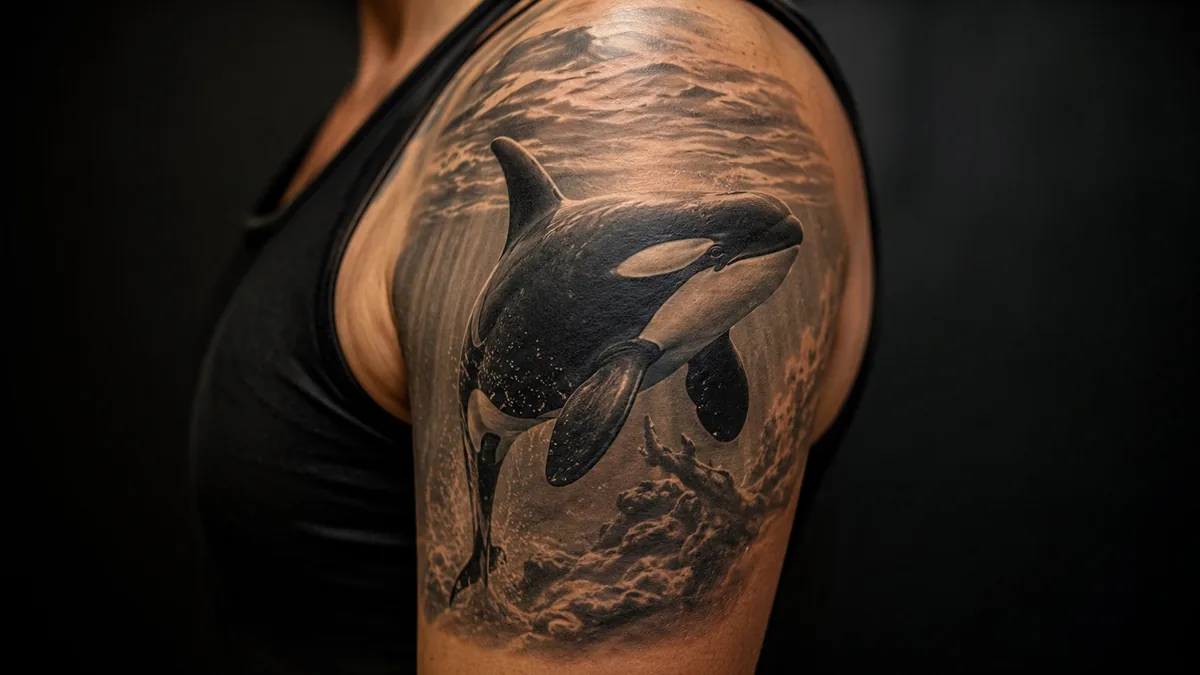
The orca is one of the most loaded animals you can put on your body. It reads as raw power, but people who really know the animal know it’s also about family, loyalty, and intelligence. That combination is rare in the tattoo world, and it’s why the killer whale has been showing up more and more in serious collections.
The meaning isn’t vague or invented. Orcas genuinely live in tight, lifelong family pods. They’re apex predators with no natural enemies. They’re highly intelligent and communicate in complex dialects. Every one of those qualities translates directly into what people want a tattoo to say about them.
Core Symbolism: What an Orca Tattoo Actually Means
The most common readings are strength, family, and protection. People get orca tattoos to represent being both fierce and deeply connected to the ones they love. That’s the honest heart of it. You’re not just a predator and you’re not just a nurturer. You’re both at once, and the orca carries that contradiction naturally.
Intelligence is another big one. Orcas are among the smartest animals on earth. They problem-solve, they teach, they grieve. Getting an orca tattooed means something different than getting a generic shark. It says you think deeply, you feel deeply, and you’re not something to underestimate.
Indigenous Cultural Background: The Real History
The orca hunts in packs and still comes home every night.
Pacific Northwest Indigenous nations, especially Haida, Tlingit, and Coast Salish peoples, have revered the orca for centuries. In these traditions, the orca is a powerful spiritual being associated with the sea, transformation, and safe passage for the dead. The orca appears constantly in totem poles, bentwood boxes, and ceremonial art. This is real, documented cultural history, not invented symbolism.
If you’re not from these Nations, be thoughtful about using traditional formline or Haida design styles directly. Taking a generic orca shape with bold black and red design is one thing. Lifting a specific clan crest or ceremonial figure is a different conversation. Talk to your artist. A lot of shops have guidelines on this, and the good ones will tell you straight.
Popular Design Variations
Neo-traditional orca tattoos are everywhere right now. Bold outlines, saturated colors, exaggerated proportions. They read from across the room and hold up as the skin ages. Geometric orcas, with sharp angular shapes or dotwork fills, are popular for people who want something more abstract and modern. Watercolor style shows up a lot too, though it fades faster and needs touch-ups more often.
Realistic black and grey is another strong option. A well-executed realistic orca in black and grey, especially mid-breach or tail-up underwater, can be absolutely stunning when done by an artist who knows how to whip shade. Fine line orca outlines exist but they’re tricky. The animal’s silhouette needs weight to read clean. Super thin lines on an orca can lose detail fast as skin settles.
Color vs. Black and Grey
Color orcas give you that high contrast black and white palette the animal naturally has. You can push the white highlights with white ink or negative space, both techniques have their strengths. White ink over healed skin can soften over time, so negative space usually holds longer. Adding splashes of teal, deep navy, or bioluminescent blue in the water around the animal gives the piece life without competing with the subject.
Black and grey orca tattoos are classic for a reason. The animal is naturally black and white, so it translates to a greyscale piece without losing anything. Smooth gradients in a grey wash style can give the whale real dimension. Bold black with solid fills and no grey work at all is another direction, closer to a traditional or graphic style. Both hold well long-term.
Best Placements and How It Ages
Orcas need room. The shape is long, dynamic, and horizontal or arcing. Ribs, thigh, back, and upper arm are the most natural fits. A large orca on the back panel or across the ribs lets the animal move with the body. Thigh placements are smart because the skin there is relatively stable, the area is lower-wear, and the size potential is huge. It’s also not the most spicy spot to sit for.
Avoid high-wear zones for detailed orca pieces. Inner wrist, hands, and feet beat up fast, and a realistic or finely detailed orca will blur and muddy quicker there. Elbow ditch and back of knee are spicy and distort. If you want a smaller orca on the forearm or wrist, go bold, clean outlines with solid fills. Bold will hold. Skip fine line on high-movement joints if you want it looking crispy in five years.
Who Gets Orca Tattoos and How to Make It Personal
People drawn to orca tattoos tend to value strength without aggression, family without softness, and depth without explanation. It’s popular with people who grew up near the ocean, marine biology folks, parents who want to represent protecting their family, and people who’ve been through something serious and came out the other side. The orca doesn’t need to be explained to people who get it.
To personalize it, think about what specific meaning you’re leaning into. Family pod angle? Consider multiple orcas, a big one with smaller ones alongside it. Transformation or grief? A breaching orca has that energy of crossing between worlds. Strength and solitude? A single orca underwater, going deep. Tell your artist what it means to you. The best tattooers use that to inform composition, not just copy a reference photo.
Choosing the Right Artist for an Orca Piece
Look for an artist whose portfolio has clean aquatic or wildlife work. Orca tattoos require someone who understands how to handle a large black mass without it looking heavy and flat. The dorsal fin needs to read sharp. The white saddle patch and eye patch need to stay clean as the piece heals. Those details are what make it look like an orca instead of a generic black blob.
Ask to see healed photos, not just fresh work. Fresh tattoos always look saturated and crispy. You want to know how their black holds, how their gradients settle, and whether fine details survive the healing process. A reputable artist will have healed shots available. If they only show fresh work, that’s worth paying attention to.









