
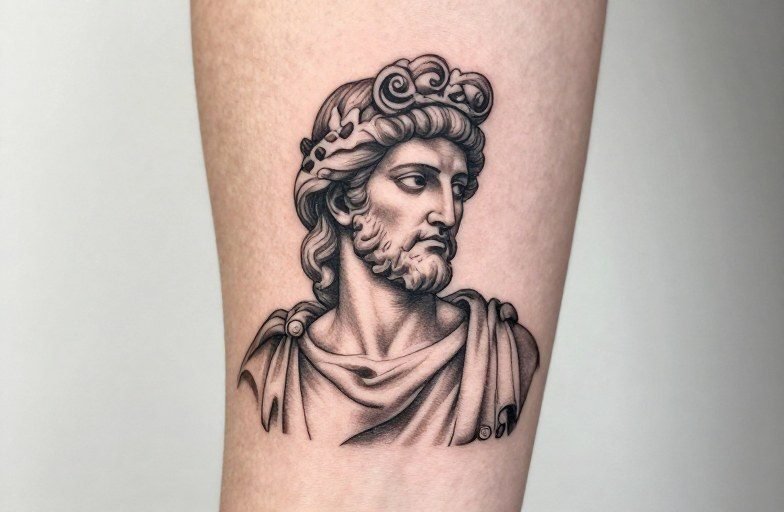
An Apollo tattoo typically represents light, truth, artistic pursuit, and disciplined strength. Drawing from the Greek god who governed the sun, music, prophecy, and archery, the design appeals to people who identify with creative drive, intellectual clarity, or the tension between destruction and healing.
Symbolism & History
Core Domains of the God
Apollo occupied a rare position in the Greek pantheon, simultaneously a healer and a bringer of plague, a musician and a warrior. His domains cluster around light (literal and metaphorical), order, and excellence through practice. Unlike gods who granted raw power, Apollo demanded refinement. The lyre, the bow, and the laurel wreath each carry distinct symbolic weight:
- The lyre: music, poetry, harmony, and the discipline required to master an art form
- The bow and arrow: precision, focused intent, and the ability to strike from a distance, intellectual or physical
- The laurel wreath: victory, poetic achievement, and transformation (often linked to the myth of Daphne)
- The sun disc or rays: illumination, truth-seeking, and visibility
Historical Context Without Myth-Making
Cult worship of Apollo centered at Delphi, where his oracle interpreted divine will. The Pythian Games, held in his honor, included musical competitions alongside athletic ones, an early recognition that physical and artistic excellence weren’t separate pursuits. Roman adoption maintained these associations while adding imperial connotations. For tattoo purposes, the Greek iconography tends to read as more philosophical or personal; Roman imagery can feel more militaristic or state-oriented, though both appear in contemporary work.
Common Variations & Styles
Classical and Neoclassical Portraits
Sculptural Apollo heads, think the Belvedere Apollo or similar Hellenistic sources, translate well to black-and-gray tattooing. The challenge lies in the hair: those tight, carved curls require either confident line work or smooth whip-shading to read as stone rather than cartoon. Forearm and calf placements give enough flat surface for the profile to hold its structure. A common pitfall: too-small classical portraits lose the subtle plane changes in the nose and brow; minimum four inches tall for single-needle detail, larger if you want realistic marble texture.
Symbolic Objects and Minimalist Approaches
Not everyone wants a face on their body. The lyre alone, rendered in clean lines, works as a musician’s mark. The bow, strung or unstrung, suits a more angular aesthetic. A single laurel branch, often wrapped around the wrist or trailing down the ribcage, reads as quieter, achievement without announcement. For these simpler designs, the gap between good and bad work is narrower but unforgiving: uneven curves or wobbly symmetry in a lyre’s frame look like mistakes, not style choices.
Apollo and the Sun Chariot
The solar chariot, horses rearing, adds dynamism and narrative complexity. This variation demands space. Upper back panels, full thighs, or rib-to-hip compositions carry the motion without cramming. Color choices matter here: traditional yellow-gold sun rays age toward mustard; brighter oranges hold better. Some artists push toward near-monochrome with strategic warm highlights, which tends to look cleaner at five years than fully saturated color.
Best Placements
Apollo’s vertical imagery, standing figure, rising chariot, tall lyre, suits naturally elongated body areas. The outer forearm remains the most common choice; it offers visibility, manageable pain, and enough width for detail. The upper arm, wrapping slightly onto the deltoid, frames classical portraits well, mimicking how sculpture sits in a gallery niche.
More committed placements include:
- Ribcage: ideal for the chariot scene, following the body’s natural curve; hurts more, but the canvas justifies it
- Thigh front or side: substantial flat area, easy to show or conceal, holds large-scale lyre or full-figure compositions
- Upper back, between shoulder blades: centered Apollo heads read like devotional pieces; the bone structure beneath adds classical gravitas
- Chest, offset to one side: the heart-side placement of a laurel wreath specifically references the Daphne myth’s emotional weight
Smaller spots, wrists, ankles, behind the ear, work only for the most reduced symbols: a single arrow, a tiny wreath, a sun disc. The detail ceiling drops fast below two inches.
Who Chooses This Tattoo / Personal Meanings
The appeal crosses obvious boundaries. Musicians gravitate toward the lyre, though actual harpists and guitarists sometimes avoid it as too on-the-nose. Competitive archers and precision shooters often select the bow, sometimes with specific personal modifications, an arrow count matching significant dates, or a draw weight numerically encoded. Writers and academics favor the laurel or the full portrait, the classical reference signaling their field without spelling it out.
Less predictable connections emerge too. People recovering from illness sometimes choose Apollo for his healer aspect, often paired with the serpent-entwined staff (technically his son Asclepius’s symbol, but culturally conflated). Those leaving rigid religious backgrounds occasionally select Apollo as a secular symbol of structured meaning, divinity without dogma, or at least a different dogma.
The sun imagery attracts night-shift workers, irony acknowledged, and people who’ve moved from darker periods. The light-to-dark contrast in black-and-gray solar rays can be executed with genuine gradient skill or with heavy black blocking that reads more aggressive than illuminating.
Similar Symbols
Apollo overlaps with several tattoo traditions. Understanding the distinctions helps if you’re choosing between them:
- Helios vs. Apollo: Helios was the original Greek sun god; Apollo absorbed that role later. Helios imagery emphasizes the chariot and rising/setting; Apollo adds music, prophecy, and the bow. For pure solar power without artistic connotation, Helios or Sol Invictus may fit better.
- Artemis/Diana: Apollo’s twin sister, moon to his sun, archer to his archer. Paired tattoos for siblings or couples use complementary imagery, her crescent to his disc, her stag to his python. The gender dynamic is flexible; plenty of men wear Artemis and women wear Apollo.
- Phoenix: Both connect to sun and renewal, but the phoenix emphasizes cyclical destruction and rebirth. Apollo’s renewal is more continuous, daily rising, practiced skill, maintained health.
- Christian saint imagery: Saint Sebastian, pierced by arrows, accidentally echoes Apollo’s weapon. The overlap is purely visual; the meaning diverges sharply. Some tattooers actively avoid the confusion, others play with it.
Final Thoughts
An Apollo tattoo carries enough symbolic density to reward long-term ownership. The god’s multiple domains, light, music, archery, healing, prophecy, mean most designs can be read several ways, which helps the tattoo age with its wearer. The visual tradition is strong enough to support everything from a single clean line to massive back pieces.
If you’re deciding, start with which domain actually resonates: the creative discipline of the lyre, the focused precision of the bow, the public achievement of the laurel, or the illuminating presence of the sun. Then match that symbol to a placement that gives it room to breathe. Classical imagery needs scale; minimal symbols need perfection. The worst Apollo tattoos try to do everything at once, chariot, lyre, bow, wreath, sun, crammed into space that supports none of them. The best know exactly which aspect they’re claiming.
Frequently Asked Questions
Does an Apollo tattoo have to be large to look good?
Not necessarily, but classical portraits need at least four inches to preserve facial structure. Minimalist symbols like a single arrow or small laurel branch work fine at smaller sizes if the line work is precise.
Is Apollo always shown as a sun god in tattoos?
No, he’s equally valid as an archer, musician, or poet. The sun imagery became dominant later in his mythological development. Choose the domain that actually fits your reason for the tattoo.
What’s the difference between Apollo and Helios tattoos?
Helios is the earlier, dedicated sun god; Apollo absorbed solar associations over time. Helios imagery is more strictly solar and chariot-focused, while Apollo includes music, prophecy, and archery.
Do Apollo tattoos work well in color, or should I stick to black and gray?
Both work. Black and gray suits classical sculpture references. Color handles the solar chariot and flame imagery well, though yellow-gold fades toward mustard over time, consider warmer oranges or near-monochrome with selective highlights.
Related Tattoo Meanings
- Greek Mythology Tattoo Meanings: Symbols That Last
- Dolphin Tattoo Meaning
- Zeus Tattoo Meaning
- Explore more









