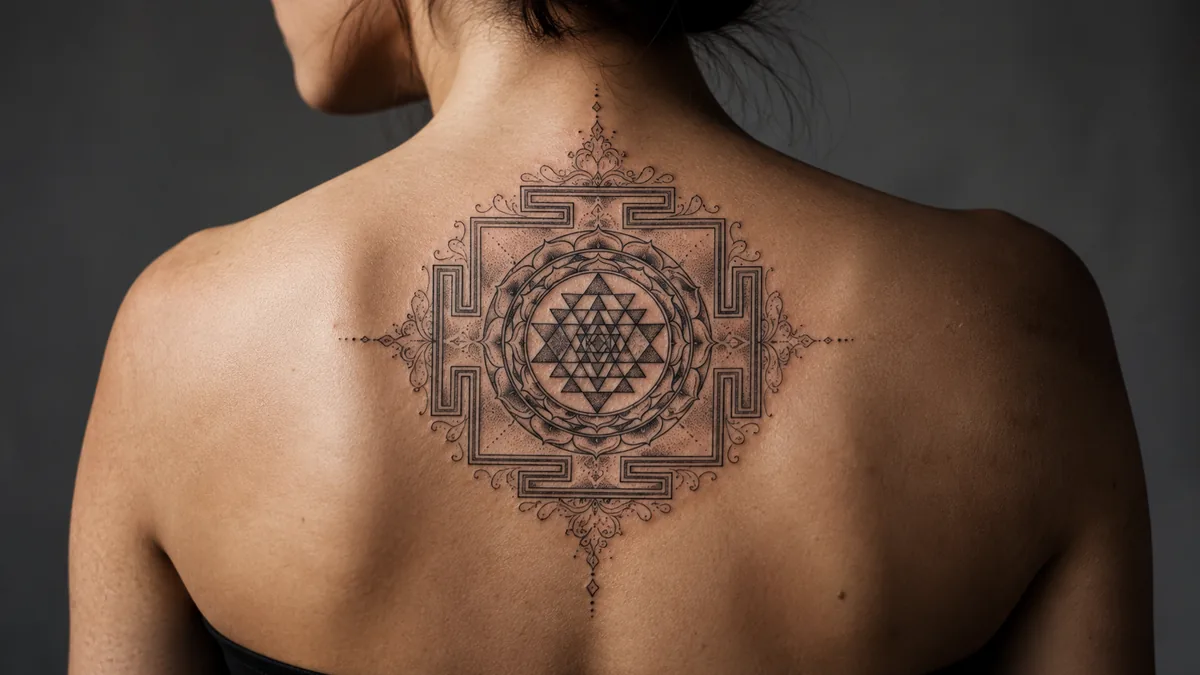
A yantra is a sacred geometric diagram used in Hindu and Tantric Buddhist practice as a meditation tool and spiritual instrument. On skin, it carries all of that weight. People who get yantra tattoos aren’t just chasing a cool geometric pattern. They’re pulling from a tradition that treats these shapes as maps of the cosmos, representations of deities, and tools for focusing the mind.
The most recognized yantra in Western tattoo culture is the Sri Yantra, that interlocking triangle design that looks impossibly complex and reads strong from across the room. But yantras come in many forms, each tied to a specific deity, intention, or energetic purpose. Know what you’re putting on your body before you sit down.
Core Meaning: What a Yantra Actually Represents
A yantra is a visual mantra. The word comes from Sanskrit and roughly means instrument or machine, as in a tool for the mind. Each geometric element carries meaning: the central point called the bindu represents pure consciousness and the source of creation. Triangles pointing upward symbolize masculine energy and fire; triangles pointing downward represent feminine energy and water. Circles suggest infinity and the cyclical nature of existence. Lotus petals around the outer rings represent purity and spiritual unfolding.
The square frame with four gates, called the bhupura, grounds the whole design and represents the four directions of the physical world. So a yantra is literally a diagram of how the cosmos is structured, from the unmanifest center outward to material reality. As a tattoo, people wear it as a reminder of that bigger picture, a constant anchor to something beyond daily noise.
Hindu and Tantric Roots
A yantra without precision is just a triangle. The geometry is the prayer.
Yantras originate in Hindu Tantra, a tradition that goes back at least 1,500 years and treats geometry, sound, and ritual as direct pathways to the divine. Each major deity has a corresponding yantra. The Sri Yantra belongs to Lalita Tripura Sundari, a goddess of beauty, power, and liberation. The Kali Yantra, the Ganesha Yantra, the Saraswati Yantra, all of them are devotional objects used in puja, which is ritual worship, as focus points for meditation and as protective talismans.
In Tantric practice, a yantra is considered a living diagram. Priests and practitioners consecrate them through specific rituals, mantras, and offerings. That context matters for the tattoo. You’re not just getting geometric art. You’re borrowing from a living spiritual tradition. Plenty of Hindu practitioners are completely fine with non-Hindus wearing yantras as long as there’s genuine respect rather than pure trend-chasing. That’s a conversation worth having before you commit.
The Sri Yantra: King of the Collection
The Sri Yantra is the yantra you see everywhere in Western studios right now, and honestly, it earns the attention. Nine interlocking triangles, four pointing up and five pointing down, create 43 smaller triangles inside the structure. It’s mathematically precise and visually complex. The whole thing represents the union of masculine and feminine energy, Shiva and Shakti, and the complete structure of the universe. Devotees use it to connect with divine consciousness and to attract abundance, beauty, and spiritual liberation.
As a tattoo design, the Sri Yantra is a beast to execute well. Clean, crispy lines are non-negotiable. The geometry has to be accurate or the whole thing falls apart visually. A lot of artists will tell you they need to draft it digitally before stenciling. Even minor wobble on those inner triangles kills the symmetry. Find an artist who has actually done one before, not someone willing to try it for the first time on your chest.
Design Variations: From Traditional to Fine Line
Traditional yantra tattoos pull directly from the source material: precise geometry, flat fills, no shading, solid black outlines. That’s the most faithful approach and it ages extremely well. Bold will hold, and the geometric structure of a yantra means those clean lines stay readable for decades. Some people add Sanskrit mantras around the border, like Om or the Shri Yantra’s associated mantra, which deepens the personal meaning without cluttering the core design.
Fine line yantras have blown up in recent years, especially on wrists and sternums. The detail can be stunning fresh out of the gun but fine line geometric work is high-maintenance. Sun exposure, skin type, and placement all affect how long those hairline strokes stay crisp. A fine line Sri Yantra on a ribcage in low-wear conditions will hold much better than the same design on an inner forearm taking daily sun and friction. Talk to your artist honestly about longevity before going ultra-fine.
Color vs. Black and Grey
Black and grey is the safe bet for yantras. The geometry reads sharp, the contrast stays high as the tattoo ages, and there’s no color shift to worry about. Many traditional Tantric yantras are rendered in specific sacred colors, gold on red being a classic combination, but translating that to skin is tricky. Gold tones in tattoo ink tend to fade toward yellow and then toward nothing. Red holds reasonably well but goes through changes.
If you want color, saturated black with selective red or deep saffron accents can look incredible and hold better than a full-color piece. Some artists use watercolor washes behind the geometry for a modern take. That style looks great fresh but the soft edges blur over time and the color fades faster than the black structure. If longevity is a priority, stick to black with maybe one or two accent colors in high-impact spots only.
Placement and How It Ages
The sternum and chest are the most popular spots for yantra tattoos, and they make sense visually and energetically. A yantra centered on the chest sits close to the heart, which aligns with the spiritual intent. The skin there is relatively flat, which makes accurate geometric placement easier, and it’s a low-wear zone that stays out of the sun. Yantras also work strong on the upper back between the shoulder blades, the thigh, and the upper arm.
Avoid high-wear zones for anything with tight geometric lines. Inner wrists, fingers, and feet all see constant movement and friction, and fine geometric work in those spots blurs faster than you want. If you’re set on a wrist placement, go bold enough that the lines have room to breathe as they soften slightly over time. Geometric tattoos age best when the lines are thick enough to stay distinct and when the placement keeps them away from daily sun exposure.
Who Gets Yantra Tattoos and How to Make It Personal
The yantra crowd is wide. You’ve got serious practitioners of Hindu or Tantric traditions who want a devotional mark tied to a specific deity or practice. You’ve got people drawn to sacred geometry who connect with the mathematical and cosmological symbolism without a specific religious framework. And you’ve got people who simply find the design beautiful and feel drawn to what it represents in a general spiritual sense. All of those are valid starting points.
To make it personal, get specific. Which yantra, and why that one? If it’s the Sri Yantra, what does the union of Shiva and Shakti mean to you? If you’re pulling a lesser-known yantra, like the Bagalamukhi Yantra for mental clarity and cutting through illusion, that specificity gives the tattoo real weight. Talk to your artist about incorporating meaningful elements around the core geometry, script, dates, or complementary symbols, without crowding the design. A yantra needs breathing room to land the way it should.