
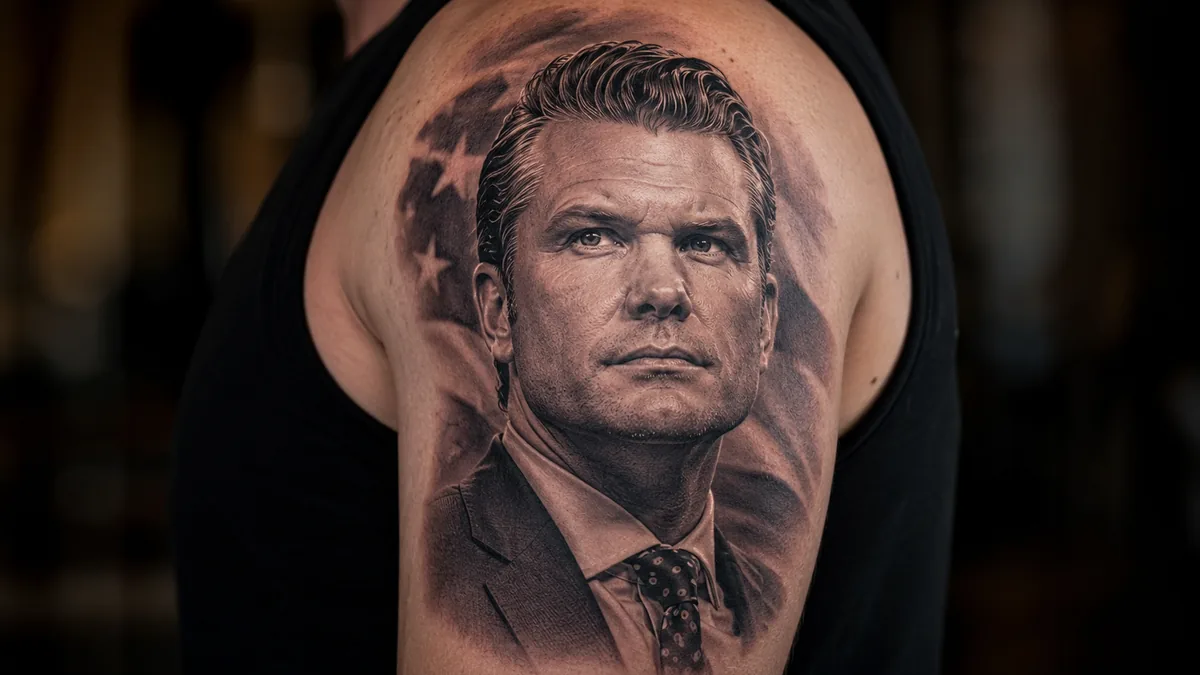
Pete Hegseth, the U.S. Secretary of Defense and former Fox News host, is covered in ink that reads like a manifesto. Every piece connects to something specific: Christian faith, Crusader history, military service, or American founding mythology. Nothing is random.
People search this because the symbolism is real and it matters. Some of these tattoos have centuries of history behind them. Others are recent enough that their meaning is still being fought over. Here is what each piece actually says, and what it means when it shows up on skin.
The Jerusalem Cross: The Centerpiece Explained
The biggest piece on Hegseth is a Jerusalem Cross on his chest. It is a central cross potent surrounded by four smaller Greek crosses, one in each quadrant. Historically, this symbol was used by the medieval Kingdom of Jerusalem during the Crusades. Hegseth has said it represents the five wounds of Christ and the spread of the Gospel to the four corners of the earth. That is a legitimate, mainstream reading. The Catholic Church, Franciscan custodians of the Holy Land, and the Knights of the Holy Sepulchre still use it today.
It is a powerful chest piece visually. Bold, symmetrical, reads clean from across the room. In black and grey it heals solid and holds for decades. The controversy around it comes from context: other tattoos he stacks alongside it push it toward militant territory for a lot of people. On its own, in traditional or religious iconography circles, it is a serious Christian symbol with real historical roots going back to roughly 1099 AD.
Deus Vult: What the Latin Actually Means
When your ink quotes a Crusade battle cry, you own every meaning that phrase has picked up since 1095.
‘Deus Vult’ is Latin for ‘God wills it.’ It was the battle cry of the First Crusade, shouted when Pope Urban II called for the march on Jerusalem in 1095. For centuries it was purely a historical phrase tied to medieval Christian warfare. That changed in recent years when segments of the far right and Christian nationalist groups revived it as a slogan, which is why it now reads as politically loaded to a lot of people outside of purely devotional contexts.
As a tattoo, the phrase has been around in military and Christian circles for a while. Some clients want it as a direct statement of faith: whatever happens is God’s will. Others are drawn to the Crusader warrior aesthetic. Any honest artist will tell you that ‘Deus Vult’ in Gothic blackletter on a forearm is going to get read a specific way in 2025. That is the client’s call, but the conversation needs to happen before the needle touches skin.
Kafir in Arabic: The Most Controversial Piece
Hegseth has the Arabic word kafir tattooed on his upper arm. It translates to ‘unbeliever’ or ‘infidel’ in Islamic theology. In modern usage it has been adopted by some far-right, anti-Muslim circles as a badge of defiance. Groups like CAIR and numerous commentators called it a hostile symbol, especially on a sitting U.S. Secretary of Defense. The Guardian, The National, and USA Today all covered the backlash in 2025 when photos from a Pearl Harbor event went wide.
From a tattoo standpoint, getting a charged foreign-script piece placed visibly is a move that has real consequences. This one is not ambiguous. Kafir does not have a neutral reading in the current climate. There is no softened version of it. Any artist should flag exactly what they are putting on a client’s skin before doing a piece like this, because it will define how that person is read in a lot of rooms.
The Patriotic and Founding-Era Symbols
Beyond the religious pieces, Hegseth carries a full deck of American founding imagery. ‘We the People’ from the U.S. Constitution sits on a forearm. ‘1775’ in Roman numerals marks the birth of the Continental Army and the start of the Revolutionary War. A modified American flag where one stripe is replaced with a rifle pushes into pro-gun, pro-military territory. The ‘Join, or Die’ segmented snake, originally Benjamin Franklin’s 1754 woodcut calling for colonial unity, rounds out the founding-era theme.
These are all tattoos with real historical backing. The ‘Join, or Die’ snake has been popular in patriotic tattooing for years. It ages well in traditional American style, black and grey or with period-accurate muted tones. ‘1775’ in Roman numerals is clean, geometric, and a low-wear placement on the arm keeps it crispy for a long time. These pieces are grounded in documented American history and read straightforwardly as patriotic military ink.
Military Unit Tattoos and Regimental Pride
Hegseth also carries ink specific to his Army service. ‘Ne Desit Virtus,’ Latin for ‘Let valor not fail,’ is the motto of the 187th Infantry Regiment, the Rakkasans, the unit he served with. That is straight-up regimental pride. Every branch of service has its own version of this tradition. Getting your unit’s motto or crest tattooed is one of the oldest military tattoo practices there is. It is personal, earned, and carries weight that only people who served alongside you fully understand.
A red Shinto torii gate also appears as part of the regimental symbology. The 187th has deep ties to Pacific theater history, and the torii gate is their emblem. Here it functions as a unit patch translated into ink, not a statement about Japanese religion. Context matters with foreign symbols. On a vet who served with a unit that carries that emblem, it reads as military heritage. Placement on the arm keeps it in the same visual cluster as the other service ink, which is the right call compositionally.
Style Options and Design Choices
If you are drawing inspiration from this type of imagery, you have real options across styles. The Jerusalem Cross works in traditional American with thick outlines and bold fill. It also works in fine line black and grey for a more devotional, less aggressive read. Blackwork makes it monumental on a chest. Neo-traditional can add depth without losing the geometric precision the symbol requires. The chi-rho, another Hegseth piece representing the first two letters of Christ in Greek, is one of the oldest Christian symbols in existence and translates well into almost any style.
For the text pieces, font choice changes the whole message. ‘Deus Vult’ in heavy blackletter reads medieval and military. The same phrase in clean serif reads more restrained. A fine line script reads completely different from the same words in heavy Gothic block on a forearm. Make sure your client understands what their font is saying before you commit. The lettering style is part of the tattoo’s meaning, not just its decoration.
Placement, Pain, and Longevity
Most of Hegseth’s ink sits on the arms and chest. Forearm and bicep placements are mid-tier on the pain scale, workable for longer sessions. The chest piece is a different story. Sternum and breastbone are genuinely spicy, especially for a large, detailed cross with four satellite crosses. Expect a solid session or two. There is no way around it.
Forearm and upper arm tattoos age well with proper aftercare and sun protection. Bold black linework holds for decades when it is done solid from the start. Bold will hold applies hard here. Fine line on high-wear zones can blur over time, so go heavier than you think you need to. The chest piece, kept out of direct sun and touched up when needed, can look strong for life. Black and grey with good saturation ages cleaner than color on most skin tones long term.
Who Gets This Ink and How to Make It Your Own
The audience for this type of tattooing is specific: veterans, committed Christians, people with a strong American founding-era identity, or some mix of all three. These are not walk-in flash tattoos. They are statement pieces built from a worldview. That is what makes them powerful and also what makes them complicated in public contexts. When you combine Crusader imagery with Arabic-script defiance slogans on a sitting defense official, you are not just wearing your faith, you are broadcasting a political position.
If you want to build a sleeve or chest piece in this vein, the best approach is to anchor it in your actual experience. Which unit did you serve with? Which scripture verse changed your life? What piece of American history do you personally connect to? A tattoo built from real biography holds more weight than one assembled from someone else’s imagery. Work with an artist who understands historical context, can steer you toward designs with clean meaning, and will tell you straight what your ink is going to say to the world.









