
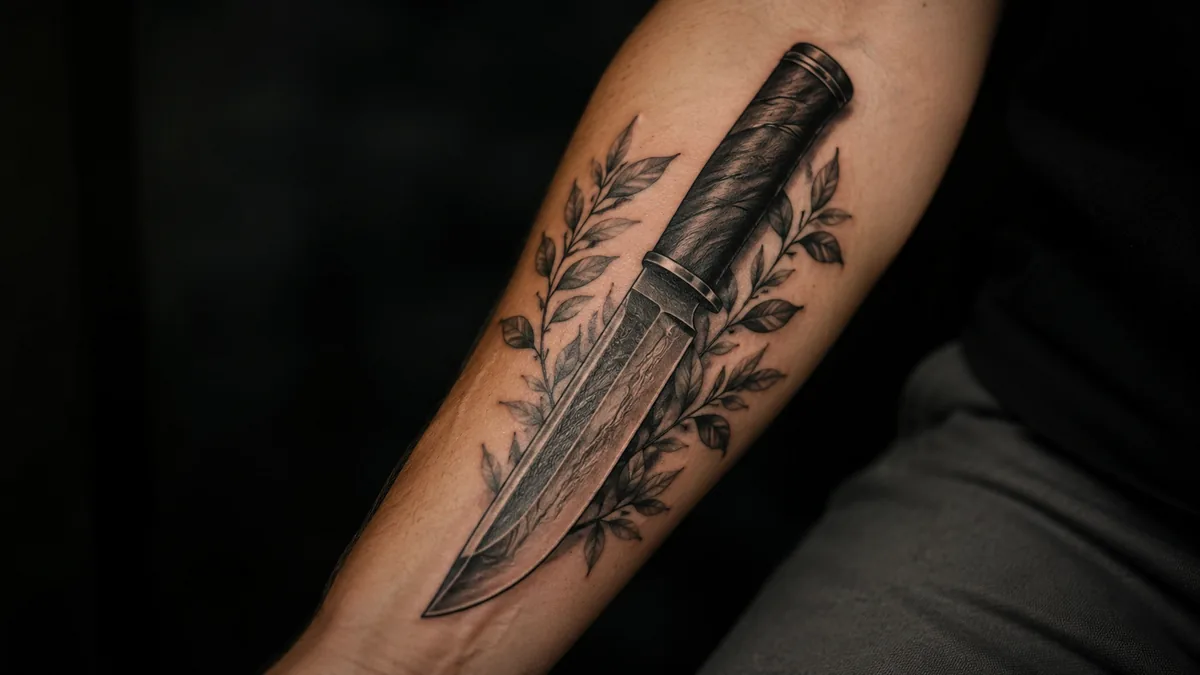
A knife tattoo isn’t subtle, and that’s the point. It reads bold, it reads sharp, and it carries real weight. People have been marking themselves with blade imagery for centuries, and the meanings run deeper than most outsiders expect.
a knife tattoo is about duality. It can mean protection or danger, survival or sacrifice, strength or grief. The same image can tell completely different stories depending on design, context, and who’s wearing it. Here’s what it actually means.
Core Symbolism: What a Knife Tattoo Actually Means
A knife is a tool before it’s a weapon. That’s the first and most honest reading. Knife tattoos often represent self-reliance, survival instinct, and the ability to cut through obstacles. They’re worn by people who’ve had to fight for what they have, people who don’t wait around to be rescued. The blade is a reminder that they carry what they need.
The darker side is real too. A knife can represent danger, aggression, betrayal, or mortality. Some people get it as a signal, a quiet warning to the world. Others use it to process trauma or a period in their life where things got razor-thin. Both readings are valid. Neither one cancels the other out.
Protection, Sacrifice, and the Warrior Mindset
Every knife tattoo is a question: what are you willing to cut away?
One of the most common personal meanings behind a knife tattoo is protection. A blade defends, and wearing one on your skin can carry that same energy. Parents get them. Veterans get them. People who’ve been through it and come out the other side get them. It’s a marker of readiness, a permanent declaration that they will protect what matters.
Sacrifice is another strong read. A knife pressed to skin, or paired with imagery like flowers, hearts, or hands, often points to something given up, something hard that had to be done. It can honor a loss, a decision, or a transformation. The knife doesn’t just cut things away. Sometimes it frees them.
Cultural and Historical Background
Knife and dagger imagery shows up across tattooing cultures worldwide. In traditional American tattooing, daggers were a staple of the flash sheet, often paired with hearts, roses, or snakes. A dagger through a heart is one of the oldest Sailor Jerry-era images around, and it still reads as heartbreak, betrayal, or lost love. Clean, iconic, instantly readable from across the room.
In Mexican and Latin American tattooing, knife and blade imagery ties closely to Day of the Dead aesthetics and themes of life, death, and fate. Chicano black and grey tradition uses blades with roses and script to mark grief, loyalty, and loved ones lost. Japanese traditional tattooing incorporates tanto blades alongside dragons and chrysanthemums to represent honor and the warrior code. These aren’t invented meanings. They’re documented lineages.
Popular Design Variations and Styles
Traditional American knives are thick-outlined, saturated, and bold. They hold for decades and read crispy even after the skin settles. Fine line knives are everywhere right now, realistic and detailed, sometimes with botanical wrapping or intricate handles. They look clean fresh out of the session, but fine line in high-wear areas fades faster. Know that going in.
Geometric knives, ornamental blades, and blackwork knives are all solid choices. Stilettos and daggers read more elegant and vintage. Hunting knives and survival blades read more rugged and utilitarian. Folding knives carry a loyalty-and-brotherhood read in some circles. The handle matters too. A handcrafted wooden handle reads differently than a tactical military grip. Bring reference.
Color vs. Black and Grey
Black and grey is the dominant choice for knife tattoos, and for good reason. Blades are naturally metallic and monochromatic, so black and grey with good whip shading and highlights gives you that realistic gleam. Aged silver, worn steel, a subtle glint on the edge. When your artist nails the light source, it looks like the real thing sitting on your skin.
Color opens things up. A red handle, a blood drop, a blue-wrapped hilt, gold detailing on an ornate blade. Color pops hard on fair to medium skin and can make a traditional knife feel alive. On darker skin tones, bold saturated colors and strong black outlines are going to do more work than subtle washes. Talk to your artist about what’s going to stay readable long-term on your specific skin.
Best Placements and How It Ages
Long and narrow by design, a knife tattoo fits naturally on the forearm, calf, shin, and ribcage. The forearm is a classic choice, high visibility, relatively low pain, and a flat surface your artist can work with. The calf is underrated for knives. Good skin, heals nice, takes both fine line and bold traditional work well. Outer bicep and upper arm also work great.
Hands, fingers, and inner wrists are spicy placement-wise and higher risk for blowout and fading. The inner elbow and back of the knee are high-wear zones, skin folds and rubs constantly, and fine line detail will soften faster there. Bold will hold anywhere, but especially in those spots. If you’re going fine line on a knife, keep the lines confident, not hairline-thin, and place it where the skin stays relatively flat.
Who Gets a Knife Tattoo and How to Make It Personal
Knife tattoos cross every demographic in the shop. Chefs get them as a professional badge of honor. Hunters and outdoorspeople get them for the survival connection. People who’ve been through addiction, grief, or hard chapters get them to mark the turning point. Soldiers, first responders, martial artists. The knife doesn’t belong to one type of person.
Making it personal comes down to specifics. What kind of blade? What’s wrapped around it? A name, a date, a flower tied to someone you lost, a snake for transformation, a snake for danger. The handle can be carved from wood meaningful to you, the blade engraved with a word. A knife paired with a rose reads different from a knife paired with a moth. Bring your artist the full story. The best tattoos are specific.
Final Thoughts on the Knife Tattoo
A knife tattoo earns its place. It’s not a trendy filler piece, it’s a statement. If you’re drawn to it for protection, grief, survival, loyalty, or the straight-up aesthetic of a well-rendered blade, the imagery has centuries of meaning behind it. That’s not nothing.
Get it from an artist who understands the style you’re after. A traditional knife needs someone who lays bold, clean line work and knows how to saturate a color field. A realistic fine line blade needs someone whose linework is consistent and whose shading doesn’t fall apart in the heal. Look at healed photos, not just fresh work. A good knife tattoo done right will be one of the sharpest things in your collection.









