
The word “ways” hits different on skin than you might expect. It’s one of those short, loaded pieces where the meaning lives in the person wearing it, not just the dictionary definition.
Some people go literal. Some go acronym. Some go full Jhene Aiko tribute. Whatever the angle, a ways tattoo carries real weight. Here’s what it actually means, how it’s done, and what to know before you sit down.
Core Symbolism: The Path You Chose
At its most basic, “ways” points to journey, direction, and personal choice. People use it to mark a turning point, a road taken, a phase survived. It’s not about where you’re going next. It’s about acknowledging that every decision brought you to right now. That’s a lot of meaning packed into five letters.
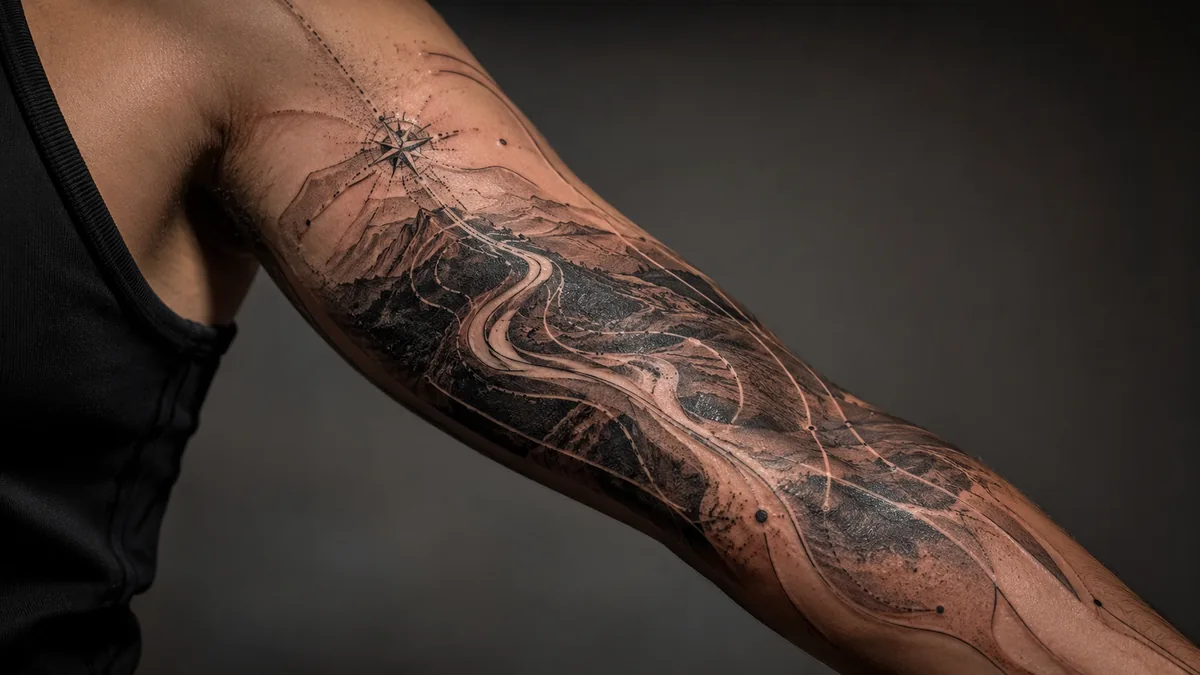
You’ll see it paired with arrows, winding roads, compass roses, or bare. The word alone is clean and minimal. Add imagery and it gets specific. A forked road says “I chose this path.” A single bold arrow says “keep moving.” The design context shapes how the symbolism reads from across the room.
W.A.Y.S. and Jhene Aiko’s Tribute
Every scar already told the story, this just makes you choose a direction.
If you see the acronym with dots, W.A.Y.S., there’s a specific story behind it. It stands for “Why Aren’t You Smiling?” That phrase came from Jhene Aiko’s brother Miyagi, who was battling cancer and still tweeting that phrase to encourage the people around him. He died in 2012. Jhene tattooed it on her wrist and wrote a song about it on her 2014 album Souled Out.
Fans who get W.A.Y.S. are usually honoring grief, survival, or mental health struggles. It’s a reminder to keep going, find something to smile about, and honor the people who pushed you forward. If your client mentions Jhene or Miyagi, you’re working on a piece with real emotional weight. Treat it accordingly.
Other Acronym Readings
Not every W.A.Y.S. tattoo ties back to Jhene Aiko. Some people use it to mean “What Are You Supposed to Learn?” That reading turns the tattoo into a constant check-in with yourself. Every rough situation becomes a question instead of just pain. It’s a mindset piece, not a memorial.
Some clients invent their own acronym from the word. That’s actually one of the strongest approaches. When an artist asks what it means and the client gives a personal breakdown of each letter tied to their own life, that piece is going to mean something for the next sixty years. Encourage it. Custom meanings age better than borrowed ones.
Style Choices: Script, Lettering, and Graphic Work
For a single word like “ways,” style matters a lot. Delicate fine-line cursive keeps it soft and personal. Old English or gothic lettering makes it bold and declarative. A clean sans-serif goes minimal and modern. Chicano script gives it cultural depth and a heavier visual presence. The font is part of the message, not just decoration.
Black and grey tends to age the best on lettering. Fully saturated color in script can bleed and blur faster, especially in smaller sizes. If someone wants color, keep it as an accent in the surrounding imagery, not inside the letters themselves. Solid black ink, whip-shaded backgrounds, or clean negative space will hold and stay readable years down the line.
Placement and How It Ages
The inner forearm is the most popular spot for word tattoos and it works well for “ways” because the skin there is relatively stable and the piece stays visible to the wearer. The outer forearm, upper arm, collarbone, ribs, and spine are all solid placements. These areas have consistent skin texture and don’t fold or crease constantly.
Avoid fingers, inner wrist crease, and feet for fine-line script. Those are high-wear zones, the skin moves constantly and blowout risk goes up. A finger tattoo that reads “ways” clearly on day one can look like a smudge in three years. If the client insists on a spicy spot, go bigger and bolder than they think they need. Bold will hold. Fine lines in rough zones won’t.
Pain Levels by Zone
Inner forearm and upper arm are some of the more comfortable spots for a word tattoo. The skin is fleshy, not close to bone, and most clients handle it fine. Collarbone and ribs are spicier. Ribs especially, the skin is thin and sitting for a longer piece along the ribcage will test patience.
Spine placements look stunning and read well but they’re no joke, especially in the lumbar region. If your client has a low pain tolerance, talk them into the outer forearm or upper arm first. If they want the spine version, tell them straight, it’s going to hurt, but it heals clean if they can sit still. Fidgeting mid-session is how you get crooked lines.
Who Gets This Tattoo and How to Make It Personal
Ways tattoos show up across a wide range of clients. Jhene Aiko fans, people marking recovery from grief or mental health struggles, travelers who see life as a literal journey, and anyone who’s come through a hard transition. The word connects to a lot of different experiences, which is exactly why it keeps showing up in studios.
To make it personal, push clients on context before they finalize the design. What specific “ways” are they referring to? Is there a date, a person, a turning point that belongs in the piece? Adding a small element, a coordinate, a name, a simple road line, can lock the meaning in without cluttering the design. Simple is almost always the right call with word tattoos. Say more with less.
Keeping It Clean Long-Term
A well-executed ways tattoo should stay crispy and readable for a decade or more if the placement is smart and the aftercare is solid. Go a size bigger than the client’s first instinct, especially for fine-line script. Tiny letters with no breathing room will fill in and lose legibility within a few years. Give the ink room to settle.
Year-round SPF on any exposed placement is non-negotiable. UV is the single biggest enemy of tattoo longevity. Black ink fades to a blue-grey under constant sun exposure. Covered placements like ribs or upper back hold color and contrast far longer than wrist or hand pieces. Tell clients upfront: great tattoo, good placement, proper aftercare. That’s the whole formula.









