
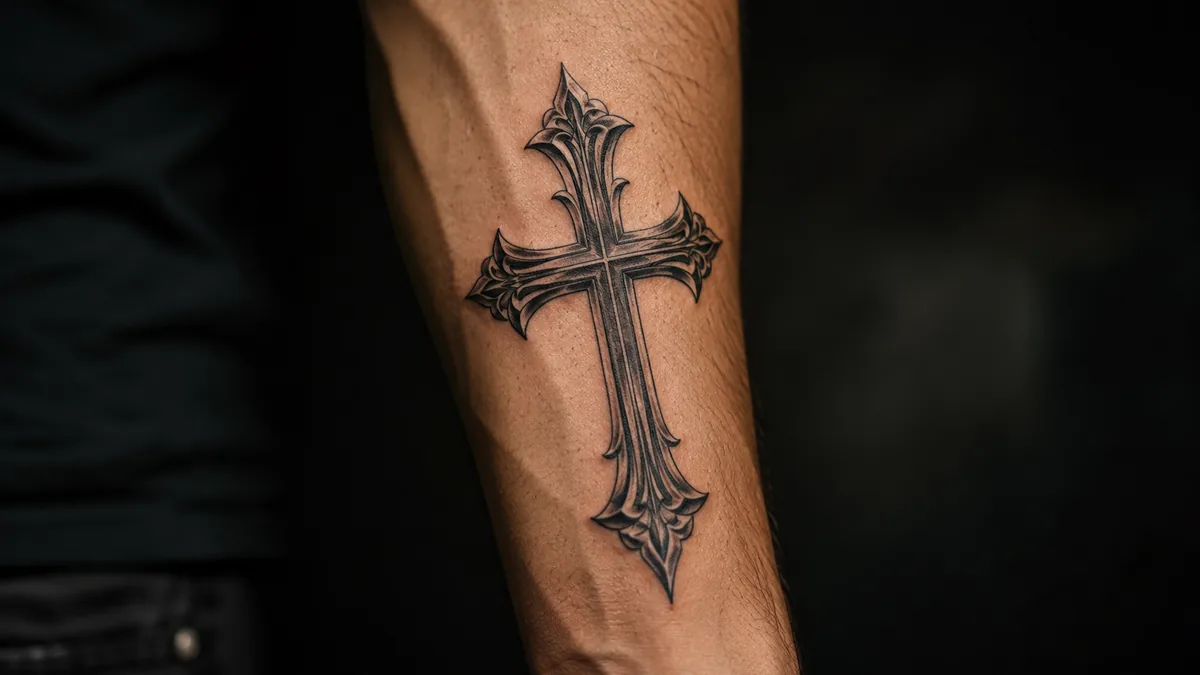
The 3 cross tattoo is one of the most recognized religious images in Western tattooing. Three crosses on a hill, stacked vertically, or arranged side by side, each design tells the same core story: the Crucifixion at Golgotha, where Jesus was crucified between two criminals. That’s the origin. That’s what most people are drawing from when they sit in the chair.
But symbolism layers over time. Today the 3 cross tattoo carries meanings that range from strict Christian faith to personal loss, spiritual protection, and the idea of forgiveness. It reads differently on different people and that’s the point. You bring your story to it.
The Core Meaning: Faith, Sacrifice, Redemption
The three crosses represent the three crucifixions at Calvary as described in the Gospels. The center cross is Christ. The two flanking crosses belong to the two thieves crucified alongside him. One mocked Jesus, one asked for mercy and received it. That contrast, judgment versus grace, is baked into the symbol. It’s not just a Christian icon. It’s a specific story about the moment salvation was offered to someone who didn’t deserve it by any standard.
For believers, wearing this tattoo is a permanent declaration of faith. It says: I know what happened on that hill and it changed everything for me. For others, the three crosses represent the Holy Trinity, Father, Son, Holy Spirit, especially when the design shows one cross larger than the other two. Both readings are legitimate and well established.
Historical and Cultural Background
Three crosses tell the whole story, where you stand is the only question left.
The three-cross image has roots going back to early Christian art. Depictions of Golgotha, or Calvary, appear in Byzantine iconography, medieval woodcuts, and Renaissance paintings. The scene became one of the most reproduced images in Western religious history. By the time tattoo culture picked it up, the symbol already carried centuries of visual weight.
In prison tattoo culture, three dots arranged in a triangle carry a separate meaning entirely, so don’t confuse the two. The 3 cross tattoo specifically refers to the upright Latin cross shapes. It crossed into mainstream American tattooing through religious communities, military personnel, and anyone who grew up with the image in church. It is not a gang symbol. It’s a faith symbol with a long paper trail.
Design Variations Worth Knowing
The classic layout is three crosses on a hill, the center one taller, the two side crosses slightly shorter and angled outward. This is called the Golgotha or Calvary cross design, and it gives you a strong silhouette that reads clean from across the room. It works bold or fine line. Another popular variation is three equal crosses in a row, side by side, which leans more toward a general Trinity read than a Crucifixion scene.
Some clients add a banner with a name or date, a sunrise or rays behind the crosses, a crown of thorns draped over the center cross, or a cloth draped over the beam. Roses and lilies both pair naturally with the design without looking crowded if placed right. Watercolor washes behind it are popular but age rougher than solid black work. Keep the crosses themselves in solid ink and you’re fine.
Black and Grey vs. Color
Black and grey is the dominant choice for 3 cross tattoos. It’s traditional in religious tattooing, it ages with dignity, and the shading gives the crosses depth without competing imagery. A well-executed black and grey Golgotha scene with whip-shaded clouds or a hill below it can look incredible at scale or surprisingly clean at small sizes. The contrast holds long term on most skin tones.
Color works when it’s intentional. Gold outlines referencing gilded religious art, deep burgundy for the cloth, blue sky gradients behind the crosses. These read beautifully fresh but require commitment to touch-up cycles. Saturated color in high-wear zones like wrists and hands will fade noticeably within a few years. If you want color, go medium to large and place it somewhere that doesn’t see constant sun and friction.
Placement, Pain, and Longevity
The most common placements are the chest, upper back, forearm, and bicep. Chest placements let you go large and cinematic, the full Golgotha scene with clouds, light rays, and detail. The upper back does the same. Both are moderate on the pain scale and heal reliably well. The sternum is spicy and the skin there moves, so keep lines bold or expect some drift over time.
Forearm and bicep placements work well for medium-sized pieces. They’re lower wear than hands and wrists, which means color holds better and lines stay crisp longer. Ribcage is a popular choice for personal, faith-heavy pieces but is one of the higher-pain zones, and the skin flexes with breathing, so bold will hold better than fine-line hairwork there. Avoid fine-line only versions on hands and fingers. Blowout risk is real and the healing is rough on those zones.
Who Gets This Tattoo and How to Make It Personal
Devout Christians are the obvious core audience, but this tattoo shows up on a wide range of people. Memorial tattoos for lost family members or friends often incorporate the 3 cross design, especially when the person being remembered was religious. Some people get it as a sobriety marker, connecting their recovery to faith. Military veterans with strong religious backgrounds get it frequently, sometimes combined with dog tag imagery or branch symbols.
To make it yours, think about what specific element carries the most weight. Is it the Crucifixion story, the Trinity, a memorial? That tells you which design direction to take. Adding a name, a birth and death date, or a personal quote below the crosses grounds it in your life without overcomplicating the symbol. Talk to your artist about scale before committing. A 3 cross piece that’s too small loses its read. Too large in the wrong spot and it fights your body’s lines. Get the sizing right and it’ll carry for life.









