
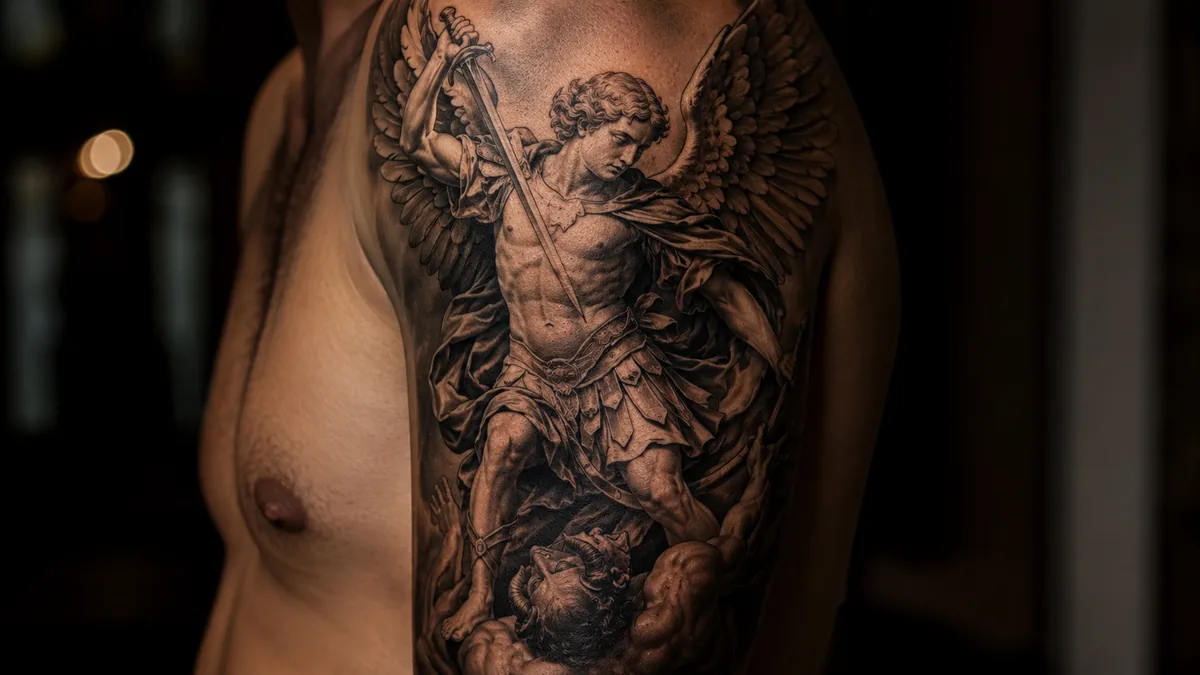
The St Michael tattoo is one of the most loaded pieces you can put on your body. It’s not just religious imagery. It’s a statement about protection, justice, and the belief that good can beat evil. People have been wearing this archangel for centuries, and the reasons still hold up today.
St Michael is the warrior archangel. He’s the one who cast Satan out of heaven. He stands guard over soldiers, cops, firefighters, paramedics, and anyone who faces danger as part of the job. That’s the core of it. This tattoo says: I fight, I protect, I don’t back down.
Core Meaning: Protection, Justice, and Strength
St Michael is the chief archangel in Catholic, Jewish, and Islamic tradition. His main role is warrior and protector. In Christian theology he leads God’s army, defeats Satan, and weighs souls at the Last Judgment. So when someone gets this tattoo, they’re pulling from that whole package: divine protection, moral strength, and righteous combat. It’s not decorative. It means something.
Most people who get it see it as a shield. Protection from evil, bad luck, or personal darkness. A lot of wearers have been through something serious. Loss, trauma, addiction, combat. The tattoo marks survival. It says they came through the fire and came out standing. That’s real and it carries weight.
Historical and Cultural Background
He doesn't symbolize perfection, he symbolizes the willingness to fight anyway.
Veneration of St Michael goes back to the early Christian church, well into the 4th century. He appears in the Bible’s Book of Revelation as the general who defeats the dragon. The Catholic Church formally recognized him as the patron saint of soldiers, police officers, paramedics, mariners, and the sick. The prayer to St Michael, written in 1886, is still recited today by law enforcement and military units worldwide.
In Mexican and Latin American culture, St Michael tattoos are huge. They blend Catholic devotion with folk traditions and often appear alongside other religious imagery like the Virgin of Guadalupe. In Italian-American communities, the St Michael piece carries old-world Catholic pride. The image crosses ethnic lines because the symbolism is universal: good fighting evil, and winning.
Popular Design Variations
The classic composition shows Michael in full armor, sword raised, standing over a defeated Satan or serpent beneath his feet. That image is pulled directly from Renaissance paintings, especially Guido Reni’s famous 1635 version. It translates incredibly well into tattoo form. The armor, wings, flowing robes, and the crushed demon below give you layers to work with, from hyper-detailed realism to bold traditional.
Beyond the classic, you see variations all the time. Michael with scales instead of a sword, referencing the Last Judgment. Michael holding a banner or flaming torch. Some clients want just the helmet and wings. Others want a portrait-style face. Geometric and neo-trad interpretations are growing. Sacred heart or rosary elements added in. Every version carries the same core meaning but the visual approach can be tailored hard to the wearer.
Black and Grey vs Color
Black and grey is the dominant choice for this piece. It suits the subject matter. The shadows, the drama, the sense of weight and gravitas, all of that reads better in grey wash than in full color. A skilled artist can build incredible depth in the armor and wings with nothing but black ink and a good hand. It heals cleaner over time too, especially on larger pieces.
Color works well in certain styles. Traditional and neo-trad St Michael tattoos look sharp with solid blacks and bold reds, golds, and blues. Saturated color makes the piece pop from across the room. Fine-line color realism is popular right now but you have to be honest with clients: fine line color on large figurative pieces can fade uneven and blur faster than bold work. Bold will hold. That rule applies here as much as anywhere.
Best Placements and How It Ages
This tattoo needs room. A full St Michael composition with the armor, wings, and fallen angel beneath him is not a wrist piece. The back, chest, full sleeve, and upper arm are the natural homes. Back pieces allow for the full vertical drama of the image. Chest pieces let the wings spread naturally across the pec and collarbone. Thigh is underrated for this, big canvas and low wear.
Avoid cramming it. Artists see this mistake constantly. A rushed, tight St Michael on a small patch of skin loses all the detail that makes the piece meaningful. On the ribcage it will be spicy during the session but it heals well and stays private. Avoid hands, fingers, elbows, and knees for detailed figurative work. High-wear zones fade fast and blow out fine lines. Give this piece the space it deserves and it will read clean for decades.
Who Gets This Tattoo and Why It Stays Personal
Law enforcement and military clients are the most common. The patron saint angle is real for them. Firefighters and paramedics get it for the same reason. Beyond that, it’s big among people raised Catholic who want a piece of that faith on their skin without it feeling soft. The warrior imagery bridges the gap between devotion and toughness, which is a combination a lot of people relate to.
It’s also deeply personal for people who have survived something. Cancer, addiction, violence, the death of someone close. The St Michael piece becomes a marker of that fight. Some clients add names, dates, or specific elements that tie the image to a personal story. A fallen comrade’s name on the banner. A birth year in the armor. That customization is what separates a meaningful tattoo from a flash sheet pull. Talk to your artist about it. They can work it in without breaking the composition.
Making It Your Own Without Losing the Symbol
The iconography of St Michael is flexible. You can shift the style, the pose, the details, and still keep the core meaning intact. Want a darker, more menacing version? Have your artist lean into shadow and aggressive linework. Prefer something more devotional and classical? Reference Renaissance paintings directly and ask for soft grey wash and fine detailing in the wings and face. Both are valid.
What you want to avoid is stripping so much away that the symbol disappears. A vague winged figure with a sword can look like any warrior angel. Keep at least one clear Michael marker: the defeated demon underfoot, the scales, the armor, or the banner. Your artist should be able to advise on what reads clearly at the size and placement you’re planning. Get a stencil check. Make sure it reads from a normal conversational distance before the needle touches skin.









