
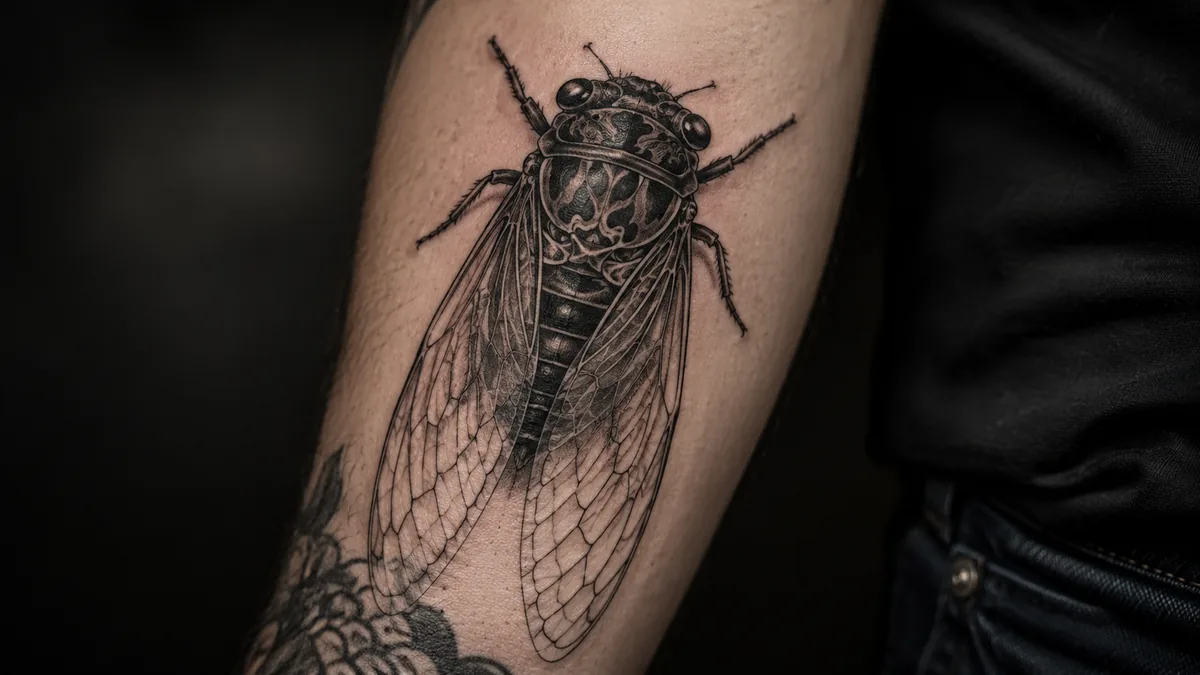
The cicada is one of those insects that earns its tattoo spot. It disappears underground for years, sometimes over a decade, then claws its way back to the surface, sheds its shell, and becomes something completely different. That cycle hits hard for a lot of people, and the tattoo carries that weight honestly.
If you’re drawn to the mythology, the personal meaning, or just the raw visual of a creature mid-molt, the cicada tattoo has real substance behind it. Here’s what it actually means, how people wear it, and what you need to know before you sit down in the chair.
Core Meaning: Rebirth and Transformation
The number one reason people get a cicada tattoo is rebirth. The life cycle is genuinely dramatic. Nymphs live underground anywhere from two to seventeen years depending on the species, then emerge, split their exoskeleton open, and fly. That’s a hard metaphor to top. People who’ve come through addiction, illness, grief, or major life upheaval connect to it immediately.
Transformation is the close second. The molted shell, called an exuvia, is left behind on whatever surface the cicada climbed. Some designs incorporate that empty shell alongside the emerged adult, representing the person you were versus who you became. It reads clearly, it’s honest, and it doesn’t require an explanation paragraph on your arm.
Patience, Timing, and Waiting It Out
Seventeen years underground, then one summer of pure noise, that's the whole story.
The seventeen-year cicada is where patience gets real. Nothing about that creature is in a rush. It waits until conditions are right, then moves. For people who’ve spent years building something quietly before it paid off, or who’ve been in recovery, or who’ve endured a long difficult stretch without recognition, that timing feels personal.
This angle works especially well for people who’ve done quiet hard work that others didn’t see. The cicada doesn’t announce itself underground. It just puts in the time. When it surfaces, it’s loud and undeniable. That arc from invisible to fully present is a meaning that holds up over years of wearing the piece.
Cultural and Historical Background
In ancient China the cicada was a symbol of immortality and resurrection. Jade cicada carvings were placed on the tongues of the deceased during burial, meant to help the soul transition and be reborn. The Chinese also associated cicadas with purity because the insect was believed to survive only on dew. That’s a real documented belief, not invented symbolism.
In ancient Greece the cicada appeared in the work of Plato and was linked to the Muses and to poetic inspiration. Homer mentioned them as well. Japanese culture connects the cicada, known as semi, to summer, impermanence, and the Buddhist concept of mono no aware, the bittersweet awareness that things don’t last. None of these traditions are interchangeable but they share a thread: the cicada marks time and transition.
Popular Design Variations
The most requested designs break into a few clear directions. Realistic or neo-traditional cicadas with detailed wing venation and iridescent coloring are popular for people who want the creature to look alive on the skin. The wings are the star of that style, and a skilled artist can render them with a translucent quality that looks genuinely three-dimensional.
Illustrative and fine-line interpretations strip it back. Clean, crispy outlines, minimal shading, and a botanical feel. Some clients add the molted exuvia alongside the living cicada to show the before and after. Geometric or dotwork cicadas work well for minimalist builds. Japanese tebori-influenced designs place the cicada in a seasonal scene with pine branches or chrysanthemums, framing it as a summer symbol within a larger narrative.
Color vs. Black and Grey
Color cicadas have serious potential. Real cicadas can have green, blue, orange, or red patterning depending on species, and iridescent wings that shift under light. A saturated color piece with proper layering can pull that iridescence off convincingly. The wings in particular benefit from color because the fine venation structure gives the artist natural lines to work with. It’s a piece that reads from across the room.
Black and grey holds up cleaner over time, especially in high-wear zones or on skin tones where color fades fast. Whip shading on the wing membranes with solid black on the body gives contrast and weight. Fine-line black and grey is popular right now, but be aware that ultra-thin lines in certain spots can blow out or lose definition as the skin ages. Talk to your artist about line weight honestly.
Placement and How It Ages
The forearm, upper arm, and shoulder blade are reliable spots. The shape of a cicada with wings spread maps naturally to longer surfaces and fits forearms, sternum, and spine placements cleanly. Ribcage placements are spicy but give the wings room to breathe. Behind the ear or on the back of the neck works well for smaller minimalist pieces, though fine lines in those zones need extra care to hold.
The inner arm and wrist are lower-wear zones that preserve detail better over time. Hands and fingers are high-wear and will require touch-ups faster, especially for fine-line work. A well-executed piece with solid lines and properly packed black will age far better than ultra-delicate linework that hasn’t been built with longevity in mind. Ask your artist what they’ve seen heal well in the placement you’re considering.
Who Gets This Tattoo and How to Make It Personal
Cicada clients are usually people who’ve been through something real. Survivors of serious illness, people in long-term recovery, folks who spent years in a career or situation that felt underground before something finally broke open. It’s also a strong memorial piece for someone lost, representing the idea that the person has moved into a different form rather than simply ending.
To make it yours, think about what part of the life cycle means the most to you. The emergence, the shell left behind, the wings fully open. Adding a specific species native to your home state grounds it geographically. Incorporating a significant date or location through background elements ties it to a real moment rather than keeping it abstract. The imagery is strong enough to stand alone, but specific details make it a story only you’re carrying.









