
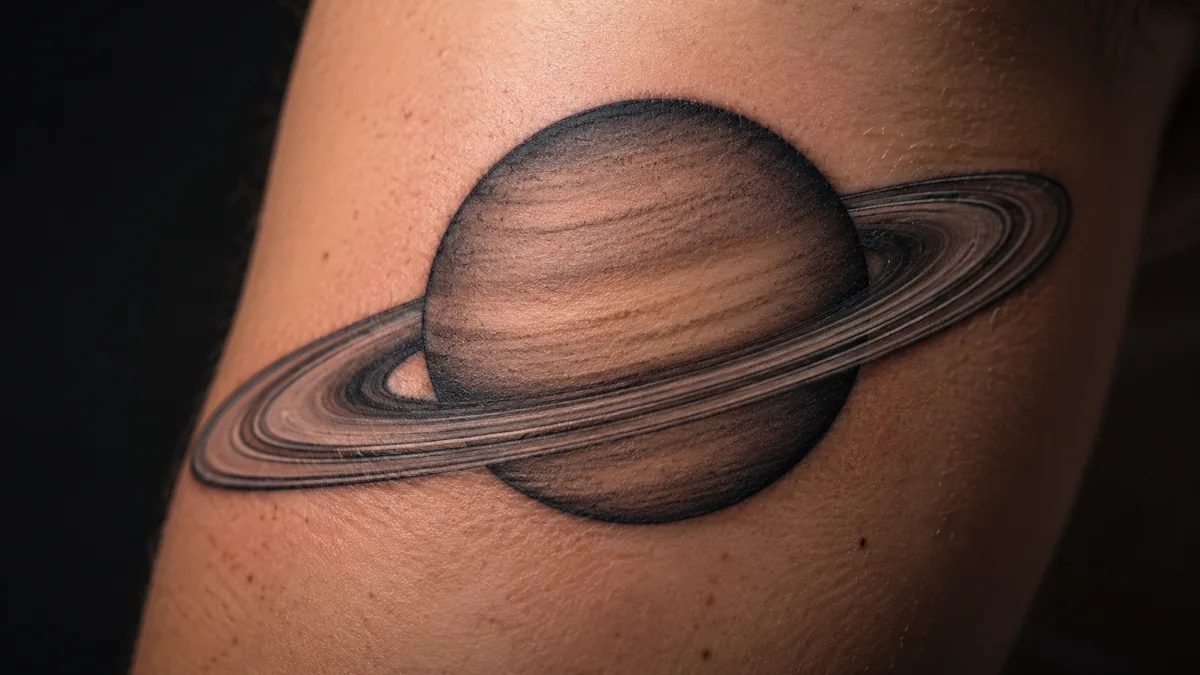
Saturn is one of those tattoos that hits different depending on who’s wearing it. it represents time, structure, responsibility, and the inevitability of change. The planet has carried heavy symbolic weight for thousands of years, and that weight translates directly to skin.
People get Saturn tattoos for a lot of reasons. Some are into astrology and feel a deep connection to the planet’s energy. Others are drawn to the visual, because let’s be honest, a ringed planet is just a striking image that reads clean from across the room. Either way, there’s real meaning behind it worth understanding before you commit.
Core Symbolism: What Saturn Actually Means
Saturn is the planet of time, limits, and hard lessons. In Western astrology it rules discipline, karma, responsibility, and mortality. It’s sometimes called the great teacher or the taskmaster because its energy is about facing reality, not escaping it. People who get this tattoo often want a reminder that effort and patience matter, that shortcuts don’t exist, and that life has boundaries worth respecting.
There’s also a mortality angle. Saturn rules over cycles of endings and beginnings. Some clients come in specifically wanting that memento mori energy without a skull, and a ringed Saturn delivers it quietly. It’s a more subtle way to say ‘I know life is short and I’m moving with intention.’ That nuance is a big part of why it appeals to thinkers and introverts.
Historical and Mythological Roots
Saturn doesn't rush, and neither should the person wearing it.
In Roman mythology, Saturn was the god of agriculture, time, and generational cycles. He was lord of the Golden Age, a period of peace and abundance, but also the figure who devoured his own children out of fear of being overthrown. That duality, abundance alongside destruction, is baked into the symbol. The Greek equivalent is Kronos, directly tied to the word chronos, meaning time.
The planet was also associated with Saturday and with the metal lead in classical astrology and alchemy. Medieval astrologers linked Saturn to old age, melancholy, and patience. None of that is invented, it’s documented across centuries of Western esoteric tradition. When someone wears Saturn, they’re tapping into a lineage of symbolism that’s genuinely old and genuinely layered.
Popular Design Variations
The most common version is a straight-on or slightly angled view of the planet with its rings visible. Fine line versions look sharp and minimal, clean geometry that works beautifully in black and grey. Blackwork versions go bold and graphic, great for upper arms or thighs where you want something that reads fast. Some artists add stars, moons, or other planets to build out a solar system scene.
Another popular direction is the anatomical or cracked-open Saturn, where the planet is split to show texture or negative space inside. You also see Saturn integrated with an hourglass, which doubles down on the time symbolism without being subtle about it. Geometric and dotwork styles suit the ringed shape naturally because the rings give you a built-in linear element to play with.
Color vs. Black and Grey
Black and grey is the dominant choice for Saturn tattoos, and it makes sense. The planet’s ringed form has natural depth and shadow, so a skilled artist can build real dimension with just ink and white highlight. It heals nice in black and grey when done right, holding contrast longer than color in most skin types. Whip shading around the rings gives that soft atmospheric glow that makes a space piece feel alive.
Color opens up different territory. NASA imagery shows Saturn in warm golden tans and soft browns, which translate well when you want something that looks almost photorealistic. Some clients go full illustrative with deep purples and blues for a stylized cosmic feel. Just know that saturated color fades faster, especially on high-wear zones, and touch-ups are part of the deal. Both approaches work, it comes down to the vibe you’re after.
Placement and How It Ages
The upper arm is the most forgiving spot for a Saturn tattoo. Skin is stable, it’s a low-wear zone, and the oval shape of the planet plus rings fits naturally in portrait orientation on the outer bicep or inner arm. The forearm works well too, especially for a horizontal composition where the rings stretch along the arm’s length. These spots give your artist room to put in solid detail that actually survives the years.
Avoid placing a fine line Saturn somewhere spicy and high-wear like the wrist crease, inner elbow, or fingers if you want it to stay crispy. Fine line specifically needs stable skin to hold. Blowout risk is real in thin-skinned spots near veins. The ribcage and sternum are popular for the pain tolerance crowd and can look stunning, but they shift with weight changes and the skin moves a lot over time. Bold will hold better than hair-thin work in those zones.
Astrology, Identity, and Who Gets This Tattoo
A solid chunk of Saturn tattoo clients are astrology-aware people who are either Saturn-ruled by their sun sign, Capricorn or Aquarius in traditional astrology, or who’ve gone through what astrologers call a Saturn return, that roughly 27-29 age window where life gets restructured fast. Getting a Saturn tattoo after a Saturn return is genuinely common, it’s a way of marking that you survived a hard chapter and came out with more clarity.
Beyond astrology, you see Saturn tattoos on people who connect to themes of perseverance, structure, and legacy. Engineers, scientists, teachers, anyone who deals in systems and long timelines. It’s also popular in alternative and goth-adjacent circles for the mortality symbolism. It crosses demographics more than you’d expect because the core ideas, time is real, effort matters, limits are part of life, are universal.
Making It Personal: Customizing Your Saturn
The cleanest way to personalize a Saturn tattoo is through what you add to it. An hourglass underneath anchors the time theme. A small eye or a key integrated into the design nods toward Saturn’s esoteric associations with insight and access. Birth dates worked into the ring design, either as Roman numerals or as a subtle text element in the rings themselves, make it specific to your timeline without being obvious about it.
Some clients want just the glyph, Saturn’s astrological symbol, which is a stylized cross with a curved hook. Small, minimal, packs the full meaning into a half-inch mark. Others want the whole planet rendered in meticulous detail as a statement piece. Both are valid. Talk to your artist about what you actually want it to communicate before locking in a size and style. A good artist will push back if the detail level you want won’t survive the placement you’ve chosen.









