Let’s be straight with each other: biblical tattoos can go sideways fast. I’ve watched a “John 3:16” turn into a blue smudge on someone’s shoulder blade because the font was too delicate and the sun got to it. I’ve also seen a simple olive branch on a forearm that still looks incredible ten years later. The difference isn’t faith level, it’s understanding how ink lives on skin. If you’re thinking about carrying scripture, symbolism, or sacred imagery on your body, here’s what actually works in real shops, on real human skin, healing through real life.
Popular Styles That Hold Up
Not every style that looks killer on paper translates to tattoo. Skin stretches, sun hits, time passes. Here are the approaches I’ve seen age with dignity.
Blackletter and Traditional Script
Old English, Gothic, and heavily serifed fonts have been tattooed since sailors carried Bibles. The thick verticals and thin horizontals create contrast that stays readable. Key rule: minimum 10-point equivalent size. Anything smaller and those elegant hairlines become fuzzy gray threads. Your artist should be building letterforms with confident, consistent line weight, not scratching in something that looks like printer text.
- Blackletter: dramatic, historical, reads well at medium distance
- Typewriter-style serif: clean, modern, needs slightly larger sizing
- Hand-scripted custom: most personal, requires skilled letterer
Illustrative and Symbolic
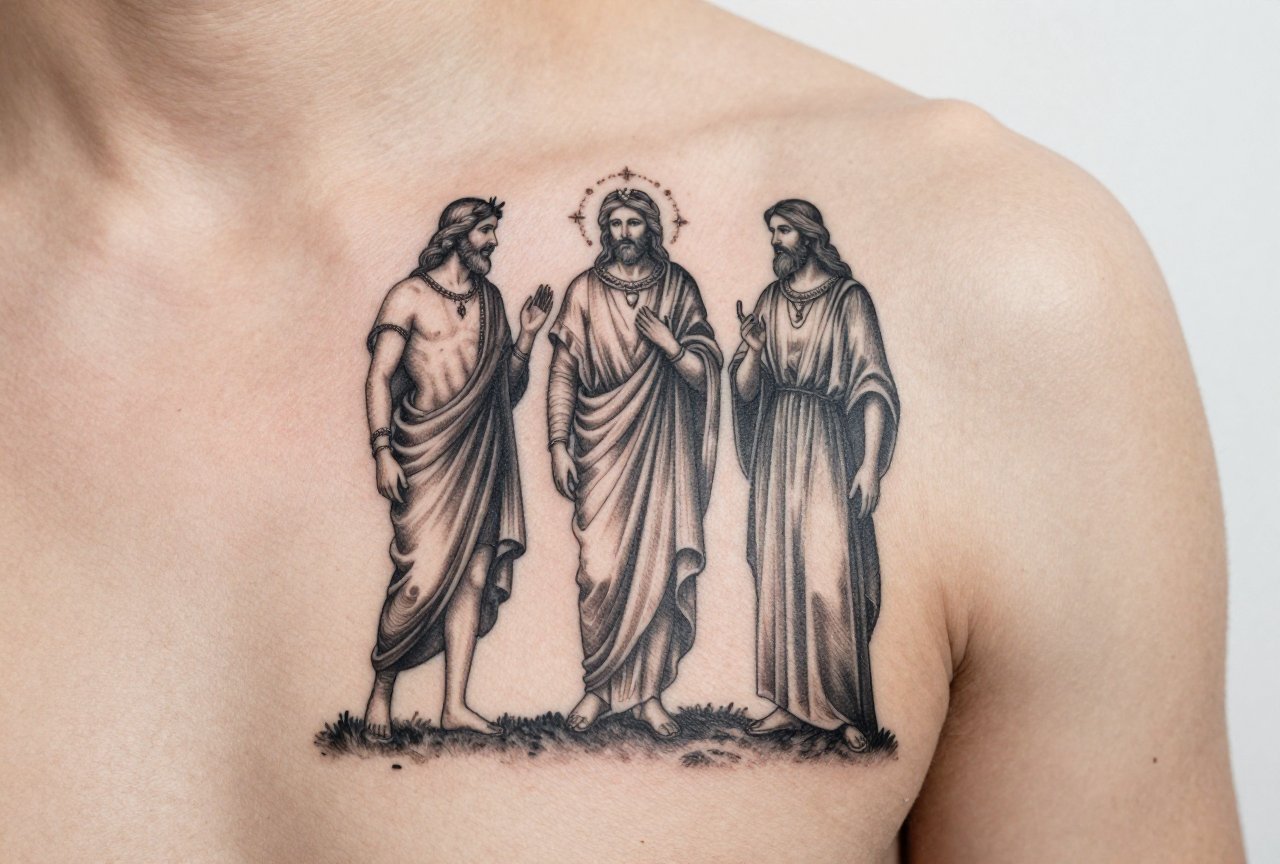
Crosses, doves, fish, anchors, trees of life, these carry meaning without requiring a magnifying glass. The best biblical imagery tattoos I’ve done or seen use bold outlines and limited fine detail. A wooden cross with grain texture? Beautiful. A cross where every splinter is rendered with single-needle precision? That detail will soften and muddy within five years. Think icon, not photograph.
Design Ideas With Real Meaning
Clients come in with verses that carried them through darkness, or imagery that connects to something deeper than trend. Here’s how those ideas translate to actual tattooable concepts.
Scripture References and Phrases
Full verses rarely work unless you have significant real estate. “I can do all things through Christ who strengthens me” is twenty-two words. That’s a rib panel, minimum, at readable size. Most people go with chapter:verse notation, “Philippians 4:13”, or a short phrase like “strength” or “walk by faith.” The notation approach is understated; only those who know the reference catch it. That’s often the point.
Some phrases I’ve tattooed that aged well:
- “Still waters”, Psalm 23, fits small, reads clean
- “Fear not”, appears dozens of times in scripture, universally applicable
- “Mending nets”, Matthew 4:19-20, speaks to repair and purpose
- Hebrew or Greek originals, “Agape,” “Shalom,” “Elohim”, but only if verified with someone who reads the language
Honest aside: I’ve had to fix three “Hebrew” tattoos that were misspelled or backwards. Your tattoo artist is not a semitic linguist. Pay for a consultation with someone who actually reads the text.
Natural and Architectural Imagery
The Bible is thick with sensory material. Mountains, vineyards, lilies, cedar, stones, tents, temples. These give your artist something visual to interpret rather than just text to copy.
- Mountains: Exodus, transfiguration, ascent, strong silhouette, ages excellently
- Vines and branches: John 15, connection, growth, works as wrapping designs around arms or legs
- Broken chains: liberation imagery, bold blackwork, immediate readability
- Loaves and fish: provision, miracle, simple enough to stay clear
Best Placements for Biblical Work
Where you put it matters as much as what you put. I’ve seen placement choices that honored the work and others that practically guaranteed distortion.
Visible but Professional
Forearms are the standard for readable script. Inner forearm protects from sun; outer forearm shows when you want. Either way, the flat surface keeps lettering from warping. Wrists are popular but problematic, small space forces tiny text, and the constant flexing and sun exposure there is brutal on fine work.
Upper arms and shoulders give you room for larger compositions. A verse wrapping a bicep, an image sitting on the deltoid. These spots age slower because they’re less exposed and the skin doesn’t stretch as dramatically with weight fluctuation.
Intimate and Personal
Ribs, sternum, along the spine, these hurt more, no way around it. But they keep the work private. I’ve had clients who wanted their verse close to their heart, literally. Others who chose the ribs because the pain felt like part of the commitment. That’s valid. Just know that rib skin moves with every breath; script there needs to be sized and spaced with that motion in mind, or it’ll look wavy when you twist.
- Inner bicep: protected, personal, easy to hide
- Behind the ear: small notation only, high sun exposure
- Side of calf: flat, readable, shows in shorts
- Top of foot: popular, but ink fades fast there; not recommended for detailed work
Color Choices: What Lasts
Black and gray biblical tattoos are the standard for good reason. Black ink has the longest track record. It stays dark, fades to gray-blue rather than muddy green, and touch-ups read cleanly. Color can work, I’ve done deep red wine, purple robes, green olive branches, but it requires commitment to sun protection and eventual refresh sessions.
If you want color, limit your palette. A full-color scene from Revelation sounds epic in consultation. In reality, that much competing pigment turns to soup faster than a simple red accent on blackwork. Gold is particularly tricky; it often heals more mustard than metallic. Your artist can suggest yellows that stay warmer longer, or use white highlight technique that suggests gold without promising what chemistry can’t deliver.
Tips for Choosing: Shop Floor Reality
Here’s where I get protective of you as a potential client. The tattoo industry has no shortage of people who will take your money and give you something that looks fine for six months.
Research Your Artist Like You Research Your Verse
Look at their healed work, not just fresh photos. Instagram is full of bright, saturated fresh tattoos. Ask to see something they did two years ago. Good artists keep those photos. If they don’t, that’s information too. For script specifically, find someone whose lettering portfolio makes you want to read every word. Script specialists exist; generalists who “can do letters” often can’t.
Think About the Conversation
Biblical tattoos invite questions. Some people want that, they’re evangelizing through skin. Others are surprised when strangers ask about their rib verse at the beach. Consider if you’re prepared for the conversation, or whether you’d rather place it somewhere that gives you control over when to share.
- Bring reference images, but expect customization, your body isn’t paper
- Schedule for when you can heal properly: no swimming, no sun, no gym friction for two weeks minimum
- Budget for quality, script especially punishes cheap work; there’s no hiding a misspelled word in a three-letter phrase
- Consider the translation: NIV, ESV, KJV, original languages, each carries different weight and different word count
One last thing from years in shops: the people happiest with their biblical tattoos years later chose meaning over trend. They didn’t pick what was popular on Pinterest. They picked what they actually needed to remember. That sincerity shows in the wearing, and it helps you love the work even when the lines soften and the black settles into its final shade.
Final Thoughts
Biblical tattoos done well become part of your story without needing to explain themselves to anyone. They age like any tattoo, some blur, some settle, all change, but the ones rooted in genuine meaning wear better than the ones chosen for aesthetic alone. Work with an artist who respects the text, size it for human skin rather than phone screens, and place it where your life won’t destroy it immediately. The rest is between you and what you believe. I’m just here to make sure the ink holds up its end of the deal.
More Tattoo Ideas
- Crow Tattoo Meaning: Intelligence, Mystery, Transformation and Omen Sy
- Crescent Moon Detailed Design Tattoo Ideas
- I Tried Very Simple Mehndi, The Wrist Flow Finally Felt Clean
- Explore more
Frequently Asked Questions
Which Bible verses work best as tattoos?
Short verses like Philippians 4:13 or Psalm 23:4 translate well because they remain readable at small sizes. Avoid long passages since tiny text blurs over time and becomes illegible.
Is it okay for Christians to get religious tattoos?
This depends on personal conviction since Leviticus 19:28 is often debated in context. Many believers view tattoos as worshipful expression if the heart motive honors God.
What biblical symbols hold up visually over years?
The ichthys, cross, anchor, and dove age gracefully because their bold simple shapes resist ink spread. Detailed imagery like crowns of thorns or angel faces require larger sizing and skilled artists to prevent muddy results.
Should I get Hebrew or Greek script for authenticity?
Only if you verify spelling with a fluent speaker or scholar, as incorrect lettering is permanent and common. Many people choose their native language for clarity and personal connection instead.