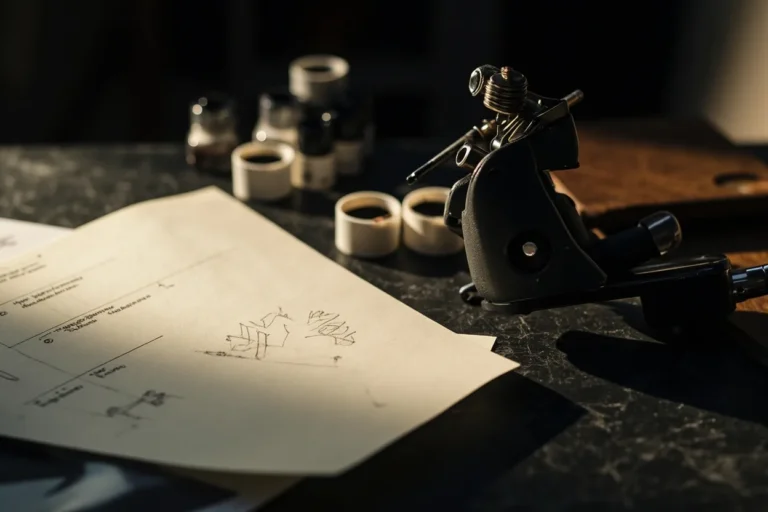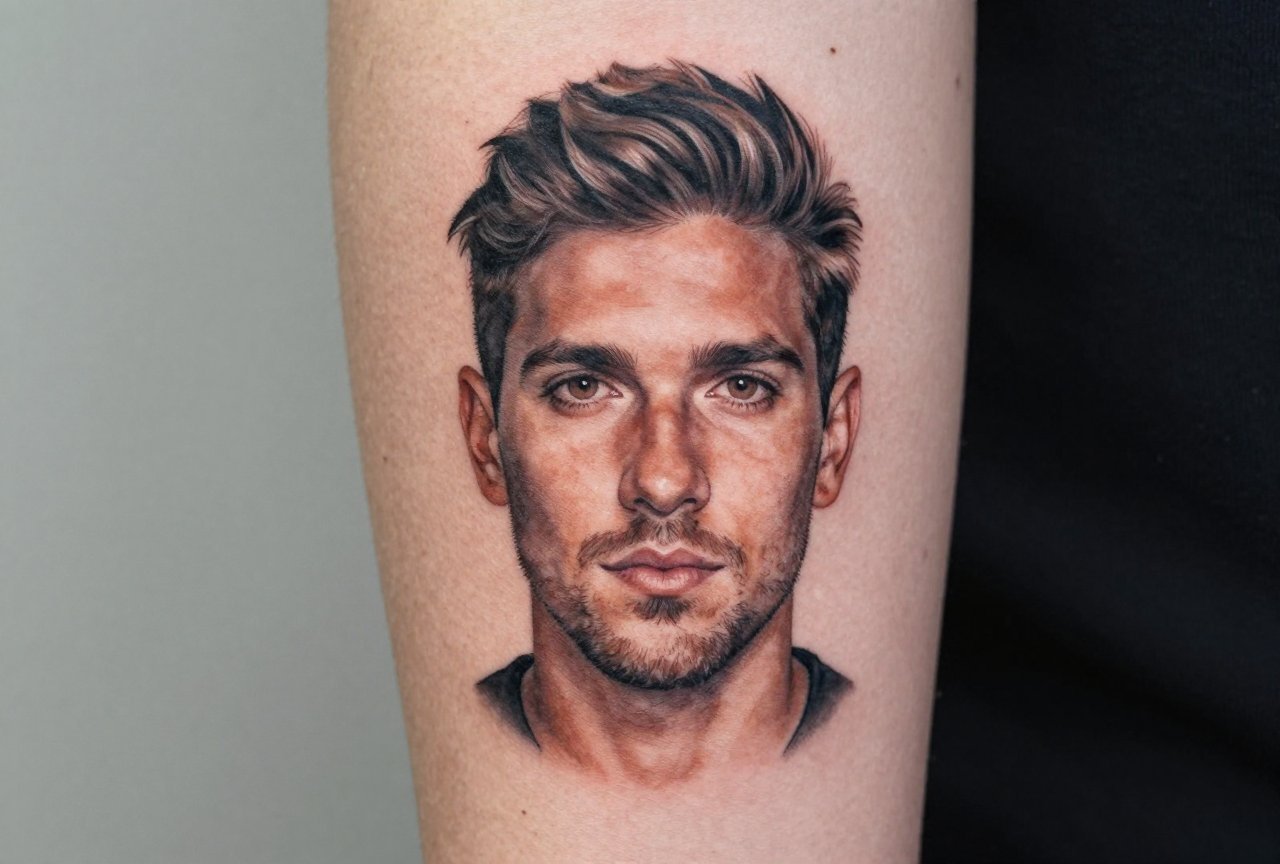
A realistic portrait tattoo is exactly what it sounds like: a face rendered on skin with the detail and dimension of a photograph. I’ve done hundreds of these over the years, from grieving parents memorializing children to collectors wanting a full sleeve of historical figures. The style demands technical precision that pushes against everything tattooing naturally wants to do, skin blurs, ink spreads, and faces are unforgiving. One wrong line in an eyebrow arch and the likeness collapses. It’s humbling work. When it’s done right, though, a portrait tattoo can stop a room.
Origins & History
Portrait tattooing didn’t start with the photorealistic precision we see today. In the 1970s and 80s, what passed for a portrait was often a stylized representation, think Sailor Jerry’s pin-up girls or biker shop flash of Elvis with heavy outlines and flat shading. The shift toward true realism came with two things: better equipment and the cultural crossover from fine art into tattooing.
The Photo-Real Revolution
By the mid-1990s, artists like Paul Booth and later Nikko Hurtado were proving that skin could hold subtle gradations previously thought impossible. Rotary machines with consistent needle depth, improved black ink formulations, and the willingness to work slowly, sometimes four to six hours on a palm-sized piece, changed everything. I remember my first portrait seminar in 2008; the instructor spent forty-five minutes just talking about how to read a photograph’s mid-tones. We didn’t even touch machines that day.
Memorial Culture
Realistic portraits exploded in popularity partly because of memorial tattooing. People wanted actual faces of lost loved ones, not symbols. This changed shop culture too. I tell clients now that memorial portraits are about 60% of my portrait work. The emotional weight is real. I’ve had grown men shake in my chair talking about their fathers. The art has to carry that.
Key Characteristics & Motifs
What separates a realistic portrait from other styles? It’s not just “looks like a photo.” There are specific technical markers:
- No outlines. Real portraits use contrast and tone to create edges, not black lines. An outline around a nose would read as cartoon immediately.
- Smooth gradation. The shading moves from dark to light in imperceptible steps. We achieve this through whip shading, graywash, and sometimes single-needle work for the finest transitions.
- Accurate proportions. The eye-to-nose distance, the curve of the upper lip, the placement of the ear, tattooed portraits fail when these drift even slightly.
- Eye detail. The catchlights in the iris, the softness of the sclera, the fold of the eyelid, this is where the life lives or dies.
- Texture suggestion. Skin pores, stubble, hair strands, the softness of aged skin versus the tightness of youth.
Common subjects include loved ones, celebrities, historical figures, pets, and religious icons. I’ve tattooed Marilyn Monroe’s face more times than I can count, and every single one had to feel different or I’d be bored out of my mind.
Color vs Black and Grey
This is the question I get asked most in consultations. The honest answer: both work, but they work differently over time.
Black and Grey
Black and grey portraits are the traditional choice. Carbon-based blacks are stable. The gray tones, achieved by diluting black ink or using premixed graywash, settle predictably. I’ve seen black and grey portraits from fifteen years ago that still read clearly. The limitation is warmth. You lose the flush of a cheek, the blue of a vein, the particular brown of an eye. Some subjects demand that. Others don’t.
Color Realism
Color portraits are harder and riskier. Reds can go pink. Flesh tones can muddy. Blues sometimes shift toward green as the body processes certain pigments. I’ve had to do corrections where a client’s “natural” skin tone in the tattoo turned orange after healing. The payoff is undeniable, though, a color portrait of a child with their actual eye color, the exact purple of a grandmother’s dress, the sunburn on a soldier’s nose. When it works, it really works. I always warn color portrait clients: budget for a touch-up in two to three years. Not because I did bad work, but because skin is alive and color is stubborn.
Best Placements
Not every spot on the body can hold a portrait’s detail. I turn down placements that will waste the client’s money and my time.
- Upper arm, outer. Classic. Flat canvas, good visibility, ages well with muscle tone.
- Forearm. Popular but tricky, sun exposure fades portraits faster here. I make clients promise sunscreen.
- Chest. Excellent for larger pieces. The sternum’s flat plane is ideal, though it hurts like hell.
- Thigh. Underrated. Big, relatively flat, easy to heal, easy to hide or show.
- Back. The full back piece is a portrait artist’s dream, space to breathe, room for background context.
I won’t do realistic portraits on fingers, feet, ribs that wrap too much, or anywhere the skin is thin and mobile. The detail won’t hold. I’ve seen too many beautiful portraits turn to mush on hands. The client is always disappointed. I’d rather say no.
Who It Suits
Realistic portraits aren’t for everyone, and that’s okay. The ideal client has specific reference material, clear photos, multiple angles, good lighting. Blurry snapshots from a funeral don’t work. I’ve had to send people away to find better images. It’s not cold; it’s honest.
Skin type matters too. Very dark skin can absolutely hold portraits, but the approach changes. I work higher contrast, rely more on negative space, sometimes incorporate dotwork for texture. Artists who say “portraits don’t work on dark skin” are lazy or unskilled. I’ve seen stunning work by Black artists on Black clients that proves otherwise.
Pain tolerance is real consideration. A detailed portrait is slow. Six hours minimum for something palm-sized. I’ve done twelve-hour sessions. The client needs stamina, hydration, and realistic expectations about their own body.
Modern Variations
The style keeps moving. I’m seeing fascinating hybrids in shops now.
Double Exposure & Surrealism
Portraits merged with landscapes, galaxies, architectural elements. The face remains realistic but dissolves into something symbolic. These are technically demanding, maintaining the likeness while breaking the form. I did one last year where a woman’s face became a forest at the hairline. Took fourteen hours. Worth it.
Micro-Realism
Tiny portraits, sometimes under two inches, using single-needle or nano-needle setups. Popular for discreet memorials. The limitation is longevity. I’ve been honest with clients: a portrait the size of a quarter might look incredible for three years, then soften significantly. They still want them. I still do them. We just talk first.
Choosing an Artist
This is the most important section. A bad portrait artist can ruin a meaningful image. Here’s what I tell people:
- Look at healed work, not just fresh photos. Everyone’s portfolio is full of bright, swollen, just-finished pieces. Ask for one-year-healed photos. If they don’t have them, that’s a flag.
- Specialization matters. A great traditional artist isn’t automatically a great portrait artist. The skill sets diverge significantly. I know phenomenal Japanese-style tattooers who won’t touch a portrait, and vice versa.
- Consultation chemistry. You’re going to sit close to this person for hours, often talking about emotional material. If the vibe is off in a twenty-minute consult, don’t book.
- Price reflects time. A realistic portrait takes me three to four times longer than a traditional piece of the same size. If someone’s charging half what others charge, they’re either rushing or desperate. Neither ends well.
I also warn against “copying” another artist’s portrait. Reference is essential, but a tattoo should be interpreted through the artist’s hand. Exact photocopying on skin looks flat, weird, and somehow less alive than the original photo.
Final Thoughts
Realistic portrait tattooing is one of the most demanding styles in the craft. It asks everything of the artist, technical precision, emotional intelligence, physical stamina, and the humility to know when a reference photo won’t translate. I’ve cried in my station after finishing memorial pieces. I’ve also laughed with clients seeing their dog’s face perfectly captured for the first time. The work is heavy and light at once.
If you’re considering a portrait, take your time finding reference, choosing an artist, and sitting with the decision. This isn’t flash art you pick off a wall. It’s someone’s face, permanently. Treat it with the weight it deserves, and find an artist who does the same. The best portrait tattoos I’ve done weren’t the most technically perfect, they were the ones where the client felt truly seen.
Frequently Asked Questions
How do I know if my reference photo is good enough for a portrait tattoo?
You need clear, high-resolution images with good lighting and sharp focus. Multiple angles help, especially for profiles or three-quarter views. Blurry phone screenshots from social media won’t work, your artist needs to see actual skin texture, eye detail, and accurate proportions to translate the image properly.
Why do some portrait tattoos look great fresh but fade weirdly later?
Fresh tattoos are swollen and saturated, which hides imperfections. As skin heals and settles, heavy-handed work can blur, light work can disappear, and color shifts become visible. This is why experienced artists build in slightly higher contrast than the photo shows, we’re tattooing for how it’ll look in five years, not five minutes.
Can a realistic portrait cover up an older tattoo?
It’s possible but limited. Portraits need clean skin to achieve subtle gradations. Existing dark lines or saturated color blocks will show through and distort the likeness. Sometimes a few laser sessions to lighten the old tattoo make a portrait cover-up viable. I always assess these in person, photos lie.
How should I care for a portrait tattoo while it heals?
Follow your artist’s specific aftercare, but generally: keep it clean, don’t pick scabs, avoid soaking in water, and stay out of sun during healing. For portraits specifically, the fine detail in eyes and skin texture is vulnerable to scabbing damage. I’ve had clients lose entire catchlights in an iris because they scratched. Patience pays.
Related Style Guides
- Traditional Lady Tattoos: A Working Artist s Guide
- Traditional Pirate Tattoos: A Working Artist s Guide
- 500 Designs Tattoo Ideas
- Explore more