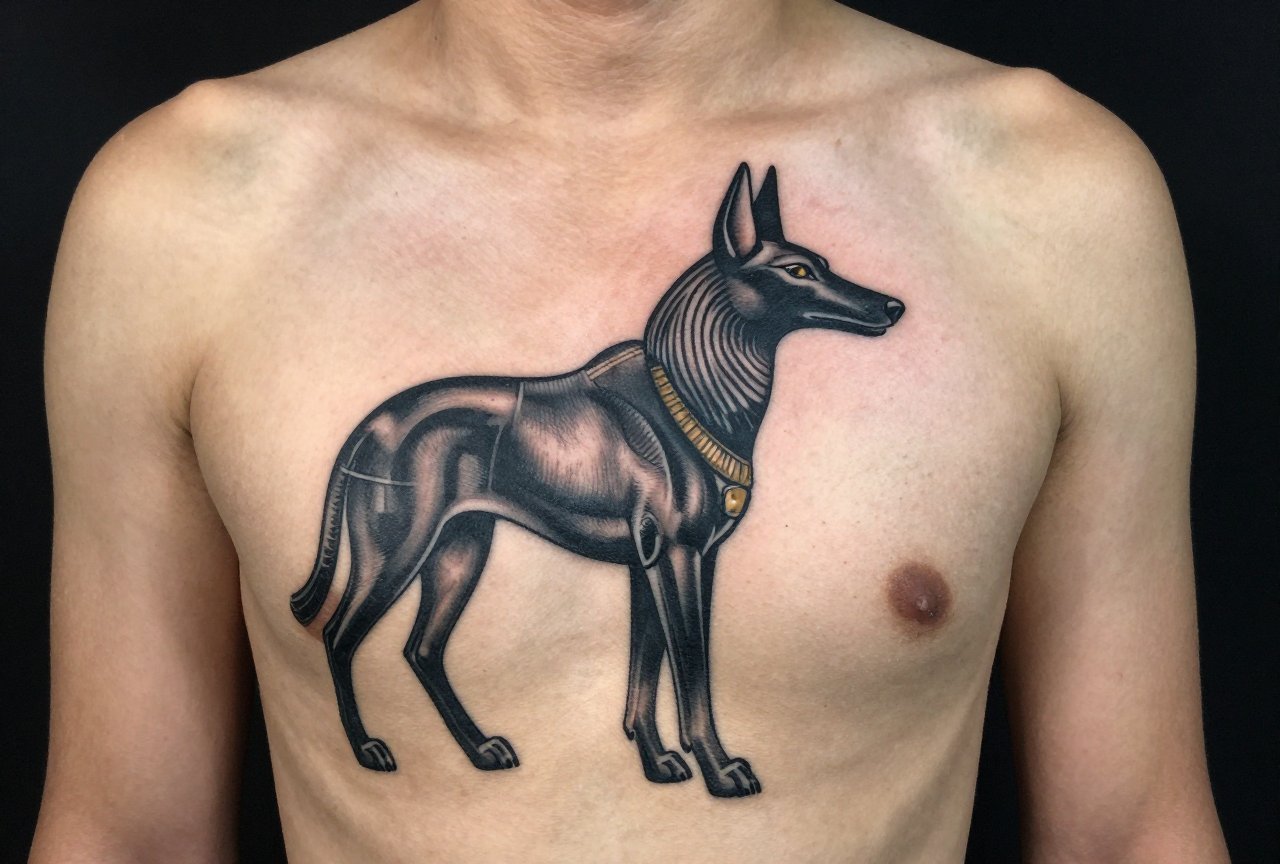
A realistic Anubis tattoo takes the ancient Egyptian jackal-headed god and renders him with photographic detail, fur you want to touch, gold that catches light, eyes that follow you across the room. I’ve tattooed this design maybe two dozen times over the years, and it always draws a crowd in the shop. There’s something about that hybrid face, part canine skull and part human expression, that demands technical precision. Get it wrong and it looks like a cheap Halloween mask. Get it right and it’s absolutely haunting.
Origins & History
Anubis wasn’t originally the god of death most people think. In the Old Kingdom, he was the patron of mummification, the one who guided souls through the weighing of the heart ceremony. That jackal head connected to real animals prowling cemeteries at night, guarding the dead. The Greeks later merged him with Hermes, but the visual language stayed distinct.
Tattoo culture grabbed onto Anubis in the 1990s alongside the broader Egyptian revival, but realistic rendering didn’t become common until the 2010s when black and grey realism hit its stride. Before that, you mostly saw stylized versions, bold outlines, flat color, more graphic than lifelike.
Why This Symbol Stuck
Clients gravitate toward Anubis for surprisingly personal reasons. I’ve heard everything from “my dog died” to “I work in hospice” to simply “I love the aesthetic.” The figure carries weight without being as universally recognized as, say, a skull or grim reaper. That ambiguity lets people project their own meaning onto it.
Key Characteristics & Motifs
A realistic Anubis lives or dies in the details. The jackal head has specific proportions: elongated snout, tall ears, that distinctive ridge where the skull meets the neck. In my chair, I spend serious time on reference photos of golden jackals and black-backed jackals, the actual species, not cartoon interpretations.
- The eyes: Often rendered human, sometimes glowing, sometimes natural. This choice changes the entire mood. Human eyes feel watchful and judgmental; animal eyes feel wild and instinctive.
- The nemes headdress: That striped cloth crown pharaohs wore. In realism, this becomes a textural playground, folds, shadows, the way fabric drapes over bone structure.
- Gold elements: Collars, armbands, the crook and flail. Realistic gold requires understanding warm highlights and cool reflected shadows. It’s not just yellow.
- Background atmosphere: Many artists set Anubis against pyramids, desert haze, or the starry void of the Duat. These environments need to recede so the figure dominates.
The Skull Variation
About one in three clients asks for a half-decomposed or skull-faced version. This hybrid, living fur transitioning to exposed bone, tests an artist’s understanding of both organic texture and hard surface. The transition point is critical. Too abrupt looks pasted together; too gradual loses the impact.
Color vs Black and Grey
This decision shapes everything. In my experience, black and grey Anubis tattoos age better and read more immediately from distance. The jackal’s natural coloration is already dark; translating that to ink feels organic. Color demands more touch-ups and risks muddiness in the blue-purple range where shadows live.
That said, a full-color piece with proper gold elements, lapis lazuli accents, and warm desert backgrounds can be stunning. I’ve done two that I still think about. The trade-off is maintenance. Color saturation drops faster in sun-exposed areas, and Egyptian palettes rely on specific hues, cobalt, carnelian, malachite, that are tricky to mix consistently.
- Black and grey: Better for smaller scales, faster healing, classic gravity
- Color: Better for large pieces where the investment in maintenance makes sense, more immediate visual impact
- Hybrid approach: Color only in gold/jewelry elements, everything else grey, this is my personal recommendation for most clients
Best Placements
Realistic Anubis needs room. The head alone, rendered properly, is about palm-sized minimum. I’ve done small ones on wrists and ankles; they always feel compressed. The snout elongation that makes the image recognizable gets lost when you shrink it.
Thigh: My favorite placement for this design. Flat surface, plenty of real estate, the vertical orientation matches the figure’s natural proportions. Heals well, minimal distortion from movement.
Upper arm/shoulder: Classic for a reason. The cap of the shoulder gives you a natural pedestal. Sleeve integration works if you plan ahead, I’ve seen Anubis heads emerging from smoke or sand that transitions into other Egyptian motifs down the arm.
Chest: Dramatic, but the sternum area is painful and the skin there shifts significantly with breathing. Fine for experienced collectors, not for first-timers.
Calf: Underrated. The muscle curve echoes the jackal’s neck arch. Most clients are surprised how well this works.
Back pieces allow full ceremonial scenes, Anubis presiding over scales, Ma’at’s feather glowing, the dead approaching. I’ve done one back piece in fifteen years. It’s a commitment most people aren’t ready for.
Who It Suits
Not everyone should get this tattoo. I tell clients straight: if you want something light and decorative, keep walking. Anubis carries visual weight. The face is inherently severe. Even in peaceful compositions, there’s a guardian intensity that doesn’t soften.
That said, the range of expression is wider than people assume. Anubis can be rendered contemplative, sorrowful, vigilant, or wrathful. I’ve tattooed a weeping Anubis that still gets mentioned in shop reviews years later. The key is honest communication with your artist about emotional tone, not just visual reference.
Skin tone matters for color choices, not for feasibility. Darker skin makes gold elements pop beautifully but requires more deliberate highlight placement. On very fair skin, black and grey can look almost too stark, some warmth in the grey wash helps.
Modern Variations
The style keeps evolving. Lately I’m seeing more clients request biomechanical fusion, Anubis with exposed circuitry, piston-driven jaws, LED eyes. It shouldn’t work but does, somehow. The ancient-meets-future tension feels natural for a death god who predates and outlasts civilizations.
Neo-traditional approaches blend realistic rendering with bold outlines and limited color palettes. These heal cleaner and faster than full realism but sacrifice some of that photographic depth. Good compromise for budget-conscious clients.
Minimalist realism is another trend: just the jackal eyes and snout emerging from negative space, no headdress, no regalia. Striking when done well, but the margin for error is razor-thin. One slightly off proportion and it’s unrecognizable.
Choosing an Artist
This is where I get serious with people. Realistic Anubis requires specific skills. Not every realism artist can handle the hybrid anatomy. You need someone comfortable with both animal portraiture and human facial structure, plus ornamental objects.
Look for:
- Clean fur texture in their portfolio, not just “furry” but individual strand direction, clumping, undercoat variation
- Metal and jewelry rendering that shows reflected environment, not just flat shine
- At least one Egyptian or mythological subject, even if not Anubis specifically
- Healed photos, not just fresh work. Realism looks different at six weeks
Ask about their reference process. I spend 3-4 hours on reference compilation before I touch stencil paper for a piece like this. Artists who wing it with a single Google image will produce single-Google-image results.
Budget realistically. A proper realistic Anubis, thigh-sized, black and grey, from an established artist runs $800-1500 in most US markets. Color adds 30-50%. Anyone charging significantly less is cutting corners somewhere, usually in design time or ink quality.
Final Thoughts
I’ve watched this design evolve from niche request to staple offering. The best realistic Anubis tattoos I’ve seen share one quality: they respect the source material without being enslaved to it. The artist understood what made the image powerful in 2000 BCE and translated that forward, not just copied museum photographs.
If you’re considering this piece, sit with the reference images that move you. Notice what you’re responding to, the severity, the gold, the animal presence, the spiritual weight. Bring that specificity to your consultation. The more you know about why you want this particular god on your body, the better your artist can build something that lasts longer than the trend cycle.
And please, for the love of all things holy, don’t ask for it holding a modern assault rifle. I’ve had that request twice. Said no twice. Some lines exist even in tattoo culture.
Frequently Asked Questions
How long does a realistic Anubis tattoo take to heal?
Plan for 2-3 weeks of surface healing and 2-3 months before the skin fully settles. The detailed areas around the eyes and headdress tend to flake more than simpler designs, so keep it moisturized and don’t pick.
Will the gold color in my Anubis tattoo stay bright?
Gold ink fades to a mustard or brownish tone over time, especially with sun exposure. Strategic highlight placement helps maintain the illusion, but expect touch-ups every few years if you want that fresh metallic pop.
Can I combine Anubis with other Egyptian gods in a sleeve?
Absolutely, but plan the composition carefully. Anubis works best as a focal point or bookend. I’ve seen successful sleeves with Anubis and Bastet opposing each other, or Anubis presiding over a narrative scene with Osiris and Ra.
Is the jackal face culturally appropriative to get tattooed?
Most Egyptian tattoo artists and scholars I’ve spoken with view Anubis as mythological public domain, unlike religious symbols still in active use. The key is respectful rendering, avoiding caricature, understanding the symbolism, and not treating it as mere decoration.
Related Style Guides
- Realistic Dandelion Tattoos: A Working Artist s Guide
- Realistic Joker Tattoos: A Working Artist s Guide
- Realistic Palm Tree Tattoos: A Working Artist s Guide
- Explore more