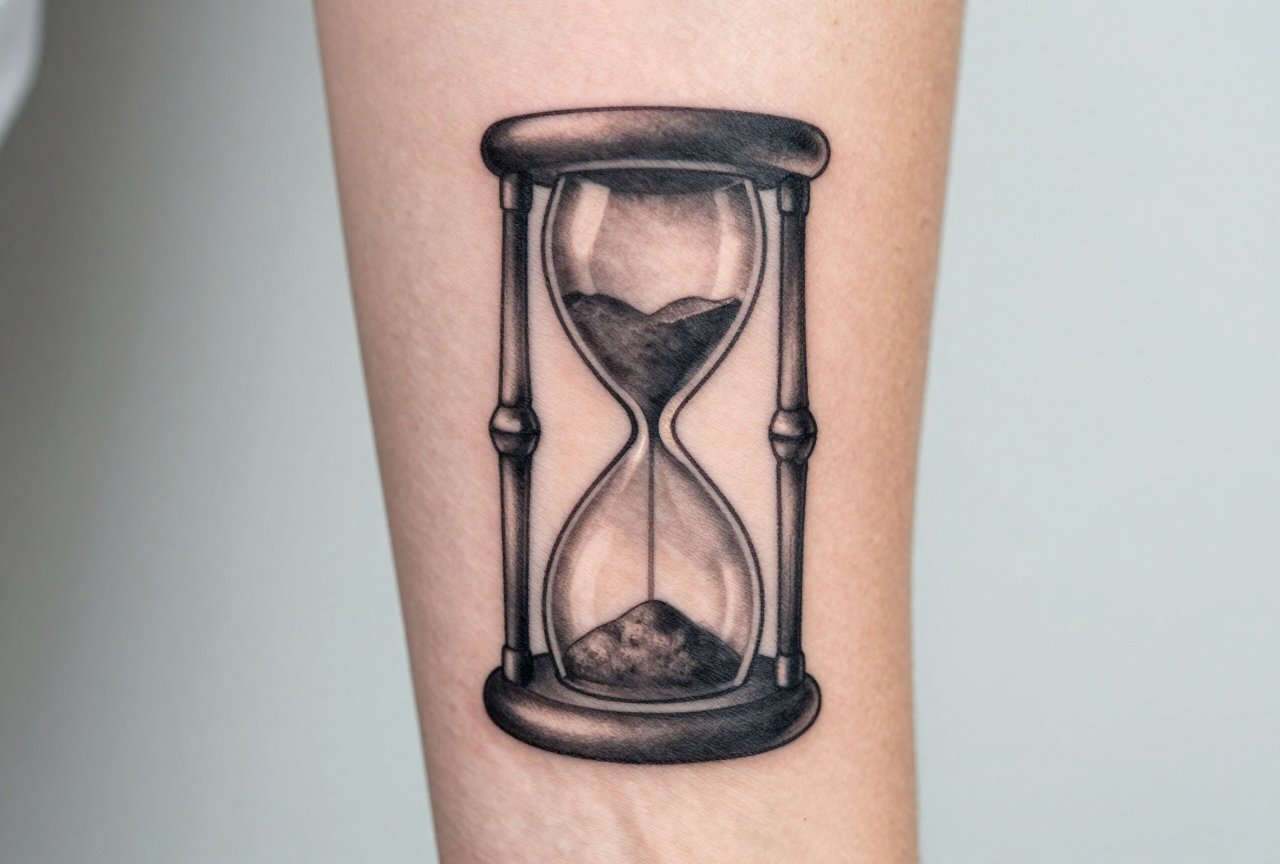
A realistic hourglass tattoo isn’t just a pretty picture of sand in glass. Done right, it’s a study in transparency, texture, and the weight of time itself. I’ve tattooed dozens of these over the years, and they keep coming through the door because the image hits something universal, we all feel time slipping. The realistic style pushes the design beyond simple symbolism into something you almost want to reach out and flip over yourself.
Origins & History
From Memento Mori to Skin
The hourglass as symbol goes back centuries. You see it in 17th-century vanitas paintings, perched on skulls, warning the viewer that time runs out for everyone. Sailors carried actual hourglasses to mark watch shifts. The image entered tattoo culture through traditional American and European flash, usually as a bold-lined piece with banners reading “Time Flies” or “Tempus Fugit.”
But the realistic version? That’s a newer beast. Photo-realism in tattooing really took hold in the 1990s and exploded with social media. Clients started bringing in reference photos of actual antique hourglasses, brass fittings, hand-blown glass with tiny bubbles, wood bases worn smooth by generations of hands. They wanted that object on their skin, not a cartoon of it. I’ve had guys bring in their grandfather’s actual hourglass from a ship, wanting every scratch and patina copied exactly.
What the Symbol Means Now
Clients attach their own meaning. I’ve heard it all: time with a dying parent, a reminder to stop wasting years, the finite nature of a military deployment. One woman wanted her hourglass broken at the bottom, sand spilled out, marking the moment her life changed after a car accident. The realistic style lets you tell that story with objects that feel real enough to hold.
Key Characteristics & Motifs
What separates a realistic hourglass from a stylized one? The details matter enormously. Here’s what I look for in strong reference material and what I push clients to consider:
- Glass distortion: Real glass bends light. You see the sand behind it shift and compress. Getting that refraction right separates decent work from stunning work.
- Texture contrast: Smooth glass against rough wood, polished brass against granular sand. The eye needs these differences to read “real.”
- Internal depth: The sand isn’t flat. It piles, cascades, catches light differently on each grain. I build this with white highlights and subtle grey washes.
- Hardware aging: Brass tarnishes. Wood cracks. Glass chips at the edges. These imperfections are where realism lives.
Common additions I see: roses wilting or blooming (time’s effect on beauty), skulls nested in the glass (memento mori tradition), celestial backgrounds (stars, moon phases), or hands reaching to turn the glass. The hourglass anchors the composition; what surrounds it tells the personal story.
Color vs Black and Grey
Black and Grey: The Classic Choice
Most hourglass tattoos I do are black and grey. The subject lends itself to it, glass reads beautifully in greyscale, and the metallic tones of aged brass translate perfectly through black ink diluted to warm washes. This ages better, no question. Color fades, shifts, sometimes muddies. Black and grey settles into the skin and keeps reading as form and depth even ten years out.
I tell clients: if you want this piece to look good at your kid’s graduation, not just next month, think hard about color. The glass reflections, the sand shadows, the wood grain, all of it holds up in monochrome.
When Color Works
That said, some designs demand it. I’ve done hourglasses with deep purple sand representing a specific birthstone, or blood-red sand for a client whose story involved literal blood and sacrifice. The trick is using color as accent, not filling the whole piece. A touch of amber in the glass, a hint of verdigris on the brass, this reads as realistic without overwhelming the composition or guaranteeing a future touch-up.
One piece I remember: a sailor’s hourglass with actual ocean blue in the background, the glass itself remaining clear. That blue will soften to grey-green eventually, but the hourglass stays legible. That’s the balance.
Best Placements
Hourglasses are vertical objects. That shape drives placement decisions more than most designs.
- Forearm (inner or outer): Perfect vertical canvas. The outer forearm shows off easily; inner is more private. Either way, the shape fits naturally. I’ve done probably thirty here.
- Thigh: Great for larger pieces with surrounding elements. The muscle curve can distort the straight glass lines slightly, so I account for that in the stencil.
- Ribcage: Painful, yes. But the vertical space is ideal, and clients who want this placement usually have a story that feels close to the heart or lungs, literally protected.
- Calf: Underrated spot. The vertical shin or back of calf holds the shape well. Heals relatively easy, too, compared to joints.
- Upper arm/shoulder: Can work, but the curve fights the straight lines. I usually angle the hourglass slightly or wrap it with flowing elements to ease the transition.
Hands, feet, neck, I’ve said no to these for realistic hourglasses. Too small for the detail, too much movement and sun exposure. The glass bubbles and fine lines blur out fast. Save those spots for bolder, simpler work.
Who It Suits
Not everyone. The realistic style demands commitment: longer sessions, higher cost, more aftercare discipline. I get clients who walk in wanting “something small and simple” and leave with a different design after we talk. The hourglass needs space to breathe. Squash it too small and the sand reads as grey mush, the glass as empty outline.
Skin tone matters for technique, not possibility. On darker skin, I push harder for bold contrast and may simplify some ultra-fine details that would blur together. The glass highlights become more crucial. I’ve done beautiful realistic work on every skin tone, it’s about adjusting approach, not avoiding the style.
Personality-wise, this suits people who value patience. The tattoo takes time. The meaning usually involves reflection, loss, or determination. It’s rarely someone’s first tattoo, and when it is, I know they’ll be back for more.
Modern Variations
The hourglass keeps evolving. Lately I’ve seen:
- Broken vessels: Cracked glass, sand escaping, sometimes frozen mid-spill. Harder to execute but emotionally potent.
- Double hourglasses: Two connected, sand flowing both directions. Represents cycles, duality, or two people bound by time.
- Integrated portraits: Faces visible in the sand, or reflected in the glass surface. Requires a portrait specialist; I collaborate on these.
- Biomechanical twists: Gears inside the glass, steampunk frames, mechanical birds perched on top. Appeals to the same crowd that loves clockwork hearts.
One trend I resist: the “infinite hourglass” with no top or bottom, just a loop. It abandons the core meaning, time’s irreversibility, for a clever visual trick. Clients sometimes ask; I explain why the original shape hits harder.
Choosing an Artist
This is where I get serious with people. Realistic tattooing is a specialty. A great traditional artist or watercolor specialist may not have the grey wash control or the patience for smooth gradients that this needs.
- Check healed work: Fresh photos lie. Ask for photos taken months or years after healing. That’s where you see if the glass stayed glass or became grey soup.
- Look for object realism: Portraits and objects are different skills. An artist who crushes faces might struggle with reflective surfaces. Find someone who has done glass, metal, water, materials with similar challenges.
- Discuss size honestly: If an artist promises a fully realistic hourglass the size of a golf ball, walk away. Some things can’t be miniaturized without losing the effect.
- Ask about touch-up policy: Realistic work sometimes needs refinement after healing. Good artists stand behind it.
In my shop, I spend the first twenty minutes of any realistic consultation just talking about expectations. What the client sees on Pinterest versus what skin actually does. The hourglass is forgiving in some ways, it’s a contained object with clear boundaries, but unforgiving in others. That glass edge needs to stay sharp. The sand needs to read as individual grains, not a smudge. Choose someone who sweats those details.
Final Thoughts
A realistic hourglass tattoo done well stops being a symbol and becomes an object you inhabit. I’ve watched clients stare at their fresh piece in the mirror, silent, because the weight of it lands differently when it looks real enough to turn over. That’s the goal. Not decoration. Presence.
The style demands respect from both artist and wearer. Longer sessions, careful healing, honest placement choices. But ten years later, when the lines have settled and the grey has softened into something that looks like memory itself, that patience pays. Time was the subject all along. The tattoo might as well honor that by lasting.
Frequently Asked Questions
How long does a realistic hourglass tattoo typically take?
A medium-sized realistic hourglass usually needs two to four sessions of three to four hours each, depending on detail level and whether there’s surrounding scenery. The glass gradients and sand texture can’t be rushed.
Will the sand still look detailed after healing?
Fine sand detail settles somewhat during healing, some of those tiny white highlights soften into the skin. A good artist builds in slightly exaggerated contrast knowing this happens, so it reads correctly once healed.
Can I get an hourglass tattoo if I have keloid-prone skin?
Realistic work with smooth shading can actually be gentler on keloid-prone skin than heavy line work, but you’ll want an experienced artist who knows to avoid overworking the area and may space sessions further apart.
Is it okay to request an exact replica of my family heirloom hourglass?
Absolutely, bring it in, or bring detailed photos from multiple angles. I love working from actual objects. Just know that some imperfections that look charming in real life might read as mistakes in tattoo form, so we’ll discuss what to emphasize and what to smooth out.
Related Style Guides
- Realistic Lighthouse Tattoos: A Working Artist s Guide
- Traditional Duck Tattoos: A Working Artist s Guide
- Traditional Head Tattoos: A Working Artist s Guide
- Explore more