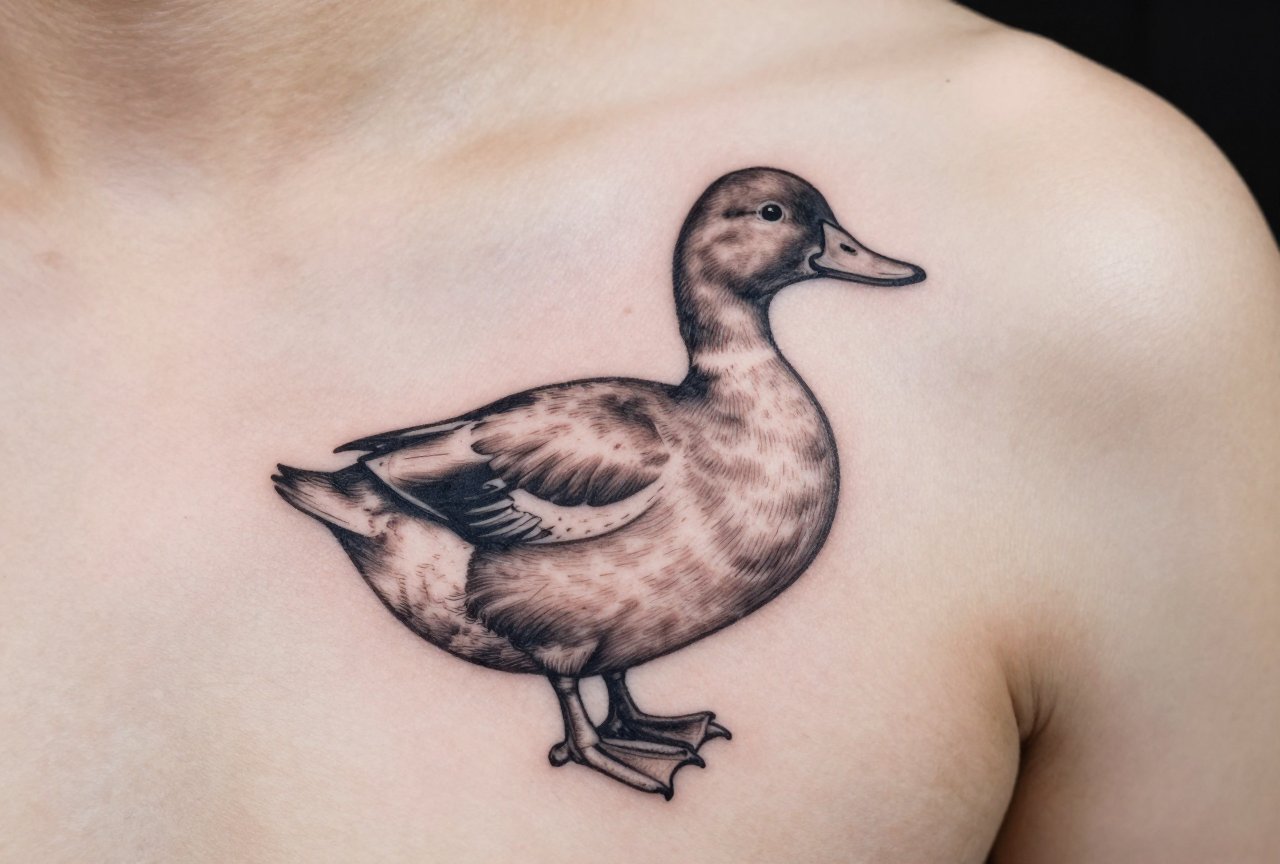
A duck tattoo typically symbolizes adaptability, emotional resilience, and the ability to stay calm while working hard beneath the surface. Ducks also represent loyal partnerships, playful freedom, and the balance between water and air, between deep feeling and clear perspective. In my chair, I’ve seen this design chosen by people who’ve survived tough transitions, built strong relationships, or simply need a reminder to float when life gets rough.
Symbolism & History
Ducks carry layered meaning that goes deeper than the cute pond image most people picture first. I’ve tattooed enough of these to know the symbolism usually connects to something personal the client doesn’t always volunteer right away.
Water, Air & The Hidden Work
The duck’s whole life is about moving between elements. On the surface, they glide. Underneath, they’re paddling like hell. That duality hits home for a lot of people. I tell clients: this is the original “keep calm and carry on” animal. The feet never stop working, but the face stays serene. For anyone grinding through school, recovery, parenting, or career building without recognition, that hidden labor resonates hard.
Historically, ducks appear in symbolism across cultures:
- Chinese tradition links ducks to marital fidelity and happiness, mandarin ducks specifically represent lifelong mates
- Celtic lore saw them as messengers between worlds, comfortable in water, air, and on land
- Native American stories often cast ducks as foolish but lucky, or as survivors who find abundance in humble places
- Norse mythology included ducks in connection to Freyja and fertility, water-born life
None of this means you need to claim a cultural heritage to get one. In modern tattooing, we see this as personal symbolism first, historical flavor second.
Color Variations & Their Meanings
A mallard’s iridescent green head reads masculine and bold. A white domestic duck softens toward innocence or domestic comfort. A black duck or silhouette goes moodier, grief, mystery, or night-thoughts. The rubber duck? That’s pure nostalgia, childhood resilience, or sometimes a dark humor twist I’ve done for people in recovery who needed to reclaim something innocent.
Common Variations & Styles
The duck adapts to almost any tattoo style, which fits the symbolism perfectly. Here’s what actually works on skin and what doesn’t.
Styles That Hold Up
Traditional American duck tattoos, bold outlines, limited color, maybe with a banner or hunting motif, age clean and read immediately from across the room. I’ve done these on forearms and calves where the rounded body shape fits the muscle flow. Neo-traditional allows more feather detail and color blending, but you need a solid artist; soft shading on birds can muddy fast if the contrast isn’t there.
Blackwork and illustrative styles work surprisingly well. The duck’s silhouette is instantly recognizable, so even a heavily stylized or geometric version reads correctly. Fine line? Tricky. Feather texture demands either committed line weight or deliberate minimalism, half-measures look like mistakes after healing.
- Traditional/Old School: Bold, readable, ages like a champion
- Realism: Stunning when done well, requires large scale for feather detail
- Minimalist/Line: Clean silhouette or single continuous line; must be precise
- Japanese-inspired: Works as part of water scenes, pairs with lotus or koi
- Whimsical/Watercolor: Popular but fades faster; plan for touch-ups
We see a lot of duck-and-hunting-dog pairings in rural shops, or duck-with-shotgun-shell for memorial pieces. The rubber duck variation pops up in more urban studios, usually smaller and more playful.
Best Placements
Where you put a duck changes how it reads and how it lives on your skin over time.
Upper arm and shoulder are classic for traditional duck designs, enough flat space for the rounded body to sit naturally, easy to show or cover. I’ve tattooed ducks on forearms where the swimming motion follows the arm’s curve, head pointing toward the hand like forward movement. Thigh and calf work for larger pieces, especially if you’re building a nature scene with reeds and water.
Ribcbs and sternum? Possible but painful and the skin there shifts a lot with breathing. Small ducks behind the ear or on the ankle are popular first tattoos, but the detail level has to stay simple or it’ll blur into a blob in five years. Finger ducks? I’ve done them, but I warn clients: that skin sheds fast, lines blow out, and you’ll be back for rework.
One placement I love: the duck on the inner bicep, swimming “upstream” toward the heart. Had a client who got that after her partner’s recovery from addiction. The hidden location matched the private meaning.
Who Chooses This Tattoo / Personal Meanings
In my experience, duck people fall into a few real categories, not stereotypes, just patterns you notice after years in the shop.
The Transition Survivors
These are folks who moved cities, changed careers, ended marriages, got sober, came out. The duck’s water-to-air adaptability speaks to identity in flux. I tattooed a duck on a woman who left a religious community at thirty; she said she’d spent her whole life being told what she was, and the duck was the first thing she chose for herself.
The Partner People
Matching or complementary duck tattoos for couples, parent-child pairs, or siblings. Mandarin ducks mate for life, and that symbolism gets referenced explicitly sometimes. More often, people just know ducks pair up and like that energy. I’ve done mother-daughter ducks where the smaller one follows the larger, simple line work on matching wrists.
The Anti-Tough Tattoo
Not everyone wants skulls, wolves, or script about strength. Some people want to claim softness as power. The duck does that. I’ve had big dudes in my chair, construction workers, military, get small ducks as reminders of their kids, their fishing trips with dads, or just to have something gentle in their collection. One guy said his whole sleeve was “aggressive shit” and the duck was his “receipt for growing up.”
- Parents honoring childhood memories or nicknames
- Outdoor people who actually hunt or watch waterfowl
- People in recovery choosing the “floating” metaphor
- Anyone who needs a visible reminder to keep paddling
Similar Symbols
If the duck isn’t quite right, these share overlapping territory and show up in similar placements.
Swans hit the same water-bird elegance but lean more romantic and less playful. More drama, less grit. Geese share the loyalty and migration themes but carry more aggressive, protective energy, honking, hissing, territorial. Loons go darker, more solitary, more northern-mystery vibe. Penguins can’t fly, so the symbolism shifts to endurance and awkward grace on land.
Among non-bird options, koi fish cover the perseverance-through-water theme with more traditional Japanese backing. Otters hit the playful family angle. Frogs do transformation and water-element connection. I’ve had clients start with one idea and land on another after we talk through what they’re actually trying to mark.
The duck’s specific advantage is that duality: above and below, calm and effort, playful and purposeful. Few symbols capture that exact tension as cleanly.
Final Thoughts
A duck tattoo won’t intimidate anyone. It won’t scan as edgy or mysterious from across the bar. What it does, when it’s done with intention, is hold a private story about keeping going, about loving someone steadily, about finding your way across boundaries that other people can’t even see.
In my chair, the best duck tattoos come from people who’ve thought about why this specific bird, not just “something nature.” The worst come from impulse decisions at flash events where the cute factor overrides meaning. If you’re considering one, sit with the image. Picture it swimming, paddling underneath, surface unruffled. That’s the energy you’re asking to carry. Make sure it’s yours.
And find an artist who knows bird anatomy enough to get the bill shape right. Nothing kills a duck tattoo faster than a beak that reads generic or duckling-like when you wanted adult, resilient, working-class waterfowl. I’ve fixed enough of those to know: the details matter, in symbolism and in skin.
Frequently Asked Questions
Does a duck tattoo work for men, or is it too feminine?
I’ve tattooed ducks on plenty of men, construction workers, veterans, dads. The meaning shifts with style and placement. A traditional duck with bold lines and hunting imagery reads masculine; a minimalist rubber duck goes softer. It’s about execution, not the bird itself.
How much detail can a small duck tattoo hold?
Less than you think. Under two inches, feather texture becomes mush after healing. Go with clean silhouette, bold outline, or stylized geometry. If you want realistic plumage, plan for at least palm-sized or larger, or budget for touch-ups as it softens.
What’s the difference between a duck and a mandarin duck tattoo meaning?
Mandarin ducks specifically symbolize romantic partnership and marital happiness in Chinese tradition. A generic duck carries broader meanings, adaptability, resilience, playfulness. If you’re honoring a relationship, specifying mandarin adds that cultural layer; otherwise, standard duck keeps it open.
Do duck tattoos fade faster than other bird tattoos?
Not inherently, but lighter colors, yellows, soft greens, do fade faster than black or deep blue on any bird. Mallard green holds decent if saturated properly. Watercolor-style ducks need more frequent refresh than traditional bold-line versions. Location matters more than species for longevity.
Related Tattoo Meanings
- Labrador Symbolism Tattoo Meaning: Loyalty, Love Devotion
- Plague Doctor Tattoo Meaning
- 1776 Tattoo Meaning: Liberty, Inked
- Explore more