
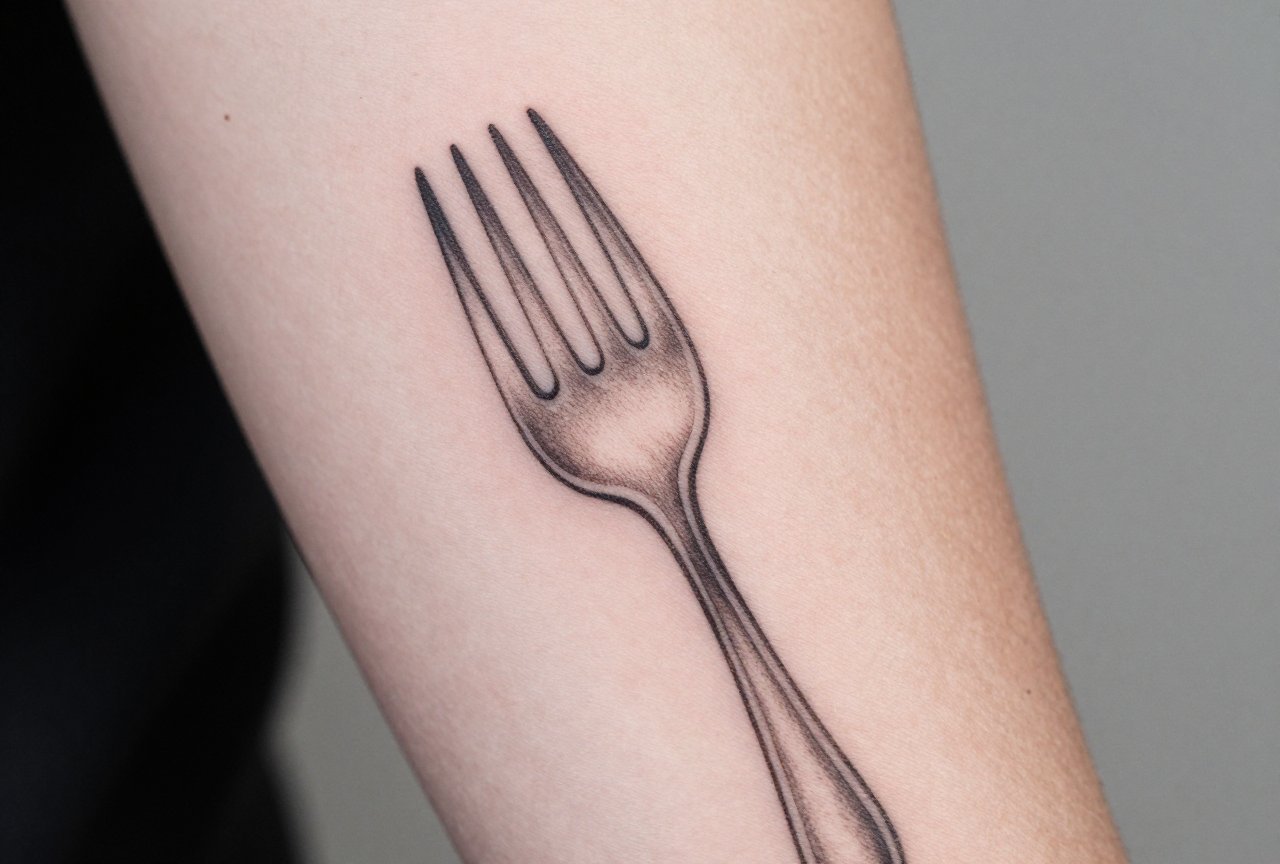
A fork tattoo can mean hunger, sustenance, choice, or even dark absurdist humor, depending on who’s wearing it and what they pair it with. I’ve seen clients get fork tattoos to mark recovery from eating disorders, to celebrate culinary careers, or just because they think a giant fork on their arm is hilarious. The meaning shifts hard based on context, style, and placement, which is exactly what makes this seemingly simple image worth talking about.
Symbolism & History
The fork carries weight across centuries. Before it became standard tableware in Europe around the 1600s, people ate with knives and fingers. The fork arrived as a refinement, a marker of civilization and class. That history bleeds into tattoo meaning whether clients know it or not.
Survival and Sustenance
At its most basic, a fork means food. I’ve tattooed simple black forks on people who’ve survived food insecurity, eating disorders, or who’ve built careers in kitchens. One guy I worked on had a fork crossed with a knife on his forearm, he’d been a line cook for fifteen years and wanted something that said “I fed people” without the tired chef clichés. The fork did that quietly.
The image can also signal hunger in a broader sense: ambition, craving for experience, wanting more from life. A bent or broken fork sometimes represents the struggle to get fed, literally or metaphorically.
Choice and Division
Forks in the road. Forked tongues. The word itself splits. I’ve had clients reference Robert Frost without irony, getting a fork with a winding path wrapping around the tines. Others go darker, devil imagery, serpent forks, the idea of deception or divided loyalties. The same object holds opposite meanings depending on what you build around it.
Common Variations & Styles
Not all fork tattoos look the same, and the style choice changes everything about how they read.
- Minimalist line work: Single needle, clean, often placed on fingers or wrists. Reads delicate, intentional, sometimes ironic. These age okay but can blur if the lines are too fine, I’ve seen finger forks fade to soft gray blobs within a few years.
- Traditional American: Bold black outlines, limited color, maybe a banner or roses. Classic, readable, holds up. We see this a lot with service industry folks who want something that won’t look muddy in ten years.
- Black and gray realism: Shiny metal reflections, wood grain handles, sometimes food dripping from the tines. Requires a specialist. I’ve watched clients sit for six hours on a hyper-realistic fork that looked like you could pick it up. Stunning, but the heavy shading will soften over time.
- Absurdist or surreal: Giant forks, melting forks, forks with eyes, forks stabbing planets. Popular with illustrators and people who collect “weird little guys.” I did one on a woman’s calf that was just a fork wearing tiny sneakers. She laughed through the whole session.
- Pairings: Knife and fork (partnership, completeness, the service industry). Fork and spoon (comfort, childhood). Fork alone (isolation, minimalism, or just “I only need this one thing”).
Color choices matter too. Silver and gray read utilitarian or melancholic. Gold or brass feel vintage, almost steampunk. Red accents, blood on the tines, or a red handle, shift the tone toward violence or passion fast.
Best Placements
Where you put a fork tattoo changes how people interpret it before they even ask.
Visible and Conversational
Forearms, hands, and fingers make the fork part of your daily presentation. A finger fork, usually the back of the hand or alongside the index finger, gets noticed constantly. I warn clients: this placement hurts more than you’d expect, and finger skin sheds ink faster than almost anywhere. You’ll need touch-ups. But the visibility is the point. It’s a conversation starter, a little provocation.
Forearms give more space for detail. Inner forearm reads personal, something you see and others might not. Outer forearm faces the world. I’ve noticed chefs tend toward outer forearm, almost like displaying a credential.
Hidden and Intimate
Ribs, upper thighs, behind the ear. These placements feel more private, more about the meaning than the display. A fork behind the ear is small, almost a whisper. I’ve done a few where the client said they were “feeding themselves first”, self-care language, recovery language. The hidden placement matched that.
Ribcage forks can be larger, more detailed, but that spot hurts. Deep breaths move the skin constantly. I always tell clients to expect a rougher session there.
Who Chooses This Tattoo / Personal Meanings
After years in the chair, patterns emerge. Certain people gravitate toward fork tattoos for specific reasons.
- Food service veterans: Cooks, servers, bartenders. They want something permanent that acknowledges the grind without the “chef life” skull-and-knives machismo. A fork is humble. It says “I showed up and fed people.”
- Eating disorder survivors: Less common but deeply meaningful. The fork becomes a tool of reclamation, something that once caused fear now marked on their own terms. I’ve done two of these, and both sessions were quiet, heavy, important.
- Minimalists and ironists: People who collect simple, unexpected images. The fork’s ordinariness is the appeal. They’ll pair it with other household objects, build a little domestic still life across their body.
- Writers and philosophers: The fork as metaphor appeals to this crowd. Choices. Paths. The examined life. One client had a fork splitting into two roads, wrapped around her ankle, straight Frost reference, but rendered beautifully.
Personal meaning always overrides general symbolism. I’ve had clients explain fork tattoos in ways I never would have guessed. That’s the job: listen first, tattoo second.
Similar Symbols
If you’re drawn to the fork but not quite sold, consider related imagery that carries overlapping meaning.
- Knife alone: More aggressive, protective, sometimes self-harm history or survival. The fork without the knife softens that edge.
- Spoon: Comfort, nurture, “spoon theory” for chronic illness communities. Softer than the fork, less about choice or struggle.
- Chopsticks: Cultural specificity, dexterity, Eastern philosophy. Carries different weight depending on the wearer’s background.
- Empty plate: Absence, loss, hunger. The fork implies action; the plate implies waiting.
- Cornucopia or fruit: Abundance, harvest, natural cycles. More optimistic than a lone fork, which can read stark or utilitarian.
Some clients combine these. I’ve seen fork-and-plate compositions, fork piercing a fruit, fork laid across an open book. The surrounding elements do the heavy lifting for meaning.
Final Thoughts
A fork tattoo seems simple until you sit with it. It can mean survival or indulgence, choice or absurdity, profession or private recovery. The style you choose, delicate line or heavy traditional, realistic metal or cartoon weirdness, shapes that meaning as much as the image itself. Placement matters. Pairings matter. Your story matters most.
I’ve tattooed enough forks now that I don’t assume anything when someone requests one. I ask. The answers are always more interesting than the symbol alone. If you’re considering a fork tattoo, know what you’re feeding with it, metaphorically, literally, or both. Bring that clarity to your artist. We’ll meet you there.
Frequently Asked Questions
Does a fork tattoo always have to do with food or cooking?
Not at all. While many chefs and servers choose fork tattoos, I’ve also done them for clients marking recovery, referencing poetry, or just embracing the absurdity of a giant utensil on their body. The meaning is whatever you build around it.
How well do fine-line fork tattoos hold up over time?
Finger and hand placements fade faster because those areas shed skin constantly and get sun exposure. A fine-line fork on a forearm or thigh ages much better. I usually suggest slightly bolder lines if you want longevity, especially on hands.
What’s the most painful placement for a fork tattoo?
Ribs and fingers are rough. Rib skin moves with every breath, and fingers have dense nerve endings close to the surface. The outer forearm or calf are much more manageable if it’s your first piece or you’re worried about pain.
Can a fork tattoo work as a matching or couple tattoo?
Absolutely. Knife and fork pairings are classic for couples or close friends. I’ve also seen two forks crossed, or matching minimalist forks on siblings who grew up sharing meals together. The domestic imagery translates naturally to partnership.
Related Tattoo Meanings
- Hades Tattoo Meaning: Power, Shadows Rebirth
- Three Swords Tattoo Meaning: Symbolism, Styles What Artists Know
- Viking Compass Tattoo Meaning
- Explore more









