Yes, you can absolutely cover up a tattoo with another tattoo, I’ve done hundreds of them in my chair over the years. But here’s the straight answer: not every tattoo can be covered by every design, and the success depends on the old ink’s age, color density, placement, and your skin’s texture. A dark, saturated black tribal band from 2005? That’s a puzzle. A faded blue butterfly from your college days? Much more forgiving. The cover-up process is part technical problem-solving, part artistic illusion, and part managing your expectations. Let’s break down what actually happens in the shop.
What Makes a Tattoo Coverable (and What Doesn’t)
I’ve had clients walk in with a full-back piece they got in prison and ask for a delicate watercolor hummingbird. I have to be the bearer of bad news sometimes. Cover-ups work by using darker, denser ink to visually overpower what’s underneath. We’re not erasing, we’re camouflaging.
Color and Saturation Matter Most
Black and dark blue are the hardest to cover. Red, yellow, and faded greens? Much easier. I tell clients to think of it like painting a dark wall in your apartment: you need primer, then layers. In tattooing, that means bigger, bolder designs with strategic shading. The old ink doesn’t disappear; the new design distracts the eye from it.
- Heavy black linework requires dense black or color packing to hide
- Faded grays and pastels are the most forgiving
- White ink over old tattoos rarely works, heals translucent or yellowish
- Scarred or raised skin limits how smooth new linework can look
Placement and Skin Changes
Skin on your upper arm behaves differently than skin on your ankle or ribs. I’ve covered names on wrists that looked great at six months but showed ghosting at two years because that area moves so much. Areas with more fat and less movement, thighs, upper arms, chest, tend to hold cover-ups better long-term.
Design Strategies That Actually Work
Every cover-up starts with me staring at the old tattoo under bright shop lights, turning the client’s arm every which way, sometimes taking photos and messing with contrast on my phone. We’re looking for the “out.”
The Go-To Cover-Up Styles
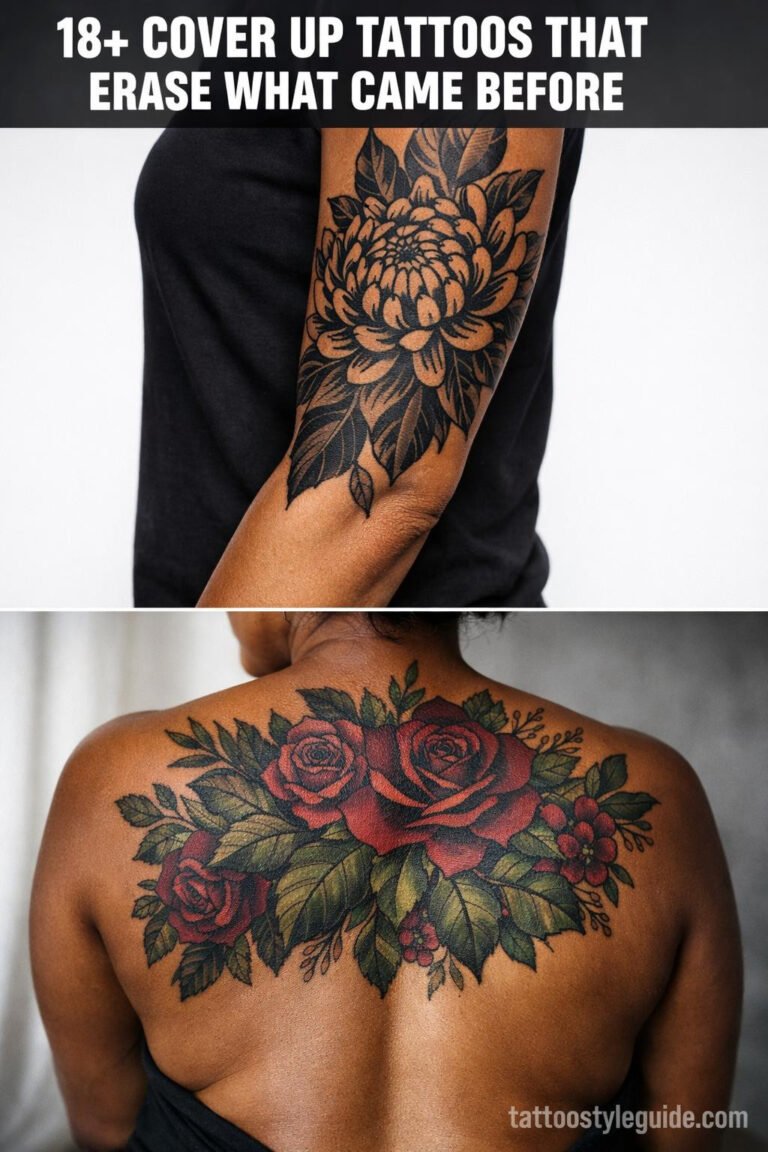
In my shop, we see this a lot: roses, koi fish, skulls, and mandalas. Not because they’re cliché, but because their natural shapes, petals, scales, flowing lines, break up old outlines visually. A solid black rose with heavy shading can swallow a name. A geometric pattern with dense black points can scatter an old tribal design. Tribal-to-tribal is actually one of the hardest; the old lines fight the new ones.
Some artists specialize in what I’d call “creative destruction”, using the old tattoo as texture within something new. I’ve turned a blown-out star into the center of a compass. The key is working with the old ink’s structure, not pretending it’s not there.
Size Reality Check
Your cover-up will almost always need to be bigger than the original. I tell clients: think 30-50% larger minimum. The new design needs borders of clean skin around the old ink to “frame” the illusion. That tiny wrist tattoo? The cover-up might need to become a half-sleeve to work properly.
The Process: What Happens in the Chair
First session usually starts with a stencil. I’ll place it, peel it, stare at it, move it, maybe sleep on it. Good cover-up artists are paranoid about placement. Then we outline. On old tattooed skin, the needle feels different, more resistance, sometimes more vibration. Clients often say it hurts more than their first tattoo. I believe them. Scarred or overworked skin has less give.
Shading over old ink is where the magic happens. We build up layers: dark backgrounds first, then mid-tones, then highlights. Sometimes we need two or three sessions to get saturation where it needs to be. The old tattoo can “fight back” through new ink during healing, showing through as the skin settles. Patience is non-negotiable.
Healing and Aftercare: The Real Timeline
Cover-ups often look worse before they look better. More trauma to already-traumatized skin means more swelling, more plasma, more of that shiny, tight healing phase. I give clients the same aftercare I give everyone: wash gently, thin layer of recommended ointment, no soaking, no sun, no picking. But I emphasize it harder for cover-ups because the stakes are higher.
Here’s what I actually see in the shop: cover-ups take longer to settle into their final look. That “ghost” of the old tattoo might be visible at three weeks. By three months, with proper care, it usually fades into the background. If it doesn’t, we schedule a touch-up. Most artists include one touch-up in the price, ask upfront.
Pain, Cost, and Managing Expectations
The Pain Factor
Cover-ups hurt more. Full stop. The skin’s been needled before, there’s possible scar tissue, and sessions often run longer because of the density required. I had a client sit through eight hours on a rib cover-up once. She brought headphones and a stress ball. We took breaks. She said it was worth it, but she wouldn’t lie about the intensity.
What You’ll Actually Pay
I don’t know your local market, but in most US shops, cover-ups run higher than fresh tattoos of the same size. More ink, more time, more problem-solving. Expect to pay a premium, sometimes 25-50% more. Some artists won’t even quote until they see the old tattoo in person. Flat rates are common for cover-ups because hourly guessing is risky.
- Small cover-up (palm-sized): often $200-400
- Medium piece (hand-sized): $400-800
- Large or complex work: $800+ or full day rates
- Multiple sessions are normal, not a failure
Consultations should be free. If an artist charges for a consult, that’s not necessarily a red flag, but it should go toward the tattoo if you book.
When Laser Removal Is the Better First Step
I’ve sent clients to laser specialists before. Not because I can’t cover their tattoo, but because the result would be so much better with some fading first. Laser doesn’t have to remove everything, three to five sessions can lighten a dark tattoo enough that I can do something delicate and beautiful instead of something dark and forced. It’s an investment, but so is a cover-up you’ll live with forever. I have good relationships with a few local laser techs and make referrals when it serves the client.
Key Takeaways
Cover-ups are possible, common, and often turn out gorgeous, but they demand honesty from you and your artist about what’s achievable. Darker, bigger, bolder designs work best. Expect more pain, more money, and more healing time than a fresh tattoo. Find an artist whose portfolio shows healed cover-ups, not just fresh photos. Ask about touch-up policies. Consider laser fading if you want flexibility. And remember: the goal isn’t perfection, it’s a tattoo you’ll be proud to wear instead of one you hide.
Frequently Asked Questions
Can any tattoo be covered up, or are some impossible?
Not every tattoo can be covered successfully. Very dense black ink, heavy scarring, or certain placements with thin skin can limit options. Sometimes laser fading is needed first, or the design has to be much larger and darker than the client originally wanted.
How long should I wait before covering up a new tattoo I regret?
Wait at least six months, ideally a year. Fresh ink needs to settle fully, and covering too soon risks more damage, unpredictable healing, and the old tattoo showing through as it continues to age under the new work.
Why do cover-ups usually need to be bigger than the original tattoo?
The new design needs to extend beyond the old tattoo’s edges with dense, saturated ink to create a visual frame. Without that border of clean design, the old lines can still read through and break the illusion.
Will I be able to see the old tattoo at all after it’s covered?
Sometimes, especially in certain light or as the tattoo ages. A skilled artist minimizes this, but complete invisibility is rare. Most clients find that even a slight ghost is infinitely better than the original tattoo they disliked.
Related Tattoo Guides
- How to Design Your Own Tattoo: A Real Shop Guide
- How to Get a Temporary Tattoo Off Your Face Safely
- Why You Shouldn t Build a Homemade Tattoo Gun
- Explore more