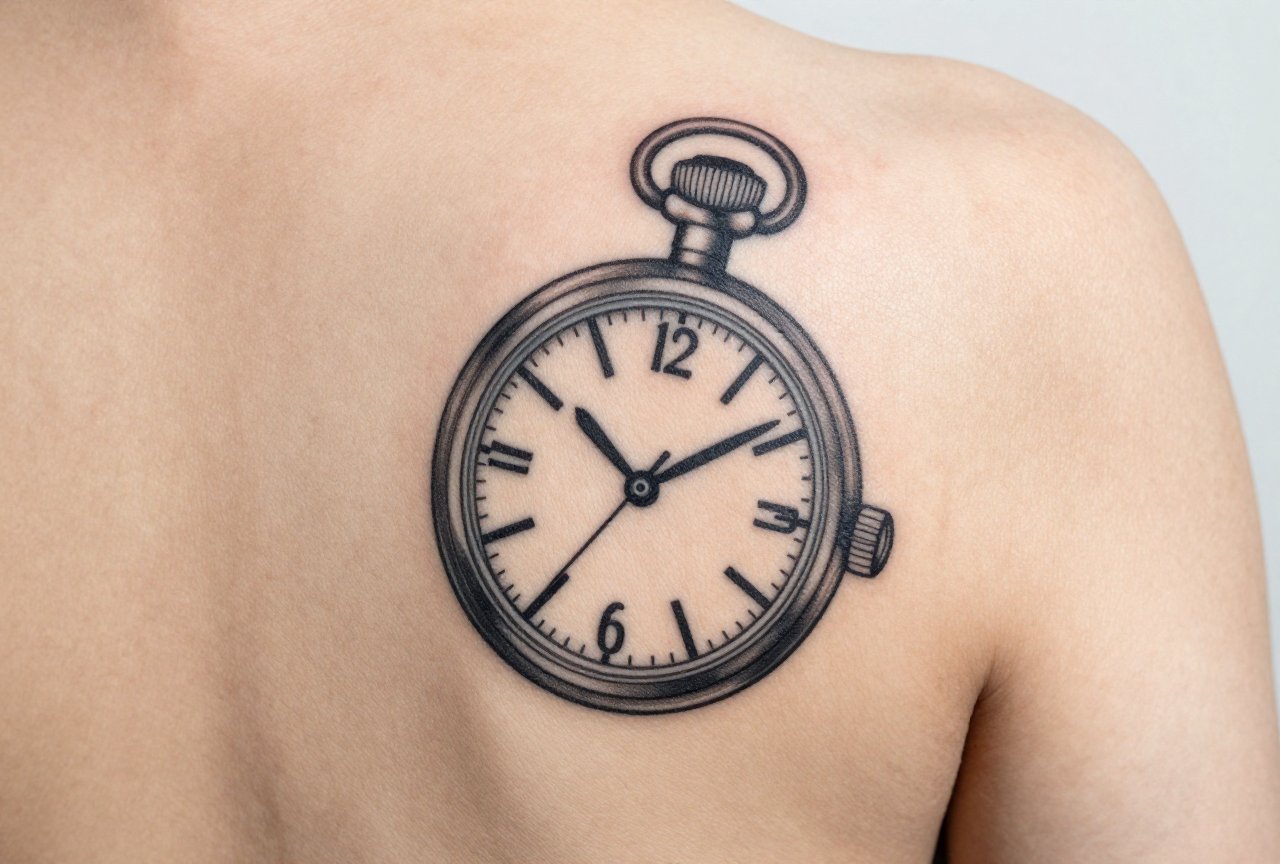
I’ve tattooed a lot of fob watches over the years. They’re one of those designs that sounds simple until you actually try to draw one that’ll read well on skin for the next decade. The roman numerals blur. The hands get muddy. That ornate Victorian filigree you loved on Pinterest? It turns to gray soup faster than you’d think. But when they’re done right, fob watches are gorgeous, nostalgic, personal, and weirdly versatile. Here’s what I’ve learned from years in the chair, both tattooing them and wearing one on my own forearm.
Popular Styles
Not every style suits every collector, and fob watches are no exception. The style you pick changes everything about how the tattoo ages, how much it hurts, and how much your artist will charge.
Realistic Black and Gray
This is what most people picture. Shiny metal, glass reflections, roman numerals you can almost read. I love doing these when the skin is right, smooth, relatively pale, not too sun-damaged. The trick is controlling your values. You need true black for the deep shadows, bright skin-tone highlights for the glass glare, and about seven shades of gray in between. Too dark and it looks like a gray blob in five years. Too light and it never pops. I did one on a guy’s inner bicep last year where the watch face was cracked like broken glass, time frozen at 3:17. His daughter’s birth time. Those are the ones that stick with me.
Traditional and Neo-Traditional
Bold lines. Limited color palette. The watch becomes more symbol than object. I tell clients who want something that’ll outlast their twenties: traditional ages better than almost anything. That thick black outline holds the shape as the ink spreads slightly over decades. The colors, red roses, blue ribbons, green leaves, stay readable because they’re separated by those dark lines. Neo-traditional gives you more detail, more gradient, but you’re gambling a bit more on long-term clarity. Still worth it if you find an artist who actually understands the style, not just someone who owns a few Sailor Jerry books.
Fineline and Single Needle
I’ll be honest: I try to talk people out of this unless they’re committed to touch-ups. Fineline fob watches look incredible fresh. The delicate chain links, the hair-thin minute marks, the subtle shading on the metal casing, beautiful. But I’ve seen too many that look like bruised smudges after three years. Skin is not paper. Ink spreads. If you must go fineline, keep it small, keep it simple, and find someone who actually specializes in this. Not your buddy who bought a single needle last month.
Design Ideas
The watch itself is rarely the whole story. What you wrap around it changes the meaning and the composition.
- Pocket watch with chain: The classic. The chain gives you movement, lets the design flow across the body. I often curve it to follow muscle structure, over a shoulder, down a ribs curve, wrapping a forearm.
- Broken or cracked face: Memorial piece. Stopped time. The hour and minute hands set to a specific moment. I’ve done birth times, death times, the moment someone got sober. The crack needs to read as damage, not accident, so I usually draw it with intention, one strong fracture line, not random spiderweb.
- Melting watch: Dali homage. These are fun but tricky. The distortion has to be deliberate and balanced or it looks like a mistake. Best done larger, with enough space for the melt to make sense.
- Watch with flowers: Roses are standard for a reason, they fill space beautifully and their curves complement the circle. Peonies work for softer energy. I’ve done dried flowers too, for a more melancholy vibe.
- Animal elements: Moths and butterflies near the watch face, ravens carrying the chain, snakes wrapping the casing. The watch becomes an object in a larger narrative.
- Steampunk gears exposed: Popular ten years ago, still requested. The mechanical interior visible through a transparent face or torn-open casing. Requires space. Don’t try this smaller than a fist.
Best Placements
Where you put a fob watch changes how it reads, how fast it fades, and how much you’ll curse during the session.
Forearm and Inner Bicep
Most common for good reason. The forearm gives you a flat canvas, easy to show off, moderate pain. Inner bicep is softer skin, better for detail, worse for longevity. Sweat and friction from arm movement blur things faster. I have my own watch on my outer forearm, slightly angled so it faces me when I look down. Selfish placement, maybe, but I got it for me.
Chest and Ribs
The chest plate is prime real estate. Flat, relatively protected from sun, enough room for a watch with chain extending toward the shoulder or heart. Ribs hurt. Everyone knows this. But the curve can actually complement a hanging watch design. I’ve done chains that follow the rib lines down to the hip. Stunning when healed. Miserable to sit through.
Thigh and Calf
Thighs are underrated for larger pieces. Muscle provides flat planes when standing, interesting dimension when seated. Calf works for smaller watches, though the shin bone side is brutal. The back of the calf, the gastrocnemius, is meaty and manageable. I did a stopwatch on a runner’s calf once, set to his marathon PR. He flinched less than most rib clients.
Hand and Neck
I generally say no to hand watches. The skin there regenerates fast, ink falls out, and the small scale forces simplification that loses the detail that makes a watch interesting. Neck is possible but bold, hard to hide, reads differently in professional contexts. If you’re committed, go for it, but sleep on it longer than usual.
Color Choices
Black and gray is the honest default. It ages gracefully, matches everything, and lets the form speak. But color has its place.
Gold tones in the casing warm the whole piece. I mix a yellow-ochre base with white highlights rather than straight yellow, less jaundiced, more metallic. Silver and steel read cooler, more modern. Rose gold has been requested more since about 2015, and it can work if your artist understands how to build it from red-brown foundations rather than just dropping pink in there.
Background color changes everything. A watch floating on skin feels different than one against a dark wash, a blue-gray sky, or a field of black. I did a piece last month where the watch itself was black and gray but sat in a traditional red rose with green leaves. The color framed it, made it feel alive. The client cried when she saw it. Good tears.
Tips for Choosing
After all these years, the same mistakes show up in my consultation chair. Here’s what I wish more people knew before they committed.
- Bring reference, not a photocopy: I want to see what you love, but I need to redraw it for your specific body. A straight copy of someone else’s tattoo is disrespectful to the original artist and boring for me.
- Consider the time you set: 11:11, 3:33, midnight, these read as generic. A specific time means something. If you don’t have one, let the artist choose something that balances the composition. Symmetry matters visually even if not emotionally.
- Size realistically: Roman numerals need space. At two inches tall, they’re guessing games. At four inches, they read. At six inches, they sing. Don’t shrink a detailed concept to fit a tiny spot.
- Think about your future self: That hyper-realistic piece will need a refresh in ten years. The traditional one might not. Budget for maintenance if you choose detail over boldness.
- Trust your artist’s redraw: If I say the chain needs to curve differently to flow with your anatomy, I’m not being difficult. I’m trying to make it look like it belongs on you, not like a sticker.
Final Thoughts
Fob watches aren’t going anywhere. They’re one of those motifs that keeps finding new life because time itself is universal, birth, death, memory, urgency, patience. I’ve tattooed them on eighteen-year-olds getting their first piece and on sixty-year-olds getting their last. The meaning shifts, but the form holds.
What matters is honesty. Honest about why you want it. Honest about what your skin can hold. Honest about the artist you choose. A fob watch can be a beautiful, lasting piece of art or a faded reminder of rushed decisions. I’ve seen both. I prefer the beautiful ones. They make the long hours worth it.
Frequently Asked Questions
How much should I expect to pay for a detailed fob watch tattoo?
A palm-sized realistic black and gray piece usually runs 3-5 hours at a professional rate, so budget $400-800 minimum. Larger pieces with color or extensive background work can hit $1,200-2,000. Anyone quoting under $200 for detailed work is cutting corners you don’t want cut.
Will the roman numerals still be readable in ten years?
If they’re sized properly and the tattoo is protected from sun, yes. I set a minimum height of about half an inch for numerals. Smaller than that, and the ink spread makes V’s look like U’s and XII turn into a solid bar. Touch-ups every few years help too.
Can I get a fob watch tattoo if I have darker skin?
Absolutely. The design just needs adjustment. I use higher contrast, bolder lines, and sometimes shift from black and gray to deep black with warm brown tones for dimension. The watch reads differently but can be equally striking. Find an artist experienced with your skin tone specifically.
How long does a detailed fob watch take to heal?
The surface closes in about two weeks, but the deeper settling takes six to eight weeks. During that first month, avoid submerging it, keep it clean but not drowned in lotion, and for god’s sake don’t pick at the scabs. I’ve watched clients ruin perfect line work by scratching.
More Tattoo Ideas
- Frankenstein Tattoo Ideas for Horror Fans
- Got Tattoo Ideas That Actually Work
- Heavy Metal Tattoo Ideas That Actually Rock
- Explore more