
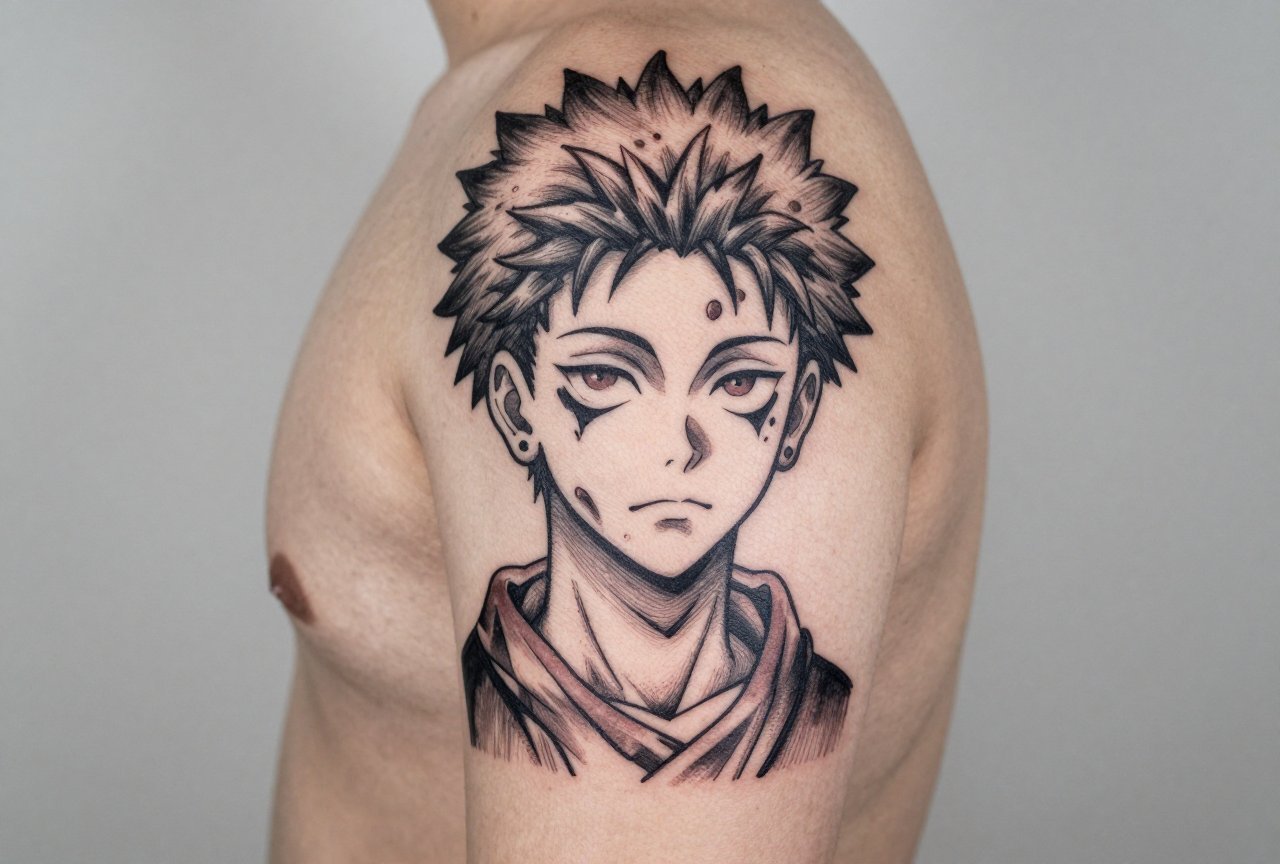
A Sukuna tattoo means you’re drawn to the duality of power and humanity, the tension between destruction and control. Based on Ryomen Sukuna from Jujutsu Kaisen, this ink represents the King of Curses, four arms, twin faces, a being so feared that sorcerers sealed him for a thousand years. I’ve tattooed this design on clients who see themselves in his complexity: the hunger to dominate, the refusal to bow, but also the strange honor code beneath the violence.
Symbolism & History
The Original Myth vs. Modern Anime
Here’s where it gets interesting. The anime Sukuna is fiction, but Gege Akutami pulled from real Japanese folklore. The historical Ryomen Sukuna was a two-faced noble from the Nara period, recorded in the Nihon Shoki as a rebel leader with four arms who fought the Yamato court. Some accounts paint him as a local hero resisting imperial conquest; others as a genuine threat. That ambiguity is the whole point.
When you choose this tattoo, you’re tapping into centuries of contested legacy. The anime amplifies it, Sukuna becomes apocalyptic force incarnate, yet he keeps his word, respects strength, and finds genuine amusement in human defiance. I’ve had clients spend hours debating whether he’s pure evil or something more nuanced. That conversation usually tells me exactly where their tattoo should go and how it should look.
Core Symbols in the Design
- The double face: Duality, hidden selves, the mask you show versus what you actually feel. I see this resonate with people who’ve had to code-switch their whole lives, between cultures, between family expectations and personal truth.
- Four arms: Overwhelming capability, doing what others can’t, sometimes the burden of being “too much” for people to handle.
- Markings and cursed energy: The black lines pulsing across his body in the anime translate beautifully to tattooing, thick, flowing, almost organic. They age well if done with solid saturation.
- The finger: Sukuna’s twenty cursed fingers, scattered and sought. A single finger tattoo is its own subgenre, fragmented power, something of yourself you’ve lost and need to reclaim.
Common Variations & Styles
Portrait & Character Work
Full-color anime portraits are popular but tricky. I’ve done Sukuna’s grinning face with his extra eyes open, and I’ve done the more subdued “Yuji Itadori possessed” version where the markings creep across a human face. The second reads more psychological horror; the first is pure iconography. Line weight matters enormously here, fine lines in the face will blur over time, so I push for bolder outlines around features and save the delicate stuff for areas that don’t see as much sun or friction.
Black and grey neo-traditional is my favorite approach for longevity. The historical Sukuna especially suits this, samurai armor elements, woodblock print textures, the two faces in profile like a coin. It holds up. I’ve seen full-color anime pieces fade to mud in five years because the reference was so saturated that the tattoo version couldn’t match it without looking chalky.
Symbolic & Abstract Takes
- Markings only: The cursed lines across skin, no face. Intimate, sometimes placed where the wearer can see it but others might not immediately. I’ve done these along collarbones, down spines, wrapping forearms.
- The mouth on skin: Sukuna’s extra mouth, often on Yuji’s body in the manga, tattooed as though it’s the wearer’s own flesh speaking. Creepy, effective, very personal.
- Japanese text: His title, Ryomen no Sukuna, in brushstroke kanji. Simple, doesn’t date as fast as character art, carries the weight without the literal image.
Best Placements
Thighs and calves give you the real estate for a full portrait with those four arms extended. The muscle structure actually helps, thighs have that flat plane before the knee, calves give you a cylinder to wrap around. I’ve done a backpiece where Sukuna’s upper arms became the client’s actual shoulder blades, the lower pair wrapping to the ribs. Took three sessions. The client wanted to feel “worn” by him, not just decorated.
Forearms work for smaller pieces, but I warn people: this is a villain. In my shop, we talk about “handshake visibility”, what someone sees when they meet you. Sukuna’s grin right there can read as aggression before you open your mouth. That’s fine if that’s your intention. I’ve had teachers and nurses think twice and move it to the upper arm or ribs.
Fingers for the cursed finger motif, obviously. These hurt, they fade fast, they need touch-ups. But there’s something perfect about carrying that specific fragment of power at your literal fingertips. I did one on a pianist who said it reminded her that destruction and creation aren’t opposites.
Who Chooses This Tattoo / Personal Meanings
What Clients Actually Tell Me
In my chair, the Sukuna conversation goes deeper than most anime requests. Naruto tattoos are often about perseverance; One Piece about found family. Sukuna people talk about anger they’re not allowed to show. The part of them that wants to burn bridges. The satisfaction of being underestimated and then proving everyone wrong.
A client last year, software engineer, very polite, very controlled, got Sukuna’s face on his ribs where only he and his partner would see it. He said it was “the me that would have destroyed my childhood.” Another was a former competitive fighter who’d had to tamp down his aggression for years of corporate life. His Sukuna piece is on his calf, visible in shorts, a deliberate choice to let that edge show sometimes.
The Gender Split (Or Lack Thereof)
I expected more male clients for this. It’s maybe 60/40. Women who choose Sukuna often emphasize the duality aspect, the two faces as performance versus authenticity. The design adapts well; I’ve seen more feminine interpretations with softer line work, the historical version in flowing robes rather than the manga’s aggressive stance. The meaning shifts but holds.
Similar Symbols
If Sukuna resonates but you’re not sure about anime ink specifically, I point people toward related iconography. Oni masks share the demonic-human boundary but with more traditional tattoo lineage, they’ve been done in Japanese shops for centuries. Raijin and Fujin, the thunder and wind gods, carry that same overwhelming power without the modern pop culture attachment.
Within anime specifically, tattoos of Ken Kaneki from Tokyo Ghoul hit similar notes, human becoming monster, retaining consciousness through transformation. The Akatsuki clouds from Naruto are too organizational, too team-based; Sukuna is fundamentally alone, and that matters for the meaning. Hisoka from Hunter x Hunter shares the chaotic pleasure-seeking, but lacks the historical weight.
I’ve also had clients combine Sukuna with actual Buddhist or Shinto protective imagery, turning the curse into something guarded, contained. A Fudo Myoo surrounding him. The tension between those elements says something about the wearer’s own relationship with their darker capabilities.
Final Thoughts
Sukuna tattoos aren’t about wanting to be a villain. In fifteen years of tattooing, I’ve never met someone who chose this because they genuinely want to cause harm. It’s about acknowledging the harm you’re capable of, the power you hold, and choosing to direct it rather than pretend it doesn’t exist. The King of Curses keeps his word. He finds weak opponents boring. There’s a strange integrity there that my clients recognize in themselves.
The best Sukuna pieces I’ve done aren’t the most technically perfect, they’re the ones where the person sat in my chair knowing exactly why they wanted him on their body. The markings flow with their muscle. The two faces catch light differently as they move. It’s living ink, not just reference art. If you’re considering this, spend time with the question: what part of you is Sukuna speaking for? The answer determines everything, style, placement, whether you go with the anime’s vivid violence or the historical figure’s contested legacy. Either way, you’re claiming something that scares people. That’s the point.
Frequently Asked Questions
Does a Sukuna tattoo mean I worship evil or negative energy?
Not in my experience. Most clients connect with Sukuna’s complexity, his power, his refusal to be controlled, the strange honor beneath his violence. It’s about owning your full self, not promoting harm. I’ve tattooed nurses, teachers, and parents who see him as a symbol of suppressed strength.
How well do the detailed anime-style Sukuna tattoos age over time?
Bold lines and solid black hold up; fine color gradients and tiny details tend to blur and fade within five to seven years. I usually recommend stronger outlines and more black saturation than the reference image shows, especially for pieces you’ll have for decades.
What’s the difference between getting the historical Sukuna versus the anime version?
The historical figure from the Nara period carries political rebellion and cultural resistance meanings, often appealing to people with Japanese heritage or interest in folklore. The anime version emphasizes supernatural power, duality, and psychological complexity. The visual style differs significantly too, woodblock-inspired versus modern manga aesthetics.
Is the cursed finger tattoo overdone or considered basic?
It’s common but not necessarily basic. The meaning depends on context, a single finger can represent fragmented power, something lost, or personal transformation. Placement and surrounding design matter more than the symbol itself. I’ve seen fingers that were deeply personal and others that were clearly impulse choices.
Related Tattoo Meanings
- Symbolic Religious Tattoo Meaning: Faith, Protection Personal Belief
- Ribbon Tattoo Meaning: Symbolism, Styles Personal Stories
- Skull Roses Tattoo Meaning: Life, Death Everything Between
- Explore more









