
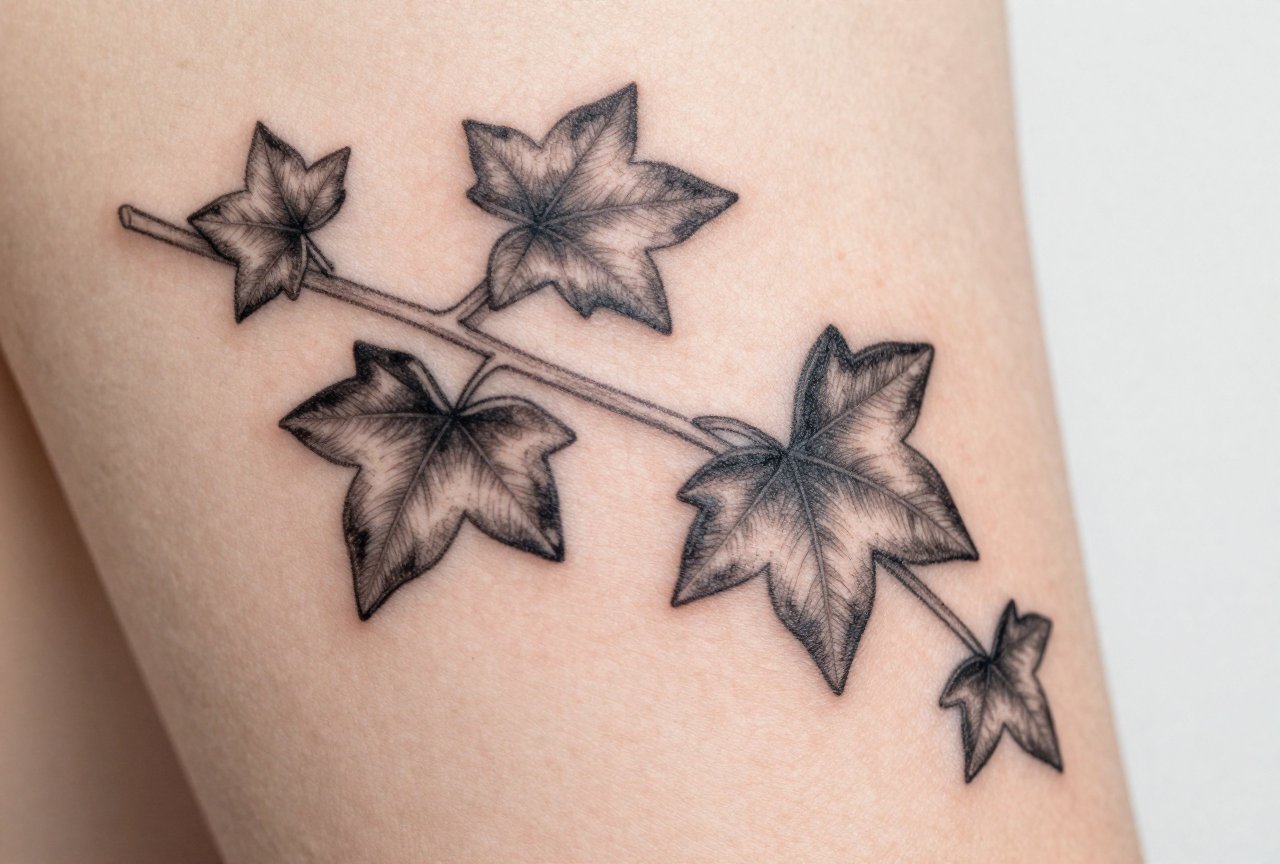
A poison ivy tattoo carries a layered meaning that most people don’t catch at first glance. It’s not just a pretty plant with bad PR. For the people who sit in my chair and ask for it, poison ivy represents something dangerous that thrives anyway, beauty that bites back, survival that doesn’t apologize. I’ve tattooed this design on bikers and botanists, survivors and gardeners, and every single one had a different reason rooted in the same fierce idea.
Symbolism & History
The symbolism starts with the plant itself. Urushiol, that oily resin that makes your skin blister and weep, is invisible. You don’t see it coming. That invisibility is what makes poison ivy such a potent metaphor for experiences that mark us without warning, toxic relationships, sudden loss, betrayal that arrives dressed as something harmless.
I’ve had clients trace the leaves along their ribs and tell me about parents who seemed loving until they weren’t. About jobs that praised them while grinding them down. The three-leaf cluster becomes a warning they survived, a badge that says I walked through something that should have destroyed me and I’m still growing.
Botanical Lore and Folk Meaning
Before Europeans arrived in North America, Indigenous peoples knew this plant differently. Some tribes used poison ivy medicinally, small, controlled doses for immunity, which is wild to think about when you’re watching someone’s arm swell from accidental contact. That duality, poison and remedy wrapped in the same green package, shows up constantly in the stories people tell me.
The plant’s aggressive growth habit matters too. It climbs, it spreads, it chokes trees slowly. But it also stabilizes eroded banks and feeds birds with its white berries. Nothing about it is simple. That’s why it works as skin art, real life doesn’t sort cleanly into good and bad, and neither does this tattoo.
Common Variations & Styles
I’ve done poison ivy in almost every style that walks through a shop door. Each approach shifts the meaning slightly, which is something I always discuss during consultation.
- American traditional: Bold lines, limited green and red palette, sometimes a skull or dagger woven through. Reads as danger with a sense of humor, that old-school toughness.
- Black and grey realism: Individual leaf veins, water droplets, the subtle serration along each edge. Clients who choose this want the botanical accuracy, they’re often actual foragers, hikers, people who know plants intimately.
- Neo-traditional with jewel tones: Deep emeralds, blood reds, gold accents. This leans into the seductive aspect, the look but don’t touch energy.
- Fine line with negative space: Delicate, almost scientific illustration style. Appeals to people who want the meaning without the aggressive visual weight.
- Trash polka or abstract: Splattered reds, geometric fragments, the plant breaking apart or reforming. Usually chosen by people processing something actively, still in motion.
Color vs. Black and Grey Aging
Here’s what I tell clients who ask about longevity: green ink is notoriously tricky. It fades faster than black, can shift toward blue or grey depending on the pigment batch and your skin’s chemistry. I’ve seen ten-year-old poison ivy pieces where the leaves look almost teal, which isn’t necessarily bad, just different. Black and grey holds its structure longer but loses the immediate plant recognition. Some people come back for touch-ups every few years to keep that green punch. Others let it drift, which becomes its own metaphor.
Best Placements
Where you put this tattoo changes how the world reads it, and how you feel it against your clothes.
- Forearm or wrist: Visible, confrontational. I’ve tattooed poison ivy here for people who want the reminder constant, who need to see it while typing, while holding someone’s hand, while reaching for another drink they maybe shouldn’t have.
- Ribcage or side: Hidden, intimate. The leaves follow the body’s natural lines beautifully here. Hurts like hell, the skin is thin, the needle vibrates against bone, but clients who choose this spot usually have pain as part of their story anyway.
- Thigh or calf: Medium visibility, good canvas size for detail. The wrap-around potential lets the vine climb, which feels true to the plant’s nature.
- Behind the ear or along the hairline: Small, almost secret. I’ve done tiny three-leaf clusters here for people who want the meaning without the conversation starter.
- Hand or fingers: Bold. The “leaves of three, let it be” rhyme becomes literal here. Hard to cover, fast to fade, but impossible to ignore.
One woman I tattooed chose her mastectomy scar area, the vines growing across reconstructed terrain. That piece still sits with me.
Who Chooses This Tattoo / Personal Meanings
After fifteen years in shops, I can tell you there’s no single type. But patterns emerge if you pay attention.
Survivors of emotional abuse choose poison ivy constantly. The plant that looks harmless, that people brush against without thinking, that punishes them later when they’re alone and wondering what happened. The parallel is almost too direct. They often want the tattoo where they can see it while dressing, a private affirmation that their sensitivity was not weakness.
People in recovery select it too. The poison they once sought, the dependency that looked like comfort until it wasn’t. The leaves become a warning label they wear proudly, I contained something dangerous and chose to grow differently.
Then there are the defiant ones. Women mostly, though not exclusively, who’ve been told they’re too much, too sharp, too difficult. They want the plant that doesn’t apologize for its chemistry. I’ve had clients laugh while I stencil the leaves, say something like “yeah, touch me without asking, see what happens.” That energy is real and valid and I love tattooing it.
Gender and Cultural Shifts
Used to be mostly men getting poison ivy, often paired with Harley Quinn imagery or the Batman villain. That’s shifted hard in the last decade. Now I see more botanical, less cartoon. More personal narrative, less pop culture reference. The plant has been reclaimed from the comics page into something organic and individual. I don’t think that’s an accident, our culture is learning to read women as complex, dangerous, surviving, and the tattoo world follows that slow turn.
Similar Symbols
Clients sometimes sit in my chair unsure between poison ivy and something adjacent. I always ask them to talk through the options aloud, usually they find their answer in the speaking.
- Roses with thorns: Classic beauty/pain duality, but more romantic, more expected. Poison ivy is weirder, less pretty, more honest about the ugliness of survival.
- Deadly nightshade or belladonna: Similar danger/beauty overlap, but more explicitly feminine, more historically witchy. Poison ivy feels more democratic, more American roadside.
- Nettles or thistles: Defensive plants, but without the hidden aspect. You see thistle coming. Poison ivy’s invisibility is the point.
- Snakes: Shedding skin, transformation, venom. The animal counterpart. Some clients combine both, ivy wrapped around a serpent, the botanical and zoological threats intertwined.
- Broken glass or barbed wire: More masculine-coded danger, less organic, less about growth. These are static where poison ivy is alive, reaching, climbing.
One guy chose poison ivy over his ex-wife’s name he’d been covering. “She looked safe,” he said. “She wasn’t.” The leaves went over the old letters like kudzu on a abandoned house.
Final Thoughts
A poison ivy tattoo isn’t a decoration. It’s a statement of fact about how the world works and how you survived it anyway. I’ve watched people cry while I wipe the green ink, not from pain but from relief at finally externalizing something they’ve carried invisibly. I’ve watched others laugh, chat about hiking disasters, treat it lightly because their survival is old news now, just part of their architecture.
Both approaches are true. Both are why this design endures when flash trends come and go. The plant doesn’t care if you respect it. It grows where it grows, takes what it needs, defends itself without malice or negotiation. On skin, that becomes a philosophy. Not pretty, maybe. But honest. And in my experience, the honest tattoos age the best, not just in the ink, but in the person wearing them.
Frequently Asked Questions
Does a poison ivy tattoo have to be green to be recognizable?
Not necessarily. Black and grey versions can read beautifully, especially with careful attention to the distinctive three-leaf cluster shape and serrated edges. Some clients prefer the muted palette for professional reasons, or because the faded green-to-blue shift doesn’t appeal to them. The botanical structure carries the recognition more than color alone.
Is the poison ivy tattoo connected to the Batman character?
It can be, and historically was for many people. The Harley Quinn and Poison Ivy pairing drove popularity in the 1990s and 2000s. But the meaning has broadened significantly. Most people choosing it now are drawing on the actual plant’s symbolism rather than the comic villain, though the overlap isn’t mutually exclusive if both resonate for you.
How painful is getting poison ivy tattooed on ribs or bone areas?
Ribcage work is genuinely tough, the skin is thin, there’s little muscle padding, and the needle vibration against bone is unmistakable. That said, pain is temporary and subjective. I always tell clients that the location’s significance usually outweighs the discomfort for people drawn to this particular design. Aftercare matters more than the session itself.
Can poison ivy be incorporated into larger nature-themed pieces?
Absolutely, and it works beautifully. I’ve woven it into full sleeve botanical gardens, mixed it with mushrooms and ferns for forest floor compositions, and used it as a transitional element between softer flowers. Its jagged leaf shape provides visual contrast against rounder forms, and the meaning layers nicely with growth-and-decay themes.
Related Tattoo Meanings
- Snake Eating Itself Tattoo Meaning: Cycles, Rebirth Self-Consumption
- Crab Tattoo Meaning: Symbolism, Styles What It Says About You
- Rock of Ages Tattoo Meaning: Faith, Strength Timeless Ink
- Explore more









