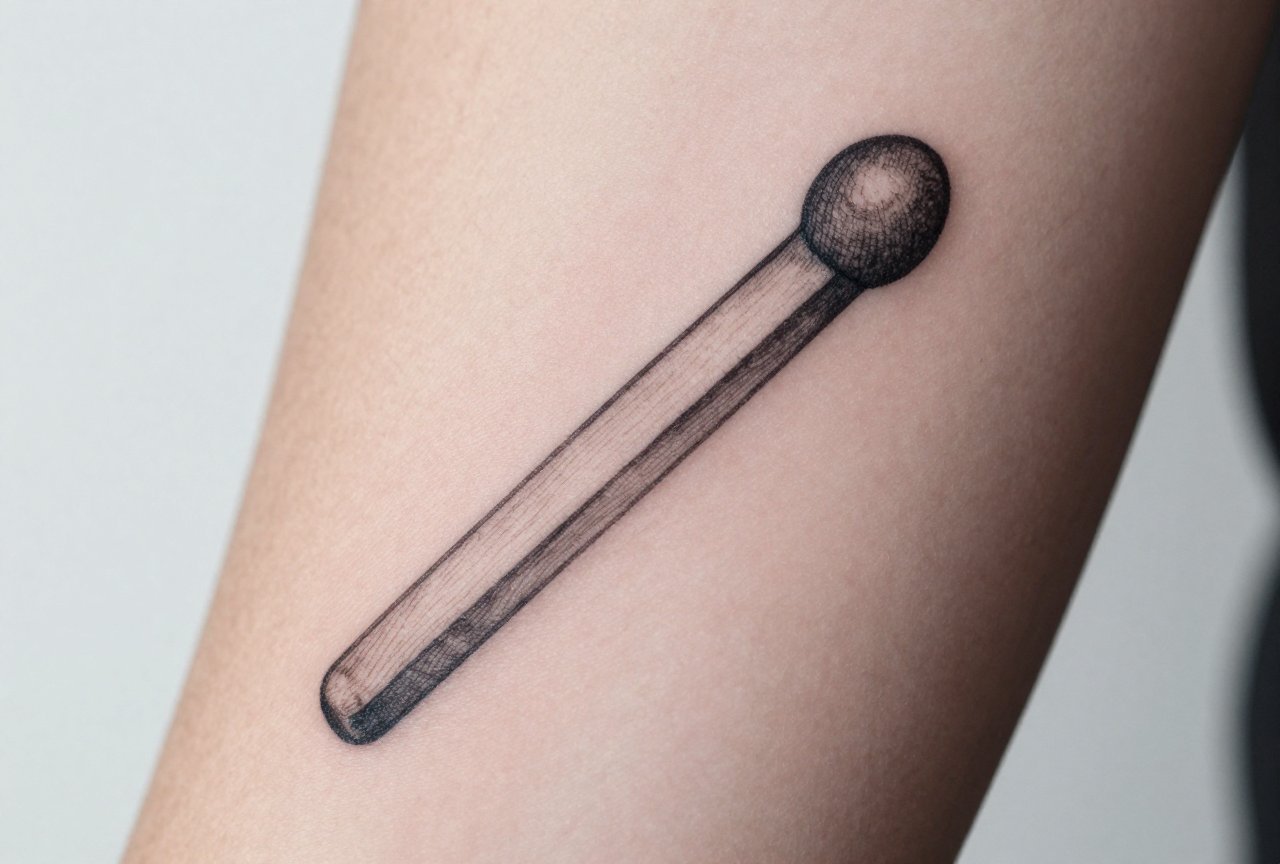
A match tattoo carries raw, immediate symbolism: the spark of life, the danger of burning too bright, and the fragile boundary between creation and destruction. I’ve tattooed dozens of these over the years, and every client brings a different story, some about survival, others about starting over, a few about the people who lit them up or burned them down. It’s a small image that punches way above its weight in meaning.
Symbolism & History
The Double Edge: Creation and Destruction
Fire’s always been humanity’s first technology and our first weapon. A match compresses that entire history into something you can strike against your jeans. In my chair, I see this duality constantly. One client wanted a burnt match to mark getting sober, “the flame that almost consumed me.” Another got a lit match for her daughter, “the spark I didn’t know I needed.” The same image, opposite meanings. That’s what makes this design stick.
The match also speaks to impermanence in a way flashier fire tattoos don’t. A bonfire rages; a match flickers and dies. That brevity resonates with people who’ve lost someone, ended something, or know their own intensity comes with a cost. I’ve heard artists call it “the punk rock candle”, no ceremony, just strike and burn.
Rebellion and Working-Class Roots
Historically, matches tied to labor movements, particularly the London matchgirls’ strike of 1888. Those women fought against phosphorus poisoning and brutal conditions. Some clients know this history and want the match as solidarity ink. Others just vibe with the aesthetic. Both are valid. I usually ask if they want the strike-anywhere tip or the safety-match design, different eras, different energies.
- Lit match: active change, current struggle, living intensity
- Burnt match: survival, aftermath, what remains
- Unlit match: potential, restraint, something waiting
- Broken match: severed connection, ended chapter
Common Variations & Styles
Blackwork and Fine Line
Most matches I tattoo run small, two to four inches, which means style choices matter enormously. Blackwork holds up; that solid black match head stays readable for years. Fine line can look stunning fresh but I’ve watched thin flame details blow out into gray smudges on hands or fingers. I always warn clients: “This’ll look like a fuzzy candle in five years if we go too delicate.” Some choose that decay as part of the meaning. Most don’t.
Color vs. Monochrome
Adding orange or yellow to the flame makes it pop, but those pigments fade faster than black. I’ve seen beautiful watercolor backgrounds behind matches, smoke wisps, abstract burns, that age into muddy blurs. If you want color, keep it contained. A solid red tip with clean black everything else? That ages like actual leather, not like a watercolor painting left in rain.
- Traditional/American: bold lines, limited color, readable from distance
- Single needle: delicate, risky for longevity, best on inner arm or torso
- Realistic: requires skilled artist, flame texture is genuinely hard to nail
- Minimalist: just the matchstick shape, sometimes with a tiny flame dot
Best Placements
Small designs need smart placement. The match’s vertical shape fits naturally along fingers, forearms, ribs, or behind the ear. I’ve tattooed them on collarbones, inner biceps, and once on a guy’s Achilles, “my weakness,” he said, which I respected even if the spot made me wince.
Fingers and hands are popular but high-maintenance. We see this a lot in shops: someone wants a match on their striking hand, the metaphor too perfect to resist. I tell them straight, it’ll need touch-ups, possibly multiple. The skin there sheds and regenerates constantly. A match on the inner forearm, by contrast, sits in a sweet spot of visibility and durability. Ribs hurt more but stay pristine longer; the skin doesn’t sun or scrub as aggressively.
- Inner forearm: visible, ages well, easy to show or hide
- Behind ear: intimate, trendy but not overdone yet
- Finger/hand: high impact, high maintenance, plan for touch-ups
- Rib/underboob: painful, private, excellent for personal meaning
Who Chooses This Tattoo / Personal Meanings
The Stories I Actually Hear
After fifteen years, patterns emerge. The match attracts people in transition, divorce, recovery, graduation, grief. It’s rarely someone’s first tattoo; usually it’s number three or four, when they’ve moved past decorative ink into something messier. I tattooed a match for a firefighter who’d pulled a kid from a burning house. Another for a musician whose band broke up the week before. The common thread isn’t the fire itself but the moment of ignition: before everything changes.
Matching Matches and Couple Tattoos
Couples get these sometimes, which I side-eye gently. “We light each other up” sounds great until you break up and you’re stuck with half a metaphor. I’ve covered two match couple tattoos in my career. That said, siblings or close friends sometimes get matching unlit matches, potential without possession, connection without fusion. That lands better. One twin gets the matchstick, the other the flame. Clever, but only if the relationship is actually solid.
Similar Symbols
Clients often browse between matches, candles, lighters, and bonfires. Each carries distinct weight. Candles feel ceremonial, religious, slower. Lighters are utilitarian, masculine-coded, more about control. Bonfires are communal, big energy, harder to place small. The match sits in the middle, portable, disposable, democratic. Anyone can strike one. Not everyone tends a candle.
I’ve had people pivot from phoenix tattoos to matches. The phoenix promises rebirth, glory, rising. The match doesn’t guarantee anything. It just offers the spark. That honesty appeals to people who’ve learned that transformation isn’t guaranteed or pretty. Sometimes you strike and nothing catches. Sometimes you burn your fingers. The match tattoo acknowledges that reality without romanticizing it.
- Phoenix: rebirth, triumph, longer narrative
- Candle: vigil, memory, spiritual steadiness
- Lighter: control, repetition, modern convenience
- Lightbulb: ideas, invention, less visceral
Final Thoughts
The match tattoo works because it’s honest about fire. It doesn’t pretend warmth is safe or that light lasts. In my experience, the best ones come from clients who’ve already been burned and chose the image anyway, not as warning, not as feature, just as fact. If you’re considering one, think about the state of the match: lit, unlit, burnt, broken. That choice matters more than most people realize when they walk in. Bring reference, but also bring the story. Any artist worth sitting with will want both.
And please, skip the “don’t play with matches” lettering underneath. I’ve seen it seventeen times. The image already says it. Trust your tattoo to speak.
Frequently Asked Questions
Does a match tattoo hurt more than other small designs?
Pain depends on placement, not the image itself. A match on bone-heavy areas like fingers or ribs stings more than padded spots like the inner arm. The design’s simplicity usually means shorter session time, which helps.
Will a fine-line match tattoo last over time?
Fine-line flames and smoke tend to blur and fade faster than bold blackwork. If longevity matters, ask your artist for slightly thicker lines and more solid black in the match head. Touch-ups are normal for delicate work.
What’s the difference between a match and a lighter tattoo meaning?
A match suggests something raw, temporary, and potentially dangerous, a single use, immediate consequence. A lighter implies control, repetition, and modern convenience. The match feels more primal and fragile.
Can a burnt match tattoo look too dark or depressing?
Not necessarily. Many clients choose burnt matches to mark survival or completion, not failure. The ash-black head against skin can actually look striking. Discuss contrast and composition with your artist to avoid a muddy result.
Related Tattoo Meanings
- Mayan Tattoos and Meanings: Symbols Carved in Skin
- Meaningful Feminine Lower Leg Tattoos for Females: Symbolism Signifi
- Money Rose Tattoo Meaning: Wealth, Hustle Beauty
- Explore more